Pakistan considers Chinese nationals’ security its ‘core responsibility,’ says interior minister

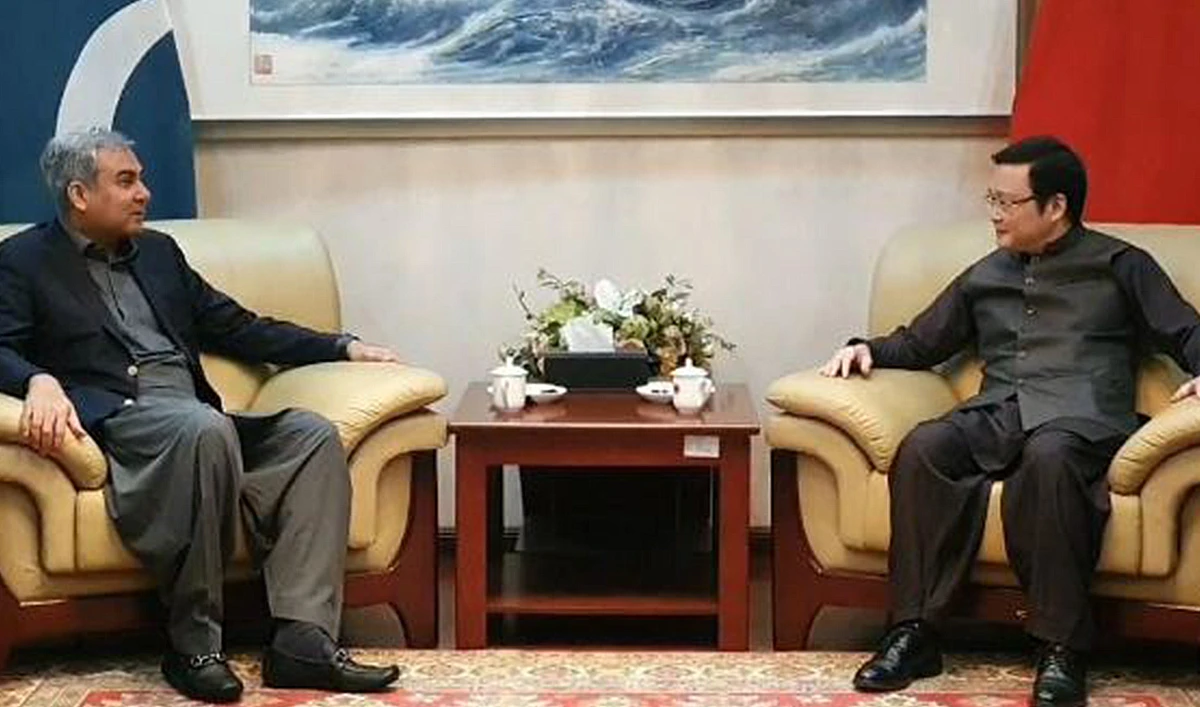
Minister for Interior Mohsin Naqvi (left) meeting with the Chinese Consul General Zhao Shiren in Islamabad, Pakistan on April 27, 2024. (APP)
Short Url
Updated 28 April 2024
Follow

Pakistan considers Chinese nationals’ security its ‘core responsibility,’ says interior minister

  • Pakistan’s Interior Minister Mohsin Naqvi meets Chinese Consul General Zhao Shiren in Islamabad
  • A suicide attack in northwestern Pakistan last month killed five Chinese engineers and a Pakistani 

ISLAMABAD: Interior Minister Mohsin Naqvi this week assured China’s consul general that the security of Chinese nationals in the South Asian country is Pakistan’s “core responsibility,” state-run Associated Press of Pakistan (APP) said, as Islamabad looks to bolster security of foreign nationals amid a surge in attacks. 

Pakistan says it has taken steps to enhance Chinese nationals’ security in the country after a suicide bomber last month attacked a convoy of Chinese engineers working on a hydropower project in the northwestern town of Dasu. Five Chinese engineers and their Pakistani driver were killed in the attack. 

The attack was the third major one in a little over a week on China’s interests in the South Asian nation, where Beijing has invested over $65 billion in energy, infrastructure and other projects as part of its wider Belt and Road initiative.

“Chinese nationals’ safety is our core responsibility, instructions have been issued to the concerned agencies to ensure the safety of Chinese citizens,” Naqvi told Chinese Consul General Zhao Shiren during a meeting in Islamabad on Saturday. 

“The minister informed about the measures taken about the security of Chinese citizens, adding that it is our national responsibility.”

The minister assured Shiren that Pakistani authorities would not allow conspiracies to harm Pakistan’s friendship with China. 

Meanwhile, the Chinese envoy said the two countries were all-weather friends. 

Chinese interests in Pakistan’s southwestern Balochistan province have also been under attack primarily by the militants, who seek to push Beijing out of the mineral-rich territory.

Pakistan is home to an insurgency launched by ethnic Baloch separatists who seek secession from the central government in the country, blaming it for the inequitable division of natural resources in the southwestern Balochistan province. The government denies this. 

At ECO meeting, Pakistan proposes ‘Regional Innovation Hub’ to curb natural disasters

Updated 21 January 2026
Follow

At ECO meeting, Pakistan proposes ‘Regional Innovation Hub’ to curb natural disasters

  • Pakistan hosts high-level 10th ECO Ministerial Meeting on Disaster Risk Reduction in Islamabad
  • Innovation hub to focus on early warning technologies, risk informed infrastructure planning

ISLAMABAD: Pakistan has proposed to set up a “Regional Innovation Hub on Disaster Risk Reduction” that focuses on early warning technologies and risk informed infrastructure planning, the Press Information Department (PID) said on Wednesday, as Islamabad hosts a high-level meeting of the Economic Cooperation Organization (ECO).

The ECO’s 10th Ministerial Meeting on Disaster Risk Reduction (DRR) is being held from Jan. 21-22 at the headquarters of the National Disaster Management Authority (NDMA) in Pakistan’s capital. 

The high-level regional forum brings together ministers, and senior officials from ECO member states, representatives of the ECO Secretariat and regional and international partner organizations. The event is aimed to strengthen collective efforts toward enhancing disaster resilience across the ECO region, the PID said. 

“Key agenda items include regional cooperation on early warning systems, disaster risk information management, landslide hazard zoning, inclusive disaster preparedness initiatives, and Pakistan’s proposal to establish a Regional Innovation Hub on Disaster Risk Reduction, focusing on early warning technologies, satellite data utilization, and risk-informed infrastructure planning,” the statement said. 

The meeting was attended by delegations from ECO member states including Pakistan, Türkiye, Azerbaijan, Iran, Kyrgyzstan, Tajikistan, Turkmenistan and Uzbekistan. Representatives of regional and international organizations and development partners were also in attendance.

Discussions focused on enhancing regional coordination, harmonizing disaster risk reduction frameworks, and strengthening collective preparedness against transboundary and climate-induced hazards impacting the ECO region, the PID said. 

ECO members states such as Pakistan, Türkiye, Afghanistan and others have faced natural calamities such as floods and earthquakes in recent years that have killed tens of thousands of people. 

Heavy rains triggered catastrophic floods in Pakistan in 2022 and 2025 that killed thousands of people and caused damages to critical infrastructure, inflicting losses worth billions of dollars. 

Islamabad has since then called on regional countries to join hands to cooperate to avert future climate disasters and promote early warning systems to avoid calamities in future.