

Pakistan considers Chinese nationals’ security its ‘core responsibility,’ says interior minister

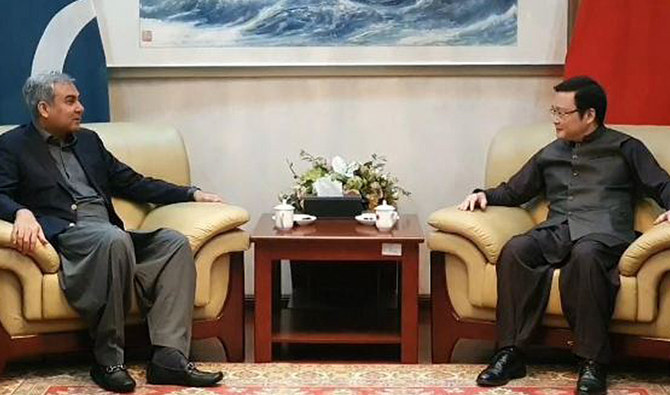
Minister for Interior Mohsin Naqvi (left) meeting with the Chinese Consul General Zhao Shiren in Islamabad, Pakistan on April 27, 2024. (APP)
Short Url
Updated 28 April 2024
Follow

Pakistan considers Chinese nationals’ security its ‘core responsibility,’ says interior minister

  • Pakistan’s Interior Minister Mohsin Naqvi meets Chinese Consul General Zhao Shiren in Islamabad
  • A suicide attack in northwestern Pakistan last month killed five Chinese engineers and a Pakistani 

ISLAMABAD: Interior Minister Mohsin Naqvi this week assured China’s consul general that the security of Chinese nationals in the South Asian country is Pakistan’s “core responsibility,” state-run Associated Press of Pakistan (APP) said, as Islamabad looks to bolster security of foreign nationals amid a surge in attacks. 

Pakistan says it has taken steps to enhance Chinese nationals’ security in the country after a suicide bomber last month attacked a convoy of Chinese engineers working on a hydropower project in the northwestern town of Dasu. Five Chinese engineers and their Pakistani driver were killed in the attack. 

The attack was the third major one in a little over a week on China’s interests in the South Asian nation, where Beijing has invested over $65 billion in energy, infrastructure and other projects as part of its wider Belt and Road initiative.

“Chinese nationals’ safety is our core responsibility, instructions have been issued to the concerned agencies to ensure the safety of Chinese citizens,” Naqvi told Chinese Consul General Zhao Shiren during a meeting in Islamabad on Saturday. 

“The minister informed about the measures taken about the security of Chinese citizens, adding that it is our national responsibility.”

The minister assured Shiren that Pakistani authorities would not allow conspiracies to harm Pakistan’s friendship with China. 

Meanwhile, the Chinese envoy said the two countries were all-weather friends. 

Chinese interests in Pakistan’s southwestern Balochistan province have also been under attack primarily by the militants, who seek to push Beijing out of the mineral-rich territory.

Pakistan is home to an insurgency launched by ethnic Baloch separatists who seek secession from the central government in the country, blaming it for the inequitable division of natural resources in the southwestern Balochistan province. The government denies this. 


Pakistan, ADB sign $730 loan agreements to boost SOE reforms, energy infrastructure

Updated 25 December 2025
Follow

Pakistan, ADB sign $730 loan agreements to boost SOE reforms, energy infrastructure

  • Both sign $330 million Power Transmission Strengthening Project and $400 million SOE Transformation Program loan agreements
  • Economic Affairs Division official says Transmission Project will secure Pakistan’s energy future by strengthening national grid’s backbone

KARACHI: Pakistan and the Asian Development Bank (ADB) on Thursday signed two loan agreements totaling $730 million to boost reforms in state-owned enterprises (SOEs) and energy infrastructure in the country, the bank said.

The first of the two agreements pertains to the SOE Transformation Program worth $400 million while the second loan, worth $330 million, is for a Power Transmission Strengthening Project, the lender said. 

The agreements were signed by ADB Country Director for Pakistan Emma Fan and Pakistan’s Secretary of Economic Affairs Division Humair Karim. 

“The agreements demonstrate ADB’s enduring commitment to supporting sustainable and inclusive economic growth in Pakistan,” the ADB said. 

Pakistan’s SOEs have incurred losses worth billions of dollars over the years due to financial mismanagement and corruption. These entities, including the country’s national airline Pakistan International Airlines, which was sold to a private group this week, have relied on subsequent government bailouts over the years to operate.

The ADB approved the $400 million loan for SOE reforms on Dec. 12. It said the program seeks to improve governance and optimize the performance of Pakistan’s commercial SOEs. 

Karim highlighted that the Power Transmission Strengthening Project will enable reliable evacuation of 2,300 MW from Pakistan’s upcoming hydropower projects, relieve overloading of existing transmission lines and enhance resilience under contingency conditions, the Press Information Department (PID) said. 

“The Secretary emphasized that both initiatives are transformative in nature as the Transmission Project will secure Pakistan’s energy future by strengthening the backbone of the national grid whereas the SOE Program will enhance transparency, efficiency and sustainability of state-owned enterprises nationwide,” the PID said. 

The ADB has supported reforms by Pakistan to strengthen its public finance and social protection systems. It has also undertaken programs in the country to help with post-flood reconstruction, improve food security and social and human capital. 

To date, ADB says it has committed 764 public sector loans, grants and technical assistance totaling $43.4 billion to Pakistan.