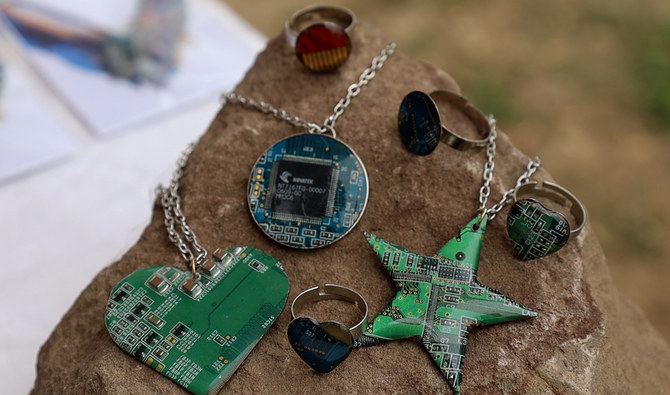
ISLAMABAD: In a room filled with discarded computer components and broken electronic items, 21-year-old Sameer Asif works under a bright fluorescent light, meticulously shaping an old motherboard into a heart-shaped pendant.
His project is more than a hobby; it’s the core of his entrepreneurial dream, “Wired Wonders,” a venture launched in 2023 to transform electronic waste into wearable art.
Jewelry crafted from electronic scrap aligns with a global trend in sustainable fashion, appealing to a young demographic that values innovation, individuality and ethical lifestyle choices.
Despite its niche market appeal, this form of jewelry reflects a growing interest in repurposing materials that would otherwise contribute to landfills, offering a creative solution to the challenge of electronic waste.
For Asif, however, the whole thing began as an accident.
“I was always into arts and crafts as a child,” he told Arab News in a conversation this week. “I enjoyed giving handmade things, and the first-ever necklace I made from a motherboard was also a gift for my friend.”
“She wore it to the university, and people started asking her about it,” he continued. “That’s when we thought this could actually become a business since people were interested in it.”
Asif said he was fascinated by electronics since childhood, using his tools to dismantle sophisticated gadgets to understand how they worked.
“When I was like five or six years old, on my birthday, someone gifted me a toy set of mechanical things,” he recalled. “It had nuts and screws, and it came with a screwdriver. I used that screwdriver to open my brother’s PlayStation 2 which he really loved.”
“I just opened it but couldn’t fit it back,” he recalled with a smile, saying his brother and parents were not pleased with him.
Asif partnered with his friend Maham Usman to launch Wired Wonders, asking her to manage the social media, sales and marketing.
Asked about the challenges of developing a small niche business, Usman said the biggest problem was procuring discarded motherboards that were not readily available.
“There are like one or two scrapyards in Rawalpindi where they sell discarded electronics in bulk,” she said. “To tackle this challenge, we have started a recycling initiative where we ask people to donate the electronic devices they want to dispense with. Not only will this help us with business, but it is also good for the environment.”
Making a single piece of jewelry can take about two hours. The process involves cutting and shaping motherboard pieces, removing the sharp edges and then pouring resin – a transparent, viscous liquid – over it for shine and preservation. Thereafter, the piece is left to dry for 24 hours.
Asked about the prices of their products, the Wired Wonders’ team informed that they ranged from $1.40 to $7.
“The gold and copper in motherboards add unique value to our jewelry,” Usman said.


![]()

Green glamor: Young Pakistani innovators transform electronic waste into fashionable jewelry
Short Url
https://arab.news/2ppcz
Green glamor: Young Pakistani innovators transform electronic waste into fashionable jewelry
- Jewelry crafted from electronic scrap appeals to a young demographic that values innovation, ethical lifestyle choices
- Sameer Asif began to pursue entrepreneurial dream by partnering with a classmate to launch ‘Wired Wonders’ in 2023
Latest updates


Recommended


© 2026 SAUDI RESEARCH & PUBLISHING COMPANY, All Rights Reserved And subject to Terms of Use Agreement.