

‘Politically motivated’: Pakistan rejects US State Department report on rights abuses

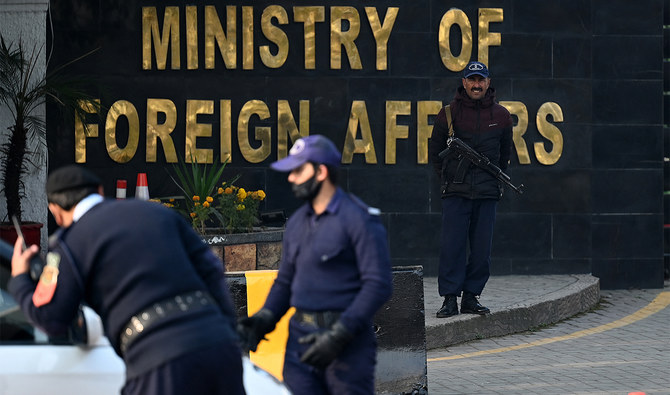
Pakistani police officers stand guard outside the Ministry of Foreign Affairs in Islamabad on January 18, 2024. (AFP/File)
Short Url
Updated 25 April 2024
Follow

‘Politically motivated’: Pakistan rejects US State Department report on rights abuses

  • Annual assessment identified arbitrary detentions, extrajudicial killings, enforced disappearances
  • Pakistan government and state agencies deny involvement in missing persons cases, other rights abuses 

ISLAMABAD: Pakistan said on Thursday it “categorically” rejected the 2023 country report on human rights practices issued by the US State Department, saying the report was politically motivated, lacking in objective evidence and followed an agenda of “politicization of international human rights.”

The annual human rights assessment released earlier this week identified arbitrary killings, extrajudicial killings, enforced disappearance, torture and “cases of cruel, inhuman, or degrading treatment or punishment by the government or its agents” in Pakistan last year.

The report also said the government “rarely took credible steps” to identify and punish officials who may have committed rights abuses.

“The contents of the report are unfair, based on inaccurate information and are completely divorced from the ground reality,” the Pakistani foreign office said in a statement, adding that the assessment used a “domestic social lens to judge human rights in other countries in a politically biased manner.”
 
“This year’s report is once again conspicuous by its lack of objectivity and politicization of the international human rights agenda. It clearly demonstrates double standards thus undermining the international human rights discourse.”

The foreign office said it was “deeply concerning” that a report purported to highlight human rights issues around the world was ignoring or downplaying the “most urgent hotspots of gross human rights violations” like Gaza and Kashmir. It also called on the US demonstrate the “requisite moral courage” to speak the truth about all situations and play a constructive role in supporting international efforts to end human rights violations.

“In line with its constitutional framework and democratic ethos, Pakistan remains steadfast in its commitment to strengthen its own human rights framework, constructively engage to promote international human rights agenda, and uphold fairness and objectivity in the international human rights discourse,” the FO added. 

Political leaders, rights groups and families of victims have long accused the government, the army and intelligence agencies of being behind cases of arbitrary detentions, extrajudicial killings and enforced disappearances, among other rights abuses. Families say people picked up by security forces on the pretext of fighting militancy or crime often disappear for years, and are sometimes found dead, with no official explanation. Pakistani state agencies deny involvement in such cases. 

On Tuesday, Pakistan’s law minister said the government would reconstitute a committee to address enforced disappearances, hours after the release of the US report.

“Now the work is being initiated on this again on the directives of the prime minister. A committee is going to be reconstituted, there will be parliamentary presence in that committee,” Law Minister Azam Nazeer Tarar said. 

“There is no lack of seriousness on the government’s part to resolve this issue.”


UN experts slam Pakistan lawyer convictions

Updated 5 sec ago
Follow

UN experts slam Pakistan lawyer convictions

  • Imaan Mazari, husband Hadi Ali Chattha were sentenced to 10 years last month for “anti-state” social media posts
  • Five UN special rapporteurs say couple jailed for exercising rights guaranteed by international human rights law

GENEVA, Switzerland: Five UN special rapporteurs on Wednesday condemned the conviction and lengthy jail sentences imposed on a prominent rights activist and her fellow lawyer husband in Pakistan over “anti-state” social media posts.

Imaan Mazari, a 32-year-old lawyer and vocal critic of Pakistan’s military, “disseminated highly offensive” content on X, according to an Islamabad court.

She and her husband Hadi Ali Chattha were jailed on January 25, with a court statement saying they “will have to remain in jail for 10 years.”

The UN experts said they had been jailed for “simply exercising rights guaranteed by international human rights law.”

“Lawyers, like other individuals, are entitled to freedom of expression. The exercise of this right should never be conflated with criminal conduct, especially not terrorism,” they said in a joint statement.

“Doing so risks undermining and criminalizing the work of lawyers and human rights defenders across Pakistan and has a chilling effect on civil society in the country.”

Mazari shot to prominence tackling some of Pakistan’s most sensitive topics while defending ethnic minorities, journalists facing defamation charges and clients branded blasphemers.

As a pro bono lawyer, Mazari has worked on some of the most sensitive cases in Pakistan, including the enforced disappearances of ethnic Balochs, as well as defending the community’s top activist, Mahrang Baloch.

Mazari and her husband have been the subject of multiple prosecutions in the past, but have never previously been convicted of wrongdoing.

“This pattern of prosecutions suggests an arbitrary use of the legal system as an instrument of harassment and intimidation in order to punish them for their work advocating for victims of alleged human rights violations,” the UN experts said.

“States must ensure lawyers are not subject to prosecution for any professional action, and that lawyers are not identified with their clients.”

The statement’s signatories included the special rapporteurs on human rights defenders, the independence of judges, freedom of opinion, freedom of association and on protecting rights while countering terrorism.

UN special rapporteurs are independent experts mandated by the UN Human Rights Council to report their findings. They do not speak in the name of the United Nations itself.

The UN experts have put their concerns to Islamabad.