Doner diplomacy: German president’s kebab trip to Turkiye sparks controversy

The faux pas risked overshadowing the celebration of 100 years of diplomatic ties between the two nations. (Getty/File)
Short Url
Updated 25 April 2024
Follow

Doner diplomacy: German president’s kebab trip to Turkiye sparks controversy

  • German-Turkish say 60-kg kebab skewer brought from Germany in diplomatic mission reduces community’s contributions to stereotypical image

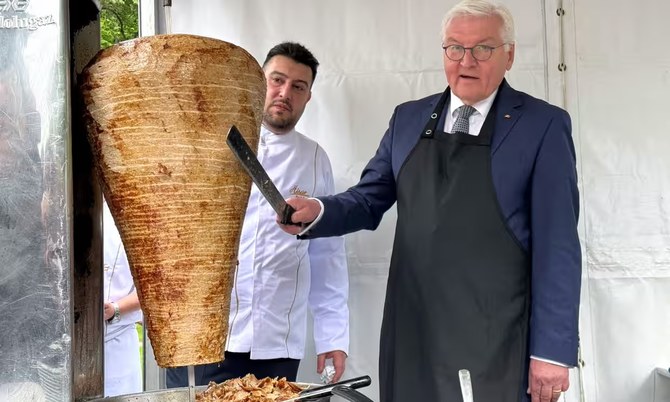
LONDON: German President Frank-Walter Steinmeier’s visit to Turkiye this week has stirred controversy after he brought along a 60-kg kebab skewer as part of his diplomatic mission.

Starting his three-day tour in Istanbul instead of Ankara, Steinmeier served kebabs at a reception, viewing it as a symbol of cultural exchange between the two nations.

“It is these special and intense relationships that bridge distances, and also some differences, today,” he said.

However, rather than emphasizing the close personal ties between Germans and Turks, the gesture drew criticism from many in the diaspora who viewed it as reducing their community’s contributions to a stereotypical image.

Germany, home to 2.7 million people of Turkish descent, welcomed hundreds of thousands of workers in the 1960s as part of its “guest worker” program, a bilateral agreement with Ankara to address labor shortages.

Turkish-Germans took to social media to condemn what they saw as a clumsy attempt to represent their community, accusing Steinmeier of failing to take them seriously or treat them as equals.

“Turkish-Germans discovered the 1st COVID vaccine in the world; some were movie directors who won awards on behalf of Germany, numerous writers, musicians, intellectuals from Turkey call Germany home,” wrote Evren Celik Wiltse, a professor of political science, on X.

“Of all of these, the (German) president chose the kebab maker to accompany him to (Turkiye)”, she added.

Berkay Mandıracı, a senior analyst of Turkish-German heritage at the non-governmental organization Crisis Group, acknowledged that the gesture was well-intentioned but felt it was “anachronistic and reductionist.” 

The faux pas, which risked overshadowing the celebration of 100 years of diplomatic ties between the two nations, received the approval of Arif Keles, a third-generation kebab shop owner invited on the delegation trip by Steinmeier.

Keles, who served kebabs during the reception, described the opportunity as a “great honor.”

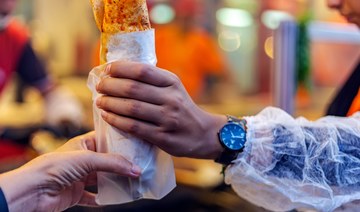
The dish of thinly sliced meat cooked on a vertical rotisserie was introduced to Germany by Turkish migrants.

Packed with chopped vegetables and doused with mayonnaise, the doner kebab has gained iconic status.

Local sales of the kebab total an estimated €7 billion ($7.5 billion), an immigrant success story the German presidency wanted to celebrate as an example of “how much Turkiye and Germany have grown together.”

Relations between Berlin and Ankara have been strained by various disputes, including disagreements over the Gaza conflict.

Steinmeier, visiting Turkiye for the first time since assuming office in 2017, has had a challenging relationship with Turkish President Recep Tayyip Erdogan, criticizing him for his approach to concerns about democratic norms in Turkiye.

Turkish-Germans have long spoken up about economic and social exclusion. Last year, Germany agreed to significantly ease citizenship rules to allow more dual nationals, a move welcomed by many Turkish individuals who have lived in Germany for decades.

With AFP


‘Right to enjoy culture’: Prisoner sues Australian state for ban on Vegemite

Updated 18 November 2025
Follow

‘Right to enjoy culture’: Prisoner sues Australian state for ban on Vegemite

  • Andre McKechnie, serving a life sentence for murder, takes his battle for the salty, sticky, brown byproduct of brewing beer to the Supreme Court of Victoria

MELBOURNE, Australia: A prisoner is challenging an Australian state’s ban on prisoners eating Vegemite, claiming in a court suit that withholding the polarizing yeast-based spread that most of the nation revers as an unfairly maligned culinary icon breaches his human right to “enjoy his culture as an Australian.”
Andre McKechnie, 54, serving a life sentence for murder, took his battle for the salty, sticky, brown byproduct of brewing beer to the Supreme Court of Victoria, according to documents the court registry released to The Associated Press on Tuesday.
While more than 80 percent of Australian households are estimated to have a jar of Vegemite in their pantries, inmates in all 12 prisons in Victoria are going without as the national favorite for smearing thinly across breakfast toast is considered contraband.
McKecknie is suing Victoria’s Department of Justice and Community Safety and the agency that manages the prisons, Corrections Victoria. The case is scheduled for trial next year.
Prisoner argues Vegemite ban breaches Charter of Human Rights and Responsibilities
McKechnie is seeking a court declaration that the defendants denied him his right under the Charter of Human Rights and Responsibilities Act to “enjoy his culture as an Australian.”
The Act guarantees “All persons with a particular cultural, religious, racial or linguistic background” the right to “enjoy their culture, to declare and practice their religion and to use their language.”
He also wants a declaration that the defendants breached the Corrections Act by “failing to provide food adequate to maintain” McKechnie’s “well-being.”
He wants the court to order the decision to ban Vegemite to be “remade in accordance with the law.”
Vegemite has been banned from Victorian prisons since 2006, with Corrections Victoria saying it “interferes with narcotic detection dogs.”
Inmates used to smear packages of illicit drugs with Vegemite in the hope that the odor would distract the dogs from the contraband.
Vegemite also contains yeast, which is banned from Victorian prisons because of its “potential to be used in the production of alcohol,” the contraband list says.
The Australian favorite since 1923 considered an acquired taste
Manufactured in Australia since 1923 as an alternative to Britain’s Marmite, Vegemite was long marketed as a source of vitamin B for growing children.
The spread is beloved by a majority of Australians, but typically considered an acquired taste at best by those who weren’t raised on it.
The last US president to visit Australia, Barack Obama, once said: “It’s horrible.”
Australian band Men at Work aroused international curiosity about the yeast-based spread when they mentioned a “Vegemite sandwich” in their 1980s hit “Down Under.”
The band’s lead singer Colin Hay once accused American critics of laying Vegemite on too thick, blaming a “more is more” US culture.
It’s a favorite on breakfast toast and in cheese sandwiches, with most fans agreeing it’s best applied sparingly. Australian travelers bemoan Vegemite’s scarcity overseas.
The Australian government intervened in April when Canadian officials temporarily prevented a Toronto-based cafe from selling Vegemite in jars and on toast in a dispute media branded as “Vegemite-gate.” Canadians relented and allowed the product to be sold despite its failure to comply with local regulations dealing with food packaging and vitamin fortification.
The Department of Justice and Community Safety and Corrections Victoria declined to comment on Tuesday. Government agencies generally maintain it is not appropriate to comment on issues that are before the courts.
Queensland prisons also ban Vegemite, but Australia’s most populous state, New South Wales, does not. Other Australian jurisdictions have yet to tell AP on Tuesday where they stand on the spread.
Victims of crime brand Vegemite lawsuit frivolous and offensive
Victims of crime advocate and lawyer John Herron said it was a frivolous lawsuit and was offensive to victims’ families.
“As victims, we don’t have any rights. We have limited if any support. It’s always about the perpetrator, and this just reinforces that,” said Herron, whose daughter Courtney Herron, was beaten to death in a Melbourne park in 2019. Her killer was found not guilty of murder by reason of mental impairment.
“It’s not a case of Vegemite or Nutella or whatever it may be. It’s an extra perk that is rubbing our faces in the tragedy that we’ve suffered,” Herron added.
McKechnie is currently held at maximum-security Port Phillip Prison. He was 23 years old when he stabbed to death wealthy Gold Coast property developer Otto Kuhne in Queensland state in 1994.
He was sentenced to life for murder and transferred a decade later from the Queensland to the Victorian prison system.
He wrote last year that he spent eight years out on parole in Victoria before he decided that the system “had done more damage than good” and opted to return to prison.
McKechnie’s lawyers didn’t respond to a request for comment on Tuesday.