

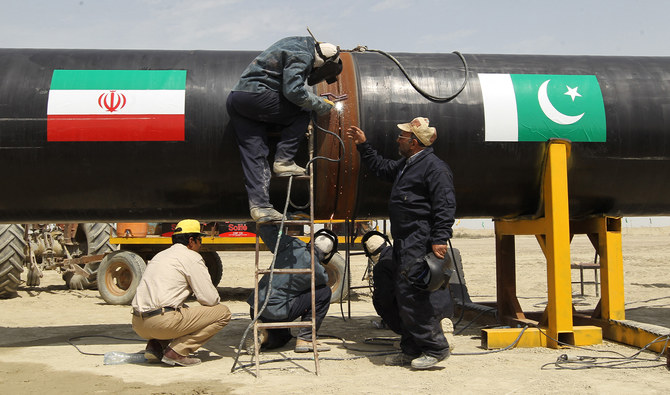

ISLAMABAD: Defense Minister Khawaja Asif said on Thursday Pakistan would find a way to complete a major gas pipeline deal with Iran which has faced delays for years due to geopolitical issues and international sanctions.
During a visit by Iranian President Ebrahim Raisi to Pakistan this week, the two nations reiterated the importance of cooperation in the energy domain, including trade in electricity, power transmission lines and the IP Gas Pipeline Project, a joint statement released following the culmination of the visit said.
“We will find a way to complete it,” Asif told reporters when asked if Pakistani officials had discussed the stalled pipeline with Raisi.
In March, Islamabad said it would seek a US sanctions waiver for the pipeline. However, later that week, the US said publicly it did not support the project and cautioned about the risk of sanctions in doing business with Tehran.
On Wednesday, the United States once again warned that countries doing business with Iran faced the “potential risk of sanctions.”
“Just let me say broadly, we advise anyone considering business deals with Iran to be aware of the potential risk of sanctions,” a State Department spokesperson said when asked about the Iranian president’s Pakistan visit and agreements signed. “But ultimately, the government of Pakistan can speak to their own foreign policy pursuits.”
The pipeline deal, signed in 2010, envisaged the supply of 750 million to a billion cubic feet per day of natural gas for 25 years from Iran’s South Pars gas field to Pakistan to meet Pakistan’s rising energy needs. The pipeline was to stretch over 1,900 kilometers (1,180 miles) — 1,150 km within Iran and 781 km within Pakistan.
Tehran says it has already invested $2 billion to construct the pipeline on its side of the border, making it ready to export. Pakistan, however, did not begin construction and shortly after the deal said the project was off the table for the time being, citing international sanctions on Iran as the reason.
Iran’s oil minister at the time responded by saying that Iran carried out its commitments and expects Pakistan to honor its own, adding that Pakistan needs to pick up the pace of work.
In 2014, Pakistan asked for a 10-year extension to build the pipeline, which expires in September this year. Iran can take Pakistan to international court and fine the country. Local media reported that Pakistan can be fined up to $18 billion for not holding up its half of the agreement.
Faced with a potential fine, Pakistan’s caretaker administration earlier this year gave the go ahead in principle to commence plans to build an 80 km segment of the pipeline. In March, Pakistan announced it would seek a sanctions’ waiver.
Washington’s support is crucial for Pakistan as the country looks to sign a new longer term bailout program with the International Monetary Fund (IMF) in coming weeks.
Pakistan, whose domestic and industrial users rely on natural gas for heating and energy needs, is in dire need for cheap gas with its own reserves dwindling fast and LNG deals making supplies expensive amidst already high inflation.
Iran has the world’s second-largest gas reserves after Russia, according to BP’s Statistical Review of World Energy, but sanctions by the West, political turmoil and construction delays have slowed its development as an exporter.
Originally, the deal also involved extending the pipeline to India, but Delhi later dropped out of the project.
With inputs from Reuters


