

L’Oréal Middle East launches women upskilling project in Saudi Arabia

L'Oreal Middle East held its 25th anniversary ceremony at Dubai Expo City. (Supplied)
Short Url
Updated 25 April 2024
Follow

L’Oréal Middle East launches women upskilling project in Saudi Arabia

  • L’Oreal Middle East inks pact with Kingdom’s Himayah Organization
  • The initiative aims to help 600 women prepare for the workplace

DUBAI: As it celebrates its 25th anniversary, L’Oreal Middle East has signed an agreement with the Himayah Organization in Saudi Arabia to support its “Safe Homes” initiative, which seeks to provide skills training for more than 600 women.

“The project aims to have a lasting long-term impact through psychological support and skill training,” said Laurent Duffier, CEO of L’Oreal Middle East, in an interview with Arab News en Francais.

Over the past 25 years, L’Oreal has assisted 25,000 women in the region.

L’Oreal launched its Hairdressing Academy in Riyadh and Dammam in 2023, to upskill and integrate women in the workforce, recording a 70 percent employment rate in this growing beauty segment in Saudi Arabia. The program is expected to create 15,000 jobs for Saudi women.

The flagship “L’Oreal for Women in Science” program invested over $925,000 in endowments to support 51 female Arab scientists over the past decade and advocate for gender equality in STEM, or science, technology, engineering and mathematics.

In addition, the firm’s “Stand Up Against Street Harassment” project trained more than 11,000 participants on countering gender-based violence.


Laurent Duffier, CEO of l'Oreal Middle East and Dr. Sameera Alghamdi, chairwomen of Himayah Organization announcing the MOU signature during the L'Oreal Middle East 25th anniversary event. (Supplied)

While the brand’s products have been distributed in the region since the 1960s, L’Oreal opened its first subsidiary in the Middle East in 1998, and currently serves 10 markets.

Today, the group is moving toward its 2030 sustainability, innovation and technology goals by engaging stakeholders across the supply chain, including consumers and startups, through strategic partnerships.

L’Oreal aims to foster innovation by investing in the startup ecosystem, the latest being the partnership with Astrolabs that launched the “L’Oreal Tech Quest Challenge” earlier in April 2024.

“The future is for beauty tech, tackling current industry challenges and augmenting the impact of L’Oreal’s solutions. ‘L’Oreal Tech Quest Challenge’ awarded a group of winners whose work will be incorporated in developing tools and best practices across the SAPMENA (South Asia Pacific - Middle East - North Africa) region,” said Duffier.

The region is home to a growing startup ecosystem. “LEAP in Saudi Arabia held in March reflects the growing entrepreneurial and creative energy in the Kingdom,” he added.

This is particularly important in the Middle East, where the beauty industry is recording one of the highest growth rates globally.

The GCC market ranks among the top 10 beauty markets worldwide, valued at $11.7 billion in 2024. Since the COVID-19 pandemic, the market has grown by 10 percent, fueled by underlying macroeconomic trends.

“Non-oil GDP in the GCC is growing at 4 to 5 percent while growing at less than 1 percent in Europe. The inflow of high-net-worth individuals had a positive impact on the luxury market in the UAE. While demand for beauty, particularly in Saudi Arabia, tripled during the last three years with the rise in women’s access to the workforce, and increase in disposable income,” said Duffier.

“The quality of retail execution, and the growth of new beauty concepts in the Kingdom, are factors boosting the market in the region, further enhanced by the growth in e-commerce,” he added.

According to a Boston Consulting Group report, in 2020 the Kingdom’s e-commerce share of total retail was 6 percent. This was far behind mature e-commerce markets and the worldwide average of 18 percent, but was 60 percent higher than the Kingdom’s 2019 share. It has been forecast that there will be double-digit growth post-COVID-19, with market value expected to exceed $13.3 billion by 2025.

“Saudi Arabia displays accelerated growth across segments. Efforts to diversify the economy are clear. It is the biggest economy in the region, with the highest potential, and it is a priority market for L’Oreal,” said Duffier.
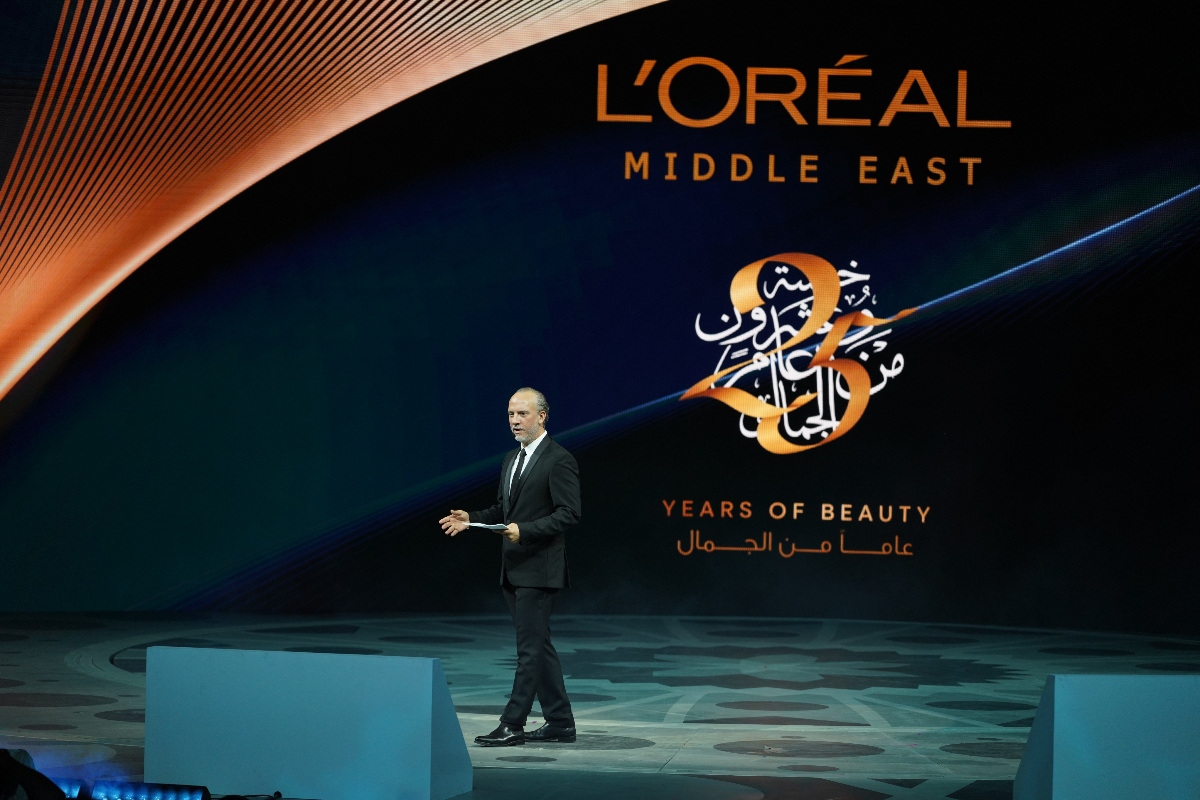


This is particularly important in the Middle East, where the beauty industry is recording one of the highest growth rates globally. (Supplied)

The offer-driven beauty and personal care market is expected to continue to be led by product innovation and beauty technology, for better end-user results, he said.

“We are launching Melasyl, after 18 years of R&D. A breakthrough ingredient for skin care treatments, among other applications,” said Duffier.

With lipstick used 5,000 years ago in Mesopotamia, Duffier describes the Middle East as the “cradle of beauty and a region that defines beauty trends.” The region has a diverse customer base, covering the full spectrum of skin and hair colors, is shifting toward digital platforms, and more sustainable consumption.

“We are working with startups to offer sustainable innovative products, with 70 percent of consumers opting for sustainable products,” said Duffier.

“We are no longer a beauty company, but a beauty tech company. Anchored in innovation and sustainability, the objective remains beauty for all. The future of beauty will be increasingly personalized to create beauty that moves the world, and most importantly to create beauty that moves the Middle East,” he said.

The quest for sustainability is also a byproduct of the reconciliation between beauty and tech, developed and implemented across the various segments: hair care (Airlight pro), derma cosmetics, the latest being La Roche-Posay’s diagnostic virtual reality tools, and make-up applications in collaboration with Microsoft.

“By applying green science, 95 percent of products’ ingredients will be bio-based and traceable to natural green-science formulations by 2030,” he said.

Advancing toward its sustainability targets, the “L’Oreal for the Future” program aims to reduce carbon dioxide emissions at all sites, and move to renewables, waste management and water treatment by 2030.

L’Oreal Middle East expects a 50 percent reduction in distribution-related carbon dioxide emissions, and a 70 percent reduction in water consumption with the introduction of Gjosa shower heads in hair salons.

Set to launch in the region this year, the latter is expected to target 500 salons per year, for a total yearly saving of 35 million gallons of water.

This is in addition to the recycling of 340 tonnes of waste over the past two years in Saudi Arabia, which is a Garnier initiative in collaboration with Panda and Naqaa Solutions.


Defense Minister Prince Khalid bin Salman inaugurates 3rd World Defense Show in Riyadh

Updated 09 February 2026
Follow

Defense Minister Prince Khalid bin Salman inaugurates 3rd World Defense Show in Riyadh

  • Organized by the General Authority for Military Industries (GAMI), the five-day event will run until February 12
  • Prince Khalid launched several key initiatives, including the launch of several defense firms and signing of cooperation deals
  • The show is also serving as a launchpad for cutting-edge security technologies across various government sectors

RIYADH: Minister of Defense Prince Khalid bin Salman inaugurated the third edition of the World Defense Show (WDS) on Sunday on behalf of Crown Prince Mohammed bin Salman.

Organized by the General Authority for Military Industries (GAMI), the five-day event will run until February 12, showcasing the Kingdom’s rapid strides toward strategic independence and technological leadership in the defense sector.

The 2026 edition features a purpose-built venue with a 2,700-meter runway for live air and land demonstrations, underscoring the show’s status as a premier global defense event.

GAMI Governor Ahmad Al-Ohali emphasized that the show reflects Saudi Arabia's commitment to localizing over 50 percent of military spending in line with Vision 2030, fostering an integrated ecosystem where government bodies and international partners collaborate on innovation.

The event brings together official delegations, government entities, and leading international companies specializing in the defense and security sectors. (SPA)

Strategic agreements and major launches

The opening day witnessed significant activity at the Saudi Arabian Military Industries (SAMI) Group pavilion, where Prince Khalid launched several key initiatives:

New entities: The inauguration of SAMI Land Company, SAMI Autonomous Company, and the SAMI Land Industrial Complex.

Supply chain: The unveiling of the SAMI Local Content Program (RUKN) and the HEET Program.

International cooperation: A memorandum of understanding was signed between the Saudi General Authority for Defense Development and the Korean Agency for Defense Development to cooperate on advanced military research.

Defense deals: The Minister signed cooperation agreements with Slovakia, Malaysia, and Somalia.

Defense Minister Prince Khalid signed cooperation agreements with Slovakia, Malaysia, and Somalia. (SPA)

Technological debuts & innovations

The show is also serving as a launchpad for cutting-edge security technologies across various government sectors:

AI-Powered Lucid Gravity: Public Security debuted its advanced Lucid Gravity electric security vehicle at the Ministry of Interior's pavilion. The vehicle integrates state-of-the-art artificial intelligence and specialized security equipment designed to accelerate emergency response times and support field operations.

Public Security’s advanced Lucid Gravity electric security vehicle is displayed at the Ministry of Interior’s pavilion. (SPA)

This high-tech addition highlights Public Security’s shift toward smart, sustainable security solutions. By leveraging predictive intelligence and advanced command-and-control systems, the Lucid Gravity exemplifies the ministry’s commitment to protecting the Kingdom through integrated technological innovation and sustainable mobility.

Smart Helmet: Also at the Ministry of Interior’s pavilion, the General Directorate of Civil Defense unveiled its smart helmet. Designed to revolutionize public safety and emergency response, the helmet features day-and-night cameras and specialized sensors to detect hazardous materials in hard-to-reach locations.

The device serves as a mobile command node, delivering live video feeds directly to command-and-control centers. By enabling real-time data analysis and faster decision-making, the smart helmet significantly reduces incident response times and enhances personnel safety in high-risk environments.

The smart helmet features day-and-night cameras and specialized sensors to detect hazardous materials in hard-to-reach locations. (SPA)

Border Security: The General Directorate of Border Guard (GDBG) showcased an integrated security system featuring radar and thermal cameras capable of detecting drones and classifying moving targets to protect critical infrastructure.

It also functions as an early warning system for critical facilities and border areas and is fully integrated with command and control systems.

Border Guard's ntegrated security system features radar and thermal cameras capable of detecting drones and classifying moving targets to protect critical infrastructure. (SPA)

Counter-Terrorism: The Islamic Military Counter Terrorism Coalition (IMCTC) presented a comprehensive framework integrating intellectual, media, and military domains to combat extremism and terror financing.

Visitors are briefed on specialized programs designed to raise the readiness of national personnel and foster sustainable institutional cooperation among member states to combat extremism. On the event’s opening day, the pavilion hosted high-level delegations, including ministers, military leaders, and ambassadors who reviewed the coalition's pivotal role in coordinating international security efforts and commended its initiatives that support regional and global stability.

A view of the Islamic Military Counter Terrorism Coalition pavilion. (SPA)

Meteorology: The National Center for Meteorology (NCM) displayed advanced weather systems essential for ensuring the safety of the event's air shows and military operations.

At its dedicated pavilion, the NCM is showcasing its latest advanced meteorological technologies and systems. These solutions serve both the military and civilian sectors, providing accurate data to support beneficiary entities' operational processes and highlighting the center's pivotal role in national security and safety.

NCM's latest meteorological technologies and systems serve both the military and civilian sectors

World Defense Show CEO Andrew Pearcey noted that participation is expected to surpass previous records, reflecting the event's growing importance on the international stage. The show continues through February 12.