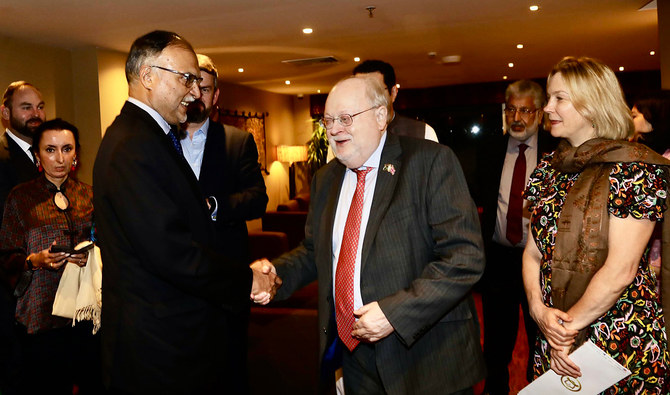
ISLAMABAD: Pakistan’s planning minister Ahsan Iqbal met a delegation from the United Kingdom, said an official statement on Thursday, to discuss the possibility of fostering closer ties and enhancing collaboration between the educational institutions in both countries.
British universities are a popular destination for Pakistani students due to the quality of education and the strong historical and cultural ties between the two countries.
Many students from Pakistan go to these educational institutions on scholarships offered by various organizations, such as the British Council, UK government and universities themselves, while others fund their studies independently.
The Pakistani planning minister presented various recommendations during his meeting with the delegation led by Steve Smith, the UK government’s International Education Champion, along with officials of the British High Commission.
He proposed faculty training programs to bolster academic expertise across borders, encouraging UK universities to establish campuses in Pakistan to promote educational accessibility and harnessing the expertise of Pakistani scholars in British universities to develop specialized knowledge clusters on the country.
“Pakistan envisions a future where universities in Pakistan are categorized into the Champions League (having first-tier universities) and the National League (having second-tier universities), driving excellence and accessibility in higher education,” Iqbal said during the meeting.
He highlighted the imperative for joint research initiatives, pointing at the importance of establishing joint research groups and fostering collaborations between PhD scholars from both countries.
The visiting delegation official reaffirmed the British government’s commitment to building international partnerships in education, citing the presence of over 20,000 Pakistani students in his country and 8,000 students who are pursuing degree programs in Pakistan with UK’s financial support.
The two sides also discussed procedural issues while pointing to the need for streamlined regulations, with a particular emphasis on minimizing hurdles for universities and strengthening the link between research institutions and economic growth.
They agreed to hold further dialogue and take concrete action toward implementing the planning minister’s recommendations to further solidify the foundation for enduring academic cooperation between the two countries.


![]()

Pakistan’s planning minister discusses enhanced educational ties with UK delegation
Short Url
https://arab.news/4mupk
Pakistan’s planning minister discusses enhanced educational ties with UK delegation
- Ahsan Iqbal proposes faculty training, research collaboration and UK campus expansions in Pakistan
- He says UK universities should develop specialized knowledge clusters through Pakistani scholars’ expertise
Latest updates


© 2026 SAUDI RESEARCH & PUBLISHING COMPANY, All Rights Reserved And subject to Terms of Use Agreement.