

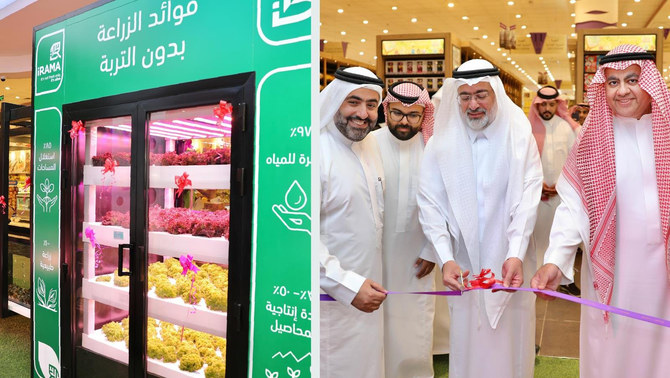

RIYADH: The Ministry of Environment, Water and Agriculture launched an urban vertical farm project for food markets and stores, the Saudi Press Agency reported.
The initiative, the first of its kind in the region, allows customers to obtain fresh food products grown in the Kingdom.
The ministry’s undersecretary, Ahmed Al-Eyada, attended the launch of the project, which was implemented by a leading bioagriculture company.
Danube markets in Riyadh is hosting the first vertical farm in the project. Commercial display units in the market contain a variety of plants and agricultural products, such as lettuce, coriander, parsley and broccoli — many of which were previously sourced from abroad.
The ministry aims to launch about 600 to 1,000 farms in the retail system across all markets in the Kingdom over the next five years. These farms are intended to meet 20 to 40 percent of domestic demand for agricultural products and vegetables.
Abdullah Sahab, CEO and founder of IRama, a Saudi company specializing in modern technologies for biodynamic agriculture, has told Arab News that the initiative directly aims to raise the quality of food and ensure seed sources and clean, organic handling of the plant in a fully protected environment.
He said: “The Ministry of Environment, Water and Agriculture hopes that this initiative will create a new agricultural market called urban farming, which aims to cover approximately 20 percent of the volume of consumption in vegetables.
“It also aims to localize the agricultural profession and reduce the obstacles and barriers that are present. It helps the farmer to reach the consumer directly, thus raising the proportion of the farmer’s income to the value of the product. Such initiatives contribute to reducing carbon emissions and reliance on liquid fuels.”
Sahab said that the initiative “will raise the rate of localization of the agricultural profession to at least 20 times what it is today.”
He added: “It will also contribute to creating a work environment for thousands of small and medium enterprises in the field of urban agriculture, such as operating, selling, and installing systems in urban areas within cities that stimulate and reduce dependence on expatriate workers and supply chains.”
Vertical urban farms in stores aim to preserve natural resources, maintain ecosystem balance and promote sustainable productivity. By shortening supply chains, they also reduce loss and waste, and introduce a new farming model suited to local farmers and businesses in the Kingdom.
The initiative offers multiple benefits for consumers by providing high-quality vegetables and fruits that retain their freshness and nutritional value for up to five times longer than traditional methods, the SPA reported.
Urban farms also promote job localization and greater income potential. Furthermore, they help overcome logistical challenges associated with transporting agricultural products to consumers.
Vertical farming not only conserves agricultural land but also reduces labor and water usage by 80 to 90 percent compared to traditional farming, providing a year-round high-yield agricultural environment.


