Pakistan and Iran call on UN Security Council to curb Israel’s hostile behavior in Middle East

1 / 2
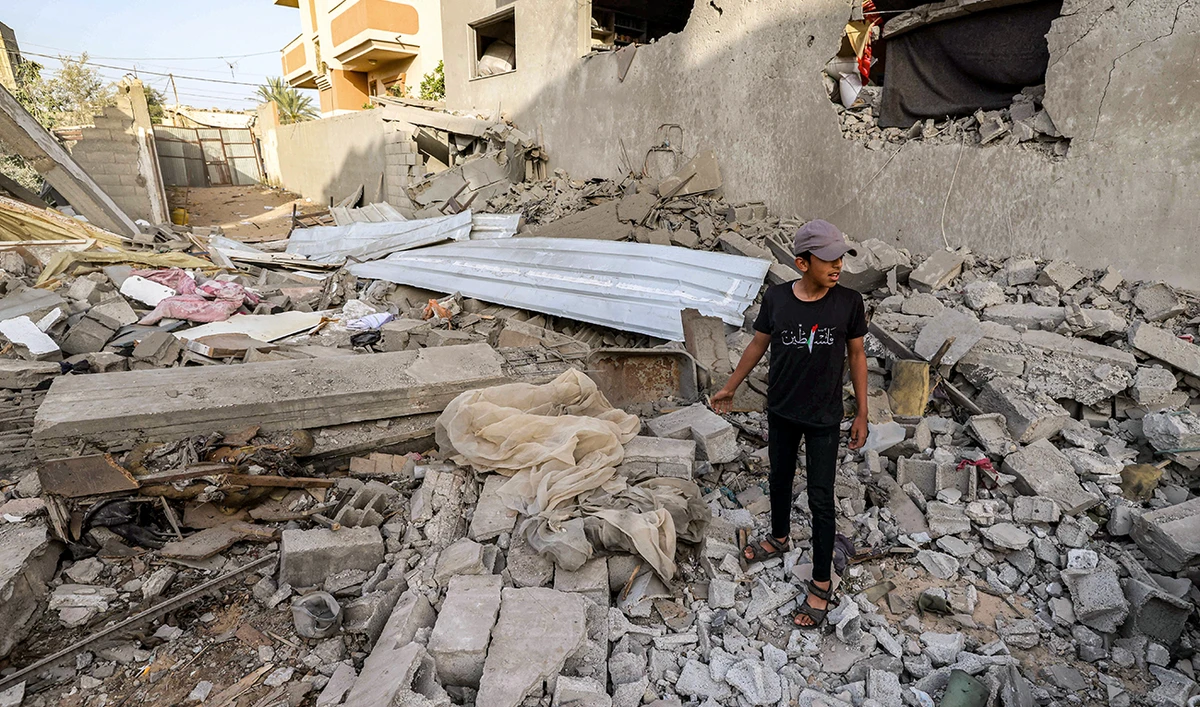
A boy stands amidst rubble in Rafah in the southern Gaza Strip on April 24, 2024 following reported Israeli air strikes overnight amid the ongoing conflict in the Palestinian territory. (AFP)
2 / 2
This handout photograph taken on April 22, 2024, and released by Pakistan's Press Information Department (PID) shows Iran’s President Ebrahim Raisi (L) shakes hands with Pakistan's Prime Minister Shehbaz Sharif upon his arrival at the Prime Minister House in Islamabad. (Pakistan's Press Information Department)
Short Url
Updated 24 April 2024
Follow

Pakistan and Iran call on UN Security Council to curb Israel’s hostile behavior in Middle East

  • The two countries issued a joint statement after Iranian President Ebrahim Raisi wrapped up three-day visit to Pakistan
  • Pakistan and Iran agree to adopt a collaborative approach to confront militant violence through institutional mechanism

ISLAMABAD: Pakistan and Iran urged the United Nations Security Council in a joint statement issued on Wednesday to prevent Israel’s hostile acts toward regional countries, noting that the behavior of Prime Minister Benjamin Netanyahu’s administration was further escalating tensions in the Middle East.

The joint statement was circulated by Pakistan’s foreign ministry after Iranian President Ebrahim Raisi concluded his three-day visit to the South Asian state in which he held several high-level meetings in Islamabad, Lahore and Karachi.

The Iranian president arrived in Pakistan on Monday as the two Muslim neighbors sought to mend ties after unprecedented tit-for-tat military strikes earlier this year. The visit also took place at a time when tensions remain high in the Middle East after Iran launched airstrikes on Israel a week ago and Israel retaliated with its own attack on Friday.

The joint Pakistan-Iran statement condemned Israel’s attack on the Iranian Embassy in Damascus on April 2, calling it an unacceptable violation of the sovereignty of Syria that undermined its stability and security. It also pointed out the attack was a violation of international law and the UN Charter, constituting an illegal act under the Vienna Convention on Diplomatic Relations of 1961.

“Recognizing that the irresponsible act of the Israeli regime forces was a major escalation in an already volatile region, both sides called on the UN Security Council to prevent Israel regime from its adventurism in the region and its illegal acts attacking its neighbours and targeting foreign diplomatic facilities,” the statement noted.

It added the two sides condemned Israel’s aggression against the Palestinian people, along with the inhumane blockade of Gaza, while seeking a just, comprehensive and durable solution to the issue based on the aspirations of the people of Palestine.

Pakistan and Iran agreed to adopt a collaborative approach to confront militant violence and to leverage the existing bilateral institutional mechanisms to effectively combat and counter the threat, while fully upholding the principles of the UN Charter, particularly the principles of sovereignty and territorial integrity of member states.

“Both sides also acknowledged the key role of enhanced economic and commercial opportunities in improving the security environment in the border areas,” the joint statement added.

It mentioned the consensus to fully operationalize barter trade mechanisms between the two countries to facilitate bilateral economic and commercial activities.

Both countries reiterated the importance of cooperation in the energy domain, including trade in electricity, power transmission lines and Iran-Pakistan (IP) gas pipeline project.

“The two leaders agreed to boost their bilateral trade to USD10 billion over the next five years,” the statement said.
Pakistan says it struck TTP, Daesh militant camps near Afghan border, Kabul alleges civilian deaths

Updated 5 sec ago
Follow

Pakistan says it struck TTP, Daesh militant camps near Afghan border, Kabul alleges civilian deaths

  • Islamabad says it targeted seven militant hideouts in “retributive response” to attacks 
  • Afghan Taliban accuse Pakistan of bombing civilians in Nangarhar and Paktika provinces 

ISLAMABAD: Pakistan said on Saturday it carried out “intelligence-based selective targeting” against militant camps near the Afghan border after a series of attacks inside the country, while the Afghan Taliban accused Pakistani forces of killing civilians in the assault.

Pakistan has faced a renewed surge in militant violence in recent months, particularly in its northwestern Khyber Pakhtunkhwa province and two major attacks in the capital, Islamabad. Authorities say many of the attacks have been carried out by the Tehreek-e-Taliban Pakistan (TTP) and allied groups that Islamabad alleges are operating from sanctuaries in Afghanistan. Kabul denies this. 

According to Pakistan’s information ministry, recent incidents included a suicide bombing at a Shiite mosque in Islamabad, separate attacks in Bajaur and Bannu, and another recent incident in Bannu during the holy month of

Ramadan, which started earlier this week. The government said it had “conclusive evidence” linking the attacks to militants directed by leadership based in Afghanistan.

“Pakistan in a retributive response, has carried out intelligence based selective targeting of seven terrorist camps and hideouts belonging to Pakistani Taliban ... and its affiliates and ISKP [Daesh] at the border region of Pakistan

Afghan border with precision and accuracy,” the Pakistani information ministry said in a statement on Feb. 21.

The statement, which did not specify the exact nature of the attacks, said it had hit camps of the “Fitna al Khwarij (FAK),” a term Pakistani authorities use for the TTP, as well as the Islamic State Khorasan Province (ISKP), the regional affiliate of the Daesh group.

Islamabad has repeatedly urged Afghanistan’s Taliban authorities to take action against militants it says are using Afghan territory to plan and launch attacks inside Pakistan. The latest statement said Kabul had “failed to undertake any substantive action” despite prior requests.

In an X post, Kabul government spokesperson Zabihullah Mujahid said Pakistani forces had violated Afghan territory.

“Pakistani special military circles have once again trespassed into Afghan territory,” Mujahid said. “Last night, they bombed our civilian compatriots in Nangarhar and Paktika provinces, martyring and wounding dozens of people, including women and children.”

The Afghan Taliban’s claims of civilian casualties could not be independently verified. Pakistan did not immediately comment on the allegation that civilians had been killed in the strikes. 

Tensions between Islamabad and Kabul have escalated since the Afghan Taliban returned to power in 2021. Pakistan says cross-border militant attacks have increased since then and has accused the Taliban of failing to honor commitments under the 2020 Doha Agreement to prevent Afghan soil from being used for attacks against other countries. The Taliban deny allowing such activity and have previously rejected similar accusations.

Saturday’s exchange of accusations marks one of the most direct confrontations between the two neighbors in recent months and risks further straining already fragile ties along the volatile border.