

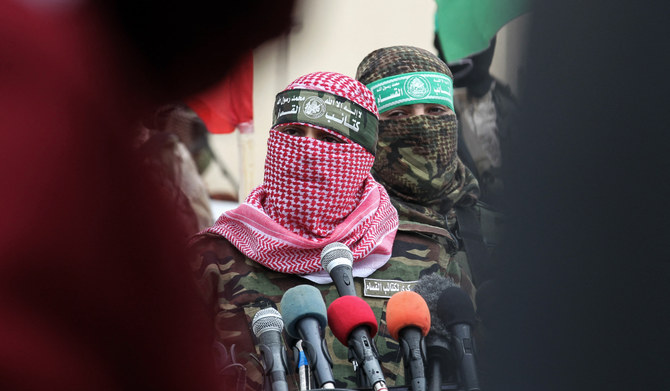
Hamas armed wing Al-Qassam Brigades calls for escalation across all fronts

Abu Ubaida (C) spokesman of the Ezzedine Al-Qassam Brigades, the military wing of the Palestinian movement Hamas, speaks during a memorial in the southern Gaza Strip town of Rafah on January 31, 2017. (AFP file photo)
Short Url
Updated 24 April 2024
Follow

Hamas armed wing Al-Qassam Brigades calls for escalation across all fronts

  • Israel has killed more than 34,000 Palestinians, according to Gaza’s Health Ministry

DUBAI: The spokesperson for Hamas’ armed Al-Qassam Brigades, Abu Ubaida, called on Tuesday for an escalation across all fronts in a televised speech marking 200 days since the start of the Israel-Hamas war in the Gaza Strip on Oct. 7.
Israel says it is seeking to eradicate Hamas, which controls the enclave, in a war that has killed more than 34,000 Palestinians thus far. The war started when the militant group attacked Israel, killing 1,200 and taking 253 hostages, according to Israeli tallies.
In a video aired by Al Jazeera TV, Abu Ubaida praised Iran’s attack on Israel on April 13, saying the direct strikes with explosive drones and missiles “set new rules, drew important equations, and confused the enemy and those behind it.”
He also called for an escalation in the West Bank and Jordan calling it “one of the most important Arab fronts.”
Jordan, which lies between Iran and Israel, intercepted and shot down dozens of Iranian drones that entered its airspace and were heading to Israel, two regional security sources said on April 13.
“We call on the Jordanian people to step up their actions and raise their voices,” Abu Ubaida said.
He said Hamas was sticking to its demands at the ongoing ceasefire talks — that Israel ends its military offensive, pulls out forces from Gaza, allows the displaced to return to northern Gaza, and lifts the blockade.
“The government of the occupation is stalling in reaching a hostages-swap deal and is trying to obstruct efforts by the mediators to reach a ceasefire agreement,” Abu Ubaida said.
Qatar and Egypt have been trying to mediate a ceasefire, but Qatar foreign ministry’s spokesman said earlier on Tuesday all concerned parties should “show seriousness” in allowing such efforts to succeed.


Last Christians gather in ruins of Turkiye’s quake-hit Antakya

Updated 25 December 2025
Follow

Last Christians gather in ruins of Turkiye’s quake-hit Antakya

  • Saint Peter’s, one of the world’s oldest rock churches, is a sacred rallying point for the isolated Christians still left in quake-hit Antakya in southeastern Turkiye

ANTAKYA: Saint Peter’s, one of the world’s oldest rock churches, is a sacred rallying point for the isolated Christians still left in quake-hit Antakya in southeastern Turkiye, the city known in ancient times as Antioch.
“Since the earthquake, our community has scattered,” said worshipper Mari Ibri.
“Those who remain are trying to regroup. We each had our own church but, like mine, they have been destroyed.”
The landscape around the cave remains scarred by the disaster nearly three years ago, when two earthquakes devastated Hatay province on February 6, 2023 and its jewel, Antakya, the gateway to Syria.
Sad fields of rubble and the silhouettes of cracked, abandoned buildings still scar the city — all enveloped in the ever-present grey dust.
Since the earthquakes, Antakya city has emptied and the Christian community has shrunk from 350 families to fewer than 90, Father Dimitri Dogum told AFP.
“Before, Christmas at our house was grandiose,” Ibri recalled.
“Our churches were full. People came from everywhere.”
Ibri’s own church in the city center was rendered inaccessible by the earthquakes.
Now she and other worshippers gather at the cave on December 24 — Christmas Eve in some Christian calendars.
It is here, they believe, that Peter, the disciple Jesus assigned to found the Christian church, held his first religious service in the 1st century.
The rock church was later enlarged and 11th-century crusaders added a pale stone facade.
It is now a museum, opened to the faithful only on rare occasions.
Christmas Eve is one.
The morning sun was still glowing red in the sky when Fadi Hurigil, leader of Antakya’s Orthodox Christian community, and his assistants prepared the service.
They draped the stone altar and unpacked candles, holy oil, chalices and plastic chairs.
Out in front they placed figurines of Christ and three saints near a bottle of rough red wine, bread baskets and presents for the children.
The sound system played a recording of the bells of Saint Peter and Paul church, which now stands empty in Antakya city center.
“That was my church,” said Ibri, crossing herself. “They recorded the peals.”
Around one hundred worshippers soon squeezed into the incense-filled cave and at least as many congregated outside.
A large police contingent looked on. Sniffer dogs had already inspected the cave and esplanade.
“It’s normal,” said Iliye, a 72-year-old from Iskenderun, 60 kilometers (40 miles) further north. “We’re a minority. It’s to protect us.”
The slow chanting of Orthodox hymns heralded the start of the two-hour service, conducted entirely in chants sung in Arabic and Turkish by Dogum and another cleric.
“It’s very moving for us to be here in the world’s first cave church, where the first disciples gathered,” the priest said.
“There used to be crowds here,” he added.
“In 2022, there were at least 750 people outside, Christians and non-Christians alike.”
Since the earthquakes, the gathering has been much smaller, although it is now starting to grow again.
At the end of the service, when Christmas carols fill the air, Dogum and Hurigil cut a huge rectangular cake.
The Nativity scene at its center — Mary, baby Jesus, the ox and the ass — was edged with whipped cream.
“There’s the religious dimension but it’s also important that people can gather here again,” a worshipper said.
“After February 6, our fellow citizens scattered. But they’re starting to come back. We’re happy about that.”