Fears grow for Rafah as Israel-Hamas war rages on 200th day

1 / 2
People rush to landing humanitarian aid packages dropped over the northern Gaza Strip on April 23, 2024 amid the ongoing conflict in the Palestinian territory between Israel and the militant group Hamas. (AFP)
2 / 2
This handout satellite image courtesy of Maxar Technologies shows tent camps for displaced Palestinians in Rafah in the southern Gaza Strip on April 23, 2024, amid the ongoing conflict between Israel and the militant Hamas group. (AFP)
Short Url
Updated 24 April 2024
Follow

Fears grow for Rafah as Israel-Hamas war rages on 200th day

  • Citing Egyptian officials briefed on the Israeli plans, the Wall Street Journal said Israel was planning to move civilians from Rafah to nearby Khan Yunis over a period of two to three weeks
  • Israel has killed at least 34,183 Palestinians, most of them women and children, according to the health ministry in the Hamas-run territory

GAZA STRIP, Palestinian Territories: The Israel-Hamas war entered its 200th day on Tuesday as aid groups warned that Israeli plans to invade the southern city of Rafah where most Gazans have taken refuge would create an “apocalyptic situation.”
Fears have been rising that Israeli Prime Minister Benjamin Netanyahu will soon follow through on repeated threats to send troops into Rafah, where 1.5 million people have sought shelter, many in makeshift encampments.
“Everybody seems to be on a countdown to war across the largest displacement camp on Earth, which is Rafah,” Norwegian Refugee Council chief Jan Egeland told AFP.
Egeland warned that a ground assault on Rafah would be an “apocalyptic situation” and that humanitarian groups “are completely in the dark on how to mitigate this countdown to a catastrophe.”
Also on Tuesday, the United Nations rights office said it was “horrified” at reports of mass graves found at the Gaza Strip’s two biggest hospitals after Israeli sieges and raids.
Israel has repeatedly targeted Gazan medical facilities during the war, accusing Hamas of using them as command centers and to hold hostages abducted on October 7. Hamas denies the accusation.
Over the past three days, Gaza’s Civil Defense agency said nearly 340 bodies were uncovered of people killed and buried by Israeli forces at the Nasser Hospital in the southern city of Khan Yunis.
Israel’s army responded by saying that claims it had buried Palestinian bodies were “baseless and unfounded,” without directly addressing allegations that Israeli troops were behind the killings.
The army said that “corpses buried by Palestinians” had been examined by Israeli troops searching for hostages and then “returned to their place.”
UN rights chief Volker Turk called for an “independent” probe into the deaths at Nasser and Gaza City’s Al-Shifa hospitals, noting the “special protection” awarded to medical facilities under international law.
UN rights office spokeswoman Ravina Shamdasani said some of the bodies found at Nasser were allegedly “found with their hands tied and stripped of their clothes,” adding that efforts were underway to corroborate the reports.
AFP images from the scene showed numerous bodies under white shrouds in front of the bombed-out Nasser Hospital.
The White House said it would discuss the subject with Israel.
“Obviously scenes of mass graves in general are deeply concerning but I don’t have anything that can confirm the veracity of those,” US National Security Council spokesman John Kirby told reporters.

The Israeli army carried out intense shelling overnight of Gaza City, AFP correspondents and witnesses said.
Shelling and loud explosions were heard in southwest Gaza and Khan Yunis city, while strikes hit the Bureij and Nuseirat refugee camps in central Gaza.
The war began with an unprecedented Hamas attack on October 7 that resulted in the death of around 1,170 people, according to an AFP tally of Israeli official figures.
In retaliation, Israel launched a military offensive that has killed at least 34,183 people in Gaza, mostly women and children, according to the health ministry in the Hamas-run territory.
The Israeli army announced the death of a soldier in Gaza, raising its toll to 261 since the ground operation began.
Israel estimates that 129 of the roughly 250 people abducted during the Hamas attack remain in Gaza, including 34 who the military says are dead.
Public pressure has mounted on Netanyahu’s government to strike a truce deal that would secure the release of the remaining hostages.
Abu Obeida, spokesman for Hamas’s armed wing, said that “after 200 days, the enemy remains trapped in the sands of Gaza” and the hostages would “most likely” not return home soon.
At a rally near Netanyahu’s home in the coastal town of Caesarea, protesters including relatives of hostages set fire to a symbolic Passover table at the start of the week-long Jewish holiday on Monday.
Dalit Shtivi, whose son Idan was kidnapped on October 7, said she was struggling to cope without him during Passover, also known as the “holiday of freedom.”
“It’s so hard. I cannot explain the pain. I cannot... think of celebrating without him,” she said.

Outcry has been growing around the world against Israel’s offensive, which has turned vast areas of Gaza to rubble and sparked fears of famine.
Hundreds of students have been arrested in recent days at pro-Palestinian demonstrations on the campuses of prominent universities in the United States, Israel’s top ally and military supplier.
In Gaza, the United Nations says “multiple obstacles” continue to impede delivery of urgently needed aid for Gazans desperate for food, water, shelter and medicine.
But Netanyahu has vowed to press on with a planned offensive on Rafah, on the besieged territory’s border with Egypt.
Citing Egyptian officials briefed on the Israeli plans, the Wall Street Journal said Israel was planning to move civilians from Rafah to nearby Khan Yunis over a period of two to three weeks.
Satellite images shared by Maxar Technologies showed tent camps that had recently been set up in that area.
The Journal reported that Israel would then send troops into Rafah gradually, targeting areas where Hamas’s leaders are thought to be hiding, in a military operation that would last six weeks.

The European Union’s humanitarian chief Janez Lenarcic called on international donors to fund the United Nations agency UNRWA, which has been central to aid operations in Gaza.
His comment came after a much-awaited independent report found that “Israel has yet to provide supporting evidence” for its claim that UNRWA employs “terrorists.”
The report did find “neutrality-related issues,” such as agency staff sharing biased posts on social media.
After the report was released, UNRWA chief Philippe Lazzarini called for an investigation into the “blatant disregard” for UN operations in Gaza, adding that 180 of the agency’s staff have been killed since the war began.
While some countries have renewed funding for the agency, the US and Britain are among the hold-outs.
The White House would “have to see real progress” before it restores funding, Kirby said.
The Gaza war has triggered violence across the region, with deadly cross-border exchanges on Tuesday between the Israeli army and Lebanon’s Hezbollah, a Hamas ally.
The Iran-backed Lebanese group said it launched drones at northern Israeli army bases in retaliation for a strike deep into Lebanon that killed a Hezbollah fighter.
A woman and a girl were killed in an Israeli strike on southern Lebanon later on Tuesday, local rescuers and official media said.


Israel says it has launched ‘broad wave’ of strikes on Iran, as Tehran widens its response across the region

Updated 14 min 22 sec ago
Follow

Israel says it has launched ‘broad wave’ of strikes on Iran, as Tehran widens its response across the region

  • ​US military says 17 Iranian navy ships destroyed, struck nearly ‌2,000 targets ‌in ​Iran thus far

JERUSALEM/DUBAI: Israel’s military said Wednesday that it launched a “broad wave of strikes” on targets in Iran, after the Islamic republic fired rounds of missile barrages at Israeli territory.
The military said the targets of its latest strikes include Iranian “launch sites, air defense systems, and additional infrastructure.”
The latest wave of strikes came after Iran struck back against Israel and across the Gulf region, targeting US embassies and disrupting energy supplies and travel.
Air raid sirens rang out across multiple parts of Israel overnight as the military worked to intercept incoming Iranian fire.
There were no immediate reports of significant impact, although police said munitions fell in the Tel Aviv area, where one woman suffered mild shrapnel injuries.
Four days into a war that President Donald Trump suggested would last several weeks or perhaps longer, nearly 800 people have been killed in Iran, including some Trump said he had considered as possible future leaders of the country.
The US military said it has ​destroyed 17 Iranian ships, including a submarine, and struck nearly ‌2,000 targets ‌in ​Iran thus far.
“Today, there is ⁠not a ‌single ‌Iranian ​ship ‌underway ‌in the Arabian Gulf, Strait of Hormuz, or ‌Gulf of Oman,” US ⁠Central Command chief Brad ⁠Cooper said in a video posted to X.


Explosions rang out Tuesday in Tehran and in Lebanon, where Israel said it retaliated against Hezbollah militants. The American embassy in Saudi Arabia and the US consulate in the United Arab Emirates came under drone attacks. Iran has fired dozens of ballistic missiles at Israel, though most of the incoming fire has been intercepted. Eleven people in Israel have been killed since the conflict began.
In other developments, the Pentagon identified four US Army Reserve soldiers killed in a drone strike Sunday at a command center in Kuwait. The strike also killed two other service members.
The spiraling nature of the war raised questions about when and how it would end.
The administration has offered various objectives, including destroying Iran’s missile capabilities, wiping out its navy, preventing it from obtaining a nuclear weapon and ensuring it cannot continue to support allied armed groups.
While the initial US-Israeli strikes killed Iranian Supreme Leader Ayatollah Ali Khamenei and Trump urged Iranians to overthrow their government, senior administration officials have since said regime change was not the goal.
Trump on Tuesday seemed to downplay the chances of the war ending Iran’s theocratic rule, saying that “someone from within” the Iranian regime might be the best choice to take power once the US-Israel campaign is finished.
Trump says people the US had in mind to lead Iran are dead
Speaking Tuesday from the Oval Office, Trump said Reza Pahlavi, the exiled son of Iran’s toppled shah, is not someone that his administration has considered in depth to take over.
As far as possible leaders inside Iran, “the people we had in mind are dead,” Trump said.
“I guess the worst case would be do this, and then somebody takes over who’s as bad as the previous person, right? That could happen,” Trump said. “We don’t want that to happen.”
Iran’s leaders are scrambling to replace Khamenei, who ruled the country for 37 years. It’s only the second time since the 1979 Islamic Revolution that a new supreme leader is being chosen. Potential candidates range from hard-liners committed to confrontation with the West to reformists who seek diplomatic engagement.
Israel and US strike nuclear facilities and other targets in Iran
Information coming out of Iran has been limited because of poor communications, round-the-clock airstrikes and tight restrictions on journalists. But explosions rang out across Iran’s capital.
The Israeli military said it conducted a wave of airstrikes on Iranian sites that produce and store ballistic missiles. It also said it destroyed what it called Iran’s secret, underground nuclear headquarters. Without providing evidence, it said the site was used for research “to develop a key component for nuclear weapons.”
“The regime attempted to rebuild its efforts and conceal them, thinking we wouldn’t notice. They were mistaken,” said Israeli military spokesman Brig. Gen. Effie Defrin.
There was no immediate public comment from the US or Iran about the site Israel named.
Iran has said it has not enriched uranium since June, though it has maintained its right to do so and says its nuclear program is peaceful.
Fears rise in Tehran as bombardment of capital intensifies
New rounds of US and Israeli airstrikes rattled Iran.
“Since midnight, I and my wife are hearing sound of explosions,” said Ali Amoli, an engineer living in north Tehran.
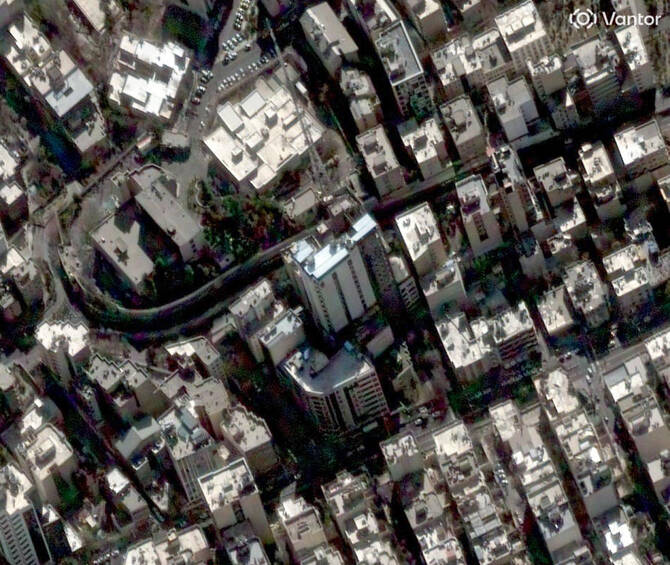
Satellite images published Tuesday by Colorado-based company Vantor showed the domed roof of Iran’s presidential complex in Tehran had been destroyed, supporting Israel’s claim of an overnight strike. Iran did not acknowledge the damage or report any casualties.
A north Tehran resident who spoke on condition of anonymity for fear of retaliation described growing fears amid the heavy bombardment. The resident said most stores in the normally bustling area of Tajrish were closed, though bakeries and supermarkets remained open.
Iran hits US Embassy in Riyadh and Washington pulls out staff
An attack from two drones on the US Embassy in Riyadh caused a “limited fire,” according to the Saudi Arabian Defense Ministry, and the embassy urged Americans to avoid the compound.
An Iranian drone struck a parking lot outside the US consulate in Dubai, sparking a small fire, Secretary of State Marco Rubio said in Washington. He said all personnel were accounted for.
The United Arab Emirates said it has intercepted the vast majority of more than 1,000 Iranian missile and drone attacks against it.
US embassies in Saudi Arabia, Kuwait and Lebanon said they were closed to the public.
The US State Department ordered the evacuation of non-emergency personnel and family in Kuwait, Bahrain, Iraq, Qatar, Jordan and the United Arab Emirates. And US citizens were urged to leave more than a dozen Middle Eastern countries, though many were stranded because of airspace closures.
The State Department said Tuesday it’s preparing military and charter flights for Americans who want to leave the Middle East. Several other countries also arranged evacuation flights for their citizens.
The US-Israeli strikes have killed at least 787 people in Iran, according to the Red Crescent Society. In Lebanon, where Israel launched retaliatory strikes on the Iranian-supported militant group Hezbollah, 50 people were killed, including seven children, Lebanon’s health ministry said.
In addition, three people were killed in the United Arab Emirates, and one each in Kuwait and Bahrain.
The US military has confirmed six deaths of American service members.
Four of the American soldiers killed were identified as Capt. Cody A. Khork, 35, of Winter Haven, Florida; Sgt. 1st Class Noah L. Tietjens, 42, of Bellevue, Nebraska; Sgt. 1st Class Nicole M. Amor, 39, of White Bear Lake, Minnesota; and Sgt, Declan J. Coady, 20, of West Des Moines, lowa, who received a posthumous promotion in rank. They were assigned to the Iowa-based 103rd Sustainment Command.
Turkish Foreign Minister Hakan Fidan on Tuesday criticized Iran’s attacks against Gulf neighbors that had worked to prevent war as an “incredibly flawed strategy” that threatened to widen the war if those states decide to retaliate.