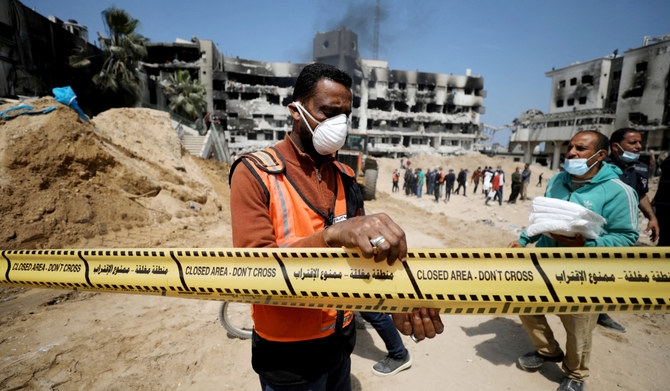

GAZA CITY, Palestinian Territories: Emergency doctor Amjad Alewah once saved lives at Al-Shifa hospital, the largest medical facility in the Gaza Strip.
But after 200 days of war between Israel and Hamas militants, he now stands in its ruins.
“We are now in the middle of the rubble of this great hospital,” Alewah, who returned to inspect the now charred emergency reception room, told AFP.
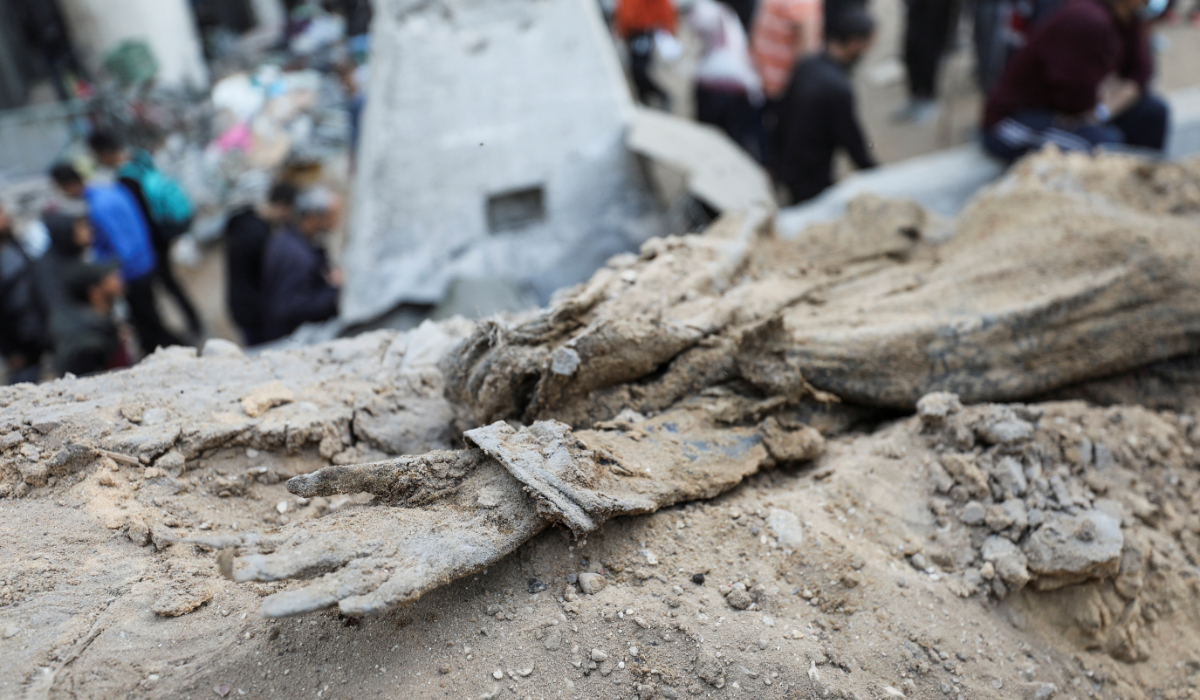
A decomposed body lies on the ground at Al Shifa Hospital after Israeli forces withdrew from the hospital and the area around it following a two-week operation, amid the ongoing conflict between Israel and Hamas, in Gaza City April 1, 2024. (REUTERS)
Following the outbreak of war, Al-Shifa became a safe haven for the thousands injured or fleeing the Israeli onslaught on the Palestinian territory.
“Every day, we received thousands of wounded,” he said, recalling having to work without enough medical equipment or fuel for electric generators.
“We had picked up the habit of spending all our time here, as if it was our main residence.”
But war came to Al-Shifa, with Israel launching multiple raids on the medical facility after accusing militants of operating a command center from tunnels below.

Palestinian forensic and civil defence recover bodies at the grounds of Al-Shifa hospital, Gaza's largest hospital, which was reduced to ashes by a two-week Israeli raid, on April 8, 2024, amid the ongoing conflict between Israel and the Palestinian Hamas militant group. (AFP)
The Israeli military said two weeks of fierce fighting last month killed over 200 militants and recovered weapons.
Hamas, which rules Gaza, denies using the hospital for military purposes.
Footage of the complex filmed by AFP after two weeks of siege between March 18 and early April shows a site laid to waste.
UN Human Rights Chief Volker Turk said he was horrified by the hospital’s destruction and demanded an independent investigation.
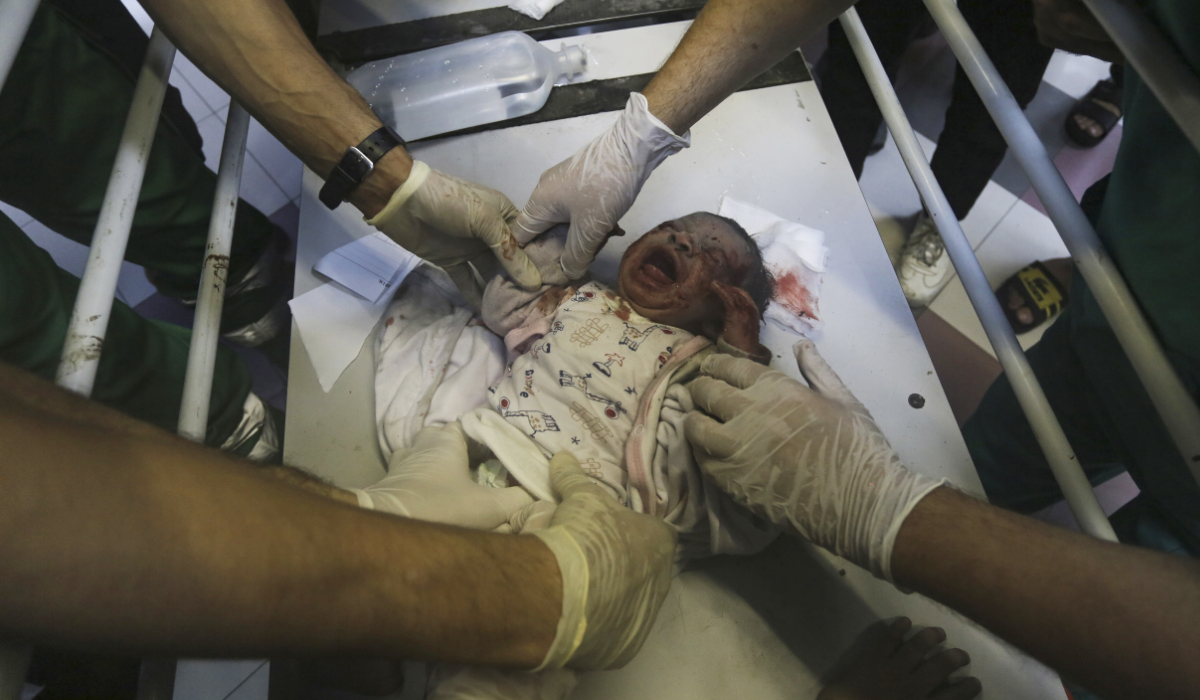
A wounded Palestinian baby receives treatment at the al-Shifa hospital, following Israeli airstrikes on Gaza City, central Gaza Strip, Monday, Oct. 23, 2023. (AFP)
“Hospitals are entitled to very special protection under international humanitarian law,” he said.
Alewah said he was saddened by the destruction of a “cornerstone of health for the whole north of the Gaza Strip,” calling on the international community and World Health Organization (WHO), which visited Al-Shifa to assess damages, to help rebuild.
“We’re lacking operating theaters to treat patients, particularly patients on dialysis or those with heart conditions.”
A rehabilitation medical committee has already been put in place, its head, Marwan Abu Saada told AFP, adding that they were working on building an emergency department in another part of the hospital complex.
“We will not lose hope,” he repeated, despite acknowledging the difficulty of the task at hand.
As many as 32 hospitals and 53 dispensaries are out of commission due to the war, according to the latest figures from the health ministry in Hamas-run Gaza, while 77,100 people are wounded across the territory.
“We want the war to end,” said Adham Qneita, a resident of Rimal, a neighborhood adjacent to the hospital.
Speaking in front of the devastation of flattened apartment buildings, he said he wished “only for death.”
“Nobody cares about us,” he told AFP.
The war between Israel and Hamas erupted when the group’s fighters launched an unprecedented attack on the country on October 7, resulting in the deaths of 1,170 people, mostly civilians, according to an AFP tally based on official Israeli figures.
Israel vowed to eliminate Hamas and its ensuing military offensive in Gaza has killed at least 34,183 people, most of them women and children, according to the Gaza health ministry.