Sunak says UK to raise defense spending amid global threats

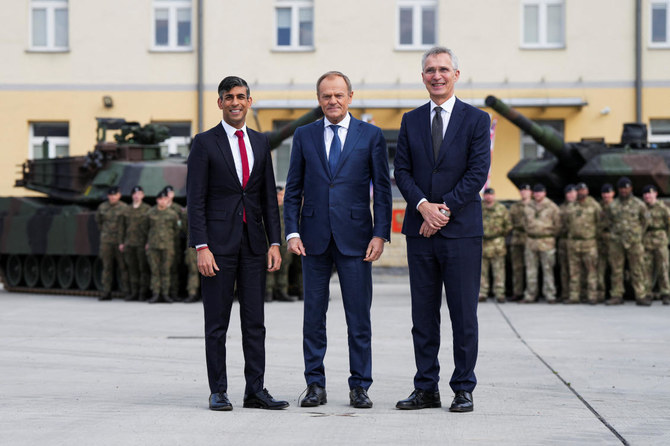
British Prime Minister Rishi Sunak, Polish Prime Minister Donald Tusk and NATO Secretary General Jens Stoltenberg meet at the Warsaw Armored Brigade’s base, in Warsaw on Apr. 23, 2024. (Reuters)
Short Url
Updated 23 April 2024
Follow

Sunak says UK to raise defense spending amid global threats

  • “In a world that is the most dangerous it has been since the end of the Cold War, we cannot be complacent,” Sunak told reporters
  • The increase in spending from 2.3 percent will see the UK become one of the highest spenders on defense in the 32-member defense alliance

WARSAW: Britain will raise defense spending to 2.5 percent of GDP by 2030 in a “most dangerous” world, Prime Minister Rishi Sunak said Tuesday during a visit to Poland.
The commitment came as NATO countries face pressure to raise defense spending in the face of global threats, particularly from Russia.
“In a world that is the most dangerous it has been since the end of the Cold War, we cannot be complacent,” Sunak told reporters in Warsaw, where he held a press conference with NATO Secretary-General Jens Stoltenberg.
The increase in spending from 2.3 percent will see the UK become one of the highest spenders on defense in the 32-member defense alliance after the United States, the British government said.
It means the UK is expected to spend £87 billion on defense in 2030-31, an increase of £23 billion over current levels.
“I believe we must do more to defend our country, our interests, and our values,” Sunak said, announcing “the biggest strengthening of national defense for a generation.”
Western nations are under pressure to boost defense funding following Moscow’s invasion of its neighbor Ukraine as well as the threat of escalation in the Middle East.
EU chief Ursula von der Leyen recently called for a “European awakening on defense and security.”
Brussels is set to come up with more proposals for financing the defense push by a summit of EU leaders in June.
Sunak has also faced calls from his Conservative Party to boost defense spending, with some calling for a level of three percent of GDP.
On Tuesday, Sunak also announced £500 million additional funding for Ukraine’s war effort against Russia.


Crypto mogul Do Kwon sentenced to 15 years in prison for $40 billion stablecoin fraud

Updated 8 sec ago
Follow

Crypto mogul Do Kwon sentenced to 15 years in prison for $40 billion stablecoin fraud

NEW YORK: Onetime cryptocurrency mogul Do Kwon was sentenced Thursday to 15 years in prison after a $40 billion crash revealed his crypto ecosystem to be a fraud. Victims said the 34-year-old financial technology whiz weaponized their trust to convince them that the investment — secretly propped up by cash infusions — was safe.
Kwon, a Stanford graduate known by some as “the cryptocurrency king,” apologized after listening as victims — one in court and others by telephone — described the scam’s toll: wiping out nest eggs, depleting charities and wrecking lives. One told the judge in a letter that he contemplated suicide after his father lost his retirement money in the scheme.
Engelmayer said at a daylong sentencing hearing in Manhattan federal court that the government’s recommendation of 12 years in prison was “unreasonably lenient” and that the defense’s request for five years was “utterly unthinkable and wildly unreasonable.” Kwon faced a maximum sentence of 25 years in prison.
“Your offense caused real people to lose $40 billion in real money, not some paper loss,” Engelmayer told Kwon, who sat at the defense table in a yellow jail suit. The judge called it “a fraud on an epic, generational scale” and said Kwon had an “almost mystical hold” on investors and caused incalculable “human wreckage.”
More than the combined losses in FTX and OneCoin cases
Kwon pleaded guilty in August to fraud charges stemming from the collapse of Terraform Labs, the Singapore-based firm he co-founded in 2018. The loss exceeded the combined losses from FTX founder Sam Bankman-Fried and OneCoin co-founder Karl Sebastian Greenwood’s frauds, prosecutors said. Engelmayer estimated there may have been a million victims.
Terraform Labs had touted its TerraUSD as a reliable “stablecoin” — a kind of currency typically pegged to stable assets to prevent drastic fluctuations in prices. But prosecutors say it was an illusion backed by outside cash infusions that came crumbling down after it plunged far below its $1 peg. The crash devastated investors in TerraUSD and its floating sister currency, Luna, triggering “a cascade of crises that swept through cryptocurrency markets.”
Kwon tried to rebuild Terraform Labs in Singapore before fleeing to the Balkans on a false passport, prosecutors said. He’s been locked up since his March 2023 arrest in Montenegro. He was credited for 17 months he spent in jail there before being extradited to the US
Kwon agreed to forfeit over $19 million as part of his plea deal. His lawyers argued his conduct stemmed not from greed, but hubris and desperation. Engelmayer rejected his request to serve his sentence in his native South Korea, where he also faces prosecution and where his wife and 4-year-old daughter live.
“I have spent almost every waking moment of the last few years thinking of what I could have done different and what I can do now to make things right,” Kwon told Engelmayer. Hearing from victims, he said, was “harrowing and reminded me again of the great losses that I have caused.”
Victims say losses ruined their lives, harmed charities
One victim, speaking by telephone, said his wife divorced him, his sons had to skip college, and he had to move back to Croatia to live with his parents after TerraUSD’s crash evaporated his family’s life savings. Another said he has to “live with the guilt” of persuading his in-laws and hundreds of nonprofit organizations to invest.
Stanislav Trofimchuk said his family’s investment plummeted from $190,000 to $13,000 — “17 years of our life, gone” during what he described as “two weeks of sheer terror.”
Chauncey St. John, speaking in court, said some nonprofits he worked with lost more than $2 million and a church group lost about $900,000. He and his wife are saddled with debt and his in-laws have been forced to work well past their planned retirement, he said.
Nevertheless, St. John said, he forgives Kwon and “I pray to God to have mercy on his soul.”
A prosecutor read excerpts from some of more than 300 letters submitted by victims, including a person identified only by initials who lost nearly $11,400 while juggling bills and trying to complete college. Kwon had made Terra seem like a safe place to stash savings, the person said.
“To some that is just a number on a page, but to me it was years of effort,” the person wrote. “Watching it evaporate, literally overnight, was one of the most terrifying experiences of my life.”
“What happened was not an accident. It was not a market event. It was deception,” the person added, imploring the judge to “consider the human cost of this tragedy.”
Kwon created an “illusion of resilience while covering up systemic failure,” Assistant US Attorney Sarah Mortazavi told Engelmayer. “This was fraud executed with arrogance, manipulation and total disregard for people.”