Pakistan’s Sindh to step up efforts against street crime after dozens killed in Karachi

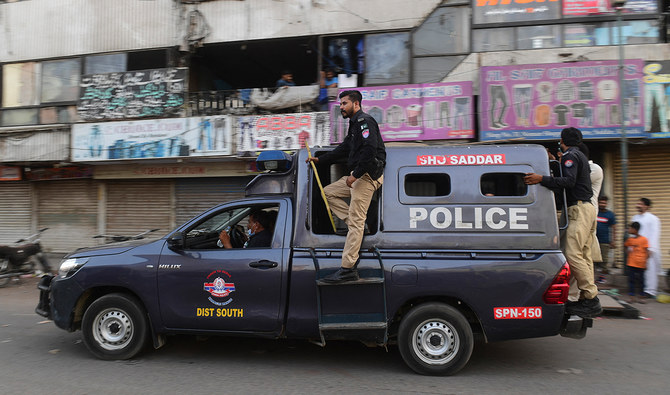
Police patrol in a market area after the authorities imposed an evening lockdown to curb the spread of the Covid-19 coronavirus in Karachi on May 24, 2021. (AFP/File)
Short Url
Updated 22 April 2024
Follow

Pakistan’s Sindh to step up efforts against street crime after dozens killed in Karachi

  • Karachi, the country’s commercial hub, has reported nearly one murder every other day since the start of this year
  • At least 18 killings, including that of an army major, occurred during muggings in the holy fasting month of Ramadan

KARACHI: The government in Pakistan’s southern Sindh province on Monday decided to intensify its efforts against rampant street crime, following the killing of dozens of people in muggings and other violent crimes in the provincial capital this year.

The decision was made at a law and order meeting held at the Chief Minister’s House, which was attended by members of the provincial cabinet, top bureaucrats, provincial and city police chiefs, Karachi Corps Commander Lt Gen Babar Iftikhar and Sindh Rangers Director-General Maj Gen Azhar Waqas.

The development comes after the killing of at least 57 people in Karachi, the country’s commercial hub and home to roughly 30 million people, averaging nearly one murder every other day since the start of this year, according to a tally collected from media reports.

At least 18 of the killings, including that of an army major who was assigned with the Coast Guard, occurred during the holy fasting month of Ramadan. The officer was shot by muggers on March 30 and died after being hospitalized for a week.

“Meeting has decided to take measures to monitor the sale of stolen or snatched mobile phones and vehicles as spare parts or in their complete form in the markets of Karachi,” read a statement issued from the CM House after the huddle.

Officials informed the participants that the police had 467 encounters with criminals this year, in which 67 suspects were killed, 489 were injured and 1,766 were arrested.

Additionally, the police were directed to revamp Madadgar-15 service for reporting crimes.

“The Home Minister announced that an additional 168 vehicles, including 120 motorbikes, would be deployed to enhance the police force’s capabilities,” the statement read.

“The Chief Minister instructed the Inspector General (IG) of police to initiate the E-tagging of repeat offenders.”


Pakistan opens real-time digital payment system to exchange companies as reserves edge up

Updated 5 sec ago
Follow

Pakistan opens real-time digital payment system to exchange companies as reserves edge up

  • Raast enables low-cost transfers between banks, microfinance firms and electronic money wallets
  • Pakistan’s overall foreign reserves stand at $21.25 billion as central bank holdings rise $16 million

KARACHI: Pakistan’s central bank on Thursday allowed exchange companies to route home remittances through its instant payment system, Raast, saying the move aims to promote digital transactions and improve the efficiency of inflows, as the country’s foreign exchange reserves rose modestly in the latest week.

The State Bank of Pakistan (SBP) said in a statement that the country's total liquid foreign reserves stood at $21.25 billion as of Jan. 9, while the central bank’s own reserves rose $16 million to $16.07 billion.

The statement said the decision to extend Raast to exchange companies forms part of the central bank’s broader push to strengthen digital payments infrastructure and support a shift toward a cashless economy.

“Building an innovative and inclusive digital financial services ecosystem is one of the key objectives of State Bank of Pakistan under its Strategic Plan 2023-2028,” the SBP said.

“In furtherance of this vision, SBP has now allowed Exchange Companies (ECs) to utilize ‘Raast,’ a state-of-the-art payment system launched by SBP in 2021, to facilitate remitters and beneficiaries of home remittances,” it added.

Raast, a real-time digital payment system, allows instant and low-cost transfers between banks, microfinance institutions and electronic money wallets.

“Through this enablement, the beneficiaries receiving remittances through ECs can receive their funds in their accounts and wallets ... in a safe and efficient manner,” the statement said.

Pakistan relies heavily on workers’ remittances from abroad and has been seeking to channel more inflows through formal banking systems by strengthening digital and regulated payment networks, as authorities try to curb informal mechanisms such as hawala and hundi, underground value transfer systems that move money outside the banking sector.