

Saudi Aramco in talks to acquire 10% stake in China’s Hengli Petrochemical

Aramco and Hengli Petrochemical Co. signed a memorandum of understanding for the proposed deal. The agreement supports the former’s strategy to increase its presence in key downstream markets, enhance its liquids-to-chemicals initiative, and ensure long-term crude oil supply agreements.
Short Url
Updated 22 April 2024
Follow

Saudi Aramco in talks to acquire 10% stake in China’s Hengli Petrochemical

RIYADH: Energy giant Saudi Aramco held talks with Chinese Hengli Group Co. to acquire a 10 percent stake in its subsidiary, subject to due diligence and required regulatory clearances.

Aramco and Hengli Petrochemical Co. signed a memorandum of understanding for the proposed deal. The agreement supports the former’s strategy to increase its presence in key downstream markets, enhance its liquids-to-chemicals initiative, and ensure long-term crude oil supply agreements.

Last year, Aramco signed two multibillion-dollar agreements for liquids to chemicals investments in China.

In March 2023, a deal was signed between China’s Norinco Group and Panjin Xincheng Industrial Group to establish a joint venture to build a refinery and petrochemical complex in China’s Liaoning province. The initiative cost stands at approximately $12 billion.

The second agreement, signed in July, is an acquisition of a 10 percent stake in China-based firm Rongsheng Petrochemical Co. for $3.4 billion.

“This MoU supports our efforts to grow our global downstream footprint. We continue to explore new opportunities in important markets as we seek to progress in our liquids-to-chemicals strategy,” Mohammed Al-Qahtani, Aramco’s downstream president, said in a press release.

He continued: “We look forward to forging new partnerships and are excited by the prospect of expanding our presence in the important Chinese market.”

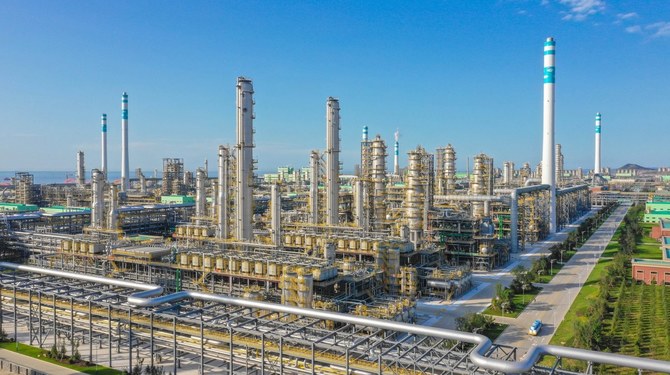
Hengli Petrochemical, a controlled subsidiary of Hengli Group, owns and operates a 400,000-barrel-per-day refinery and integrated chemicals complex in Liaoning province, and several plants and production facilities in Jiangsu and Guangdong provinces.

Speaking at a development forum held in March 2023 in Beijing, Amin Nasser, president and CEO of Aramco, highlighted substantial opportunities for cooperation between Saudi Aramco and Chinese partners in sectors aimed at reducing emissions.

“China has distinct strengths in renewables and critical materials, while Aramco and Saudi Arabia have a clear interest in solar, wind, hydrogen, and electrofuels. These areas have great long-term potential, and combining our strengths could match our ambitions,” he noted.

Saudi Arabia and China are working together to strengthen their already well-established strategic ties.

In September, the Kingdom’s minister of industry and mineral resources held meetings with key Chinese officials in Beijing. Bandar Alkhorayef also toured various companies and factories in different Chinese cities as part of his trip.

He held talks with China’s Vice Minister of Commerce Wang Shouwen, during which they discussed ways to boost economic collaboration and trade ties, the Saudi Press Agency reported.

The top officials also discussed investment opportunities in several economic sectors, including mining. At the time, the Saudi minister highlighted the Kingdom’s progress in the field of industries and mining.


Saudi Arabia, Japan trade rises 38% between 2016 and 2024, minister says

Updated 11 January 2026
Follow

Saudi Arabia, Japan trade rises 38% between 2016 and 2024, minister says

RIYADH: Trade between Saudi Arabia and Japan has increased by 38 percent between 2016 and 2024 to reach SR138 billion ($36 billion), the Kingdom’s investment minister revealed.

Speaking at the Saudi-Japanese Ministerial Investment Forum 2026, Khalid Al-Falih explained that this makes the Asian country the Kingdom’s third-largest trading partner, according to Asharq Bloomberg.

This falls in line with the fact that Saudi Arabia has been a very important country for Japan from the viewpoint of its energy security, having been a stable supplier of crude oil for many years.

It also aligns well with how Japan is fully committed to supporting Vision 2030 by sharing its knowledge and advanced technologies.

“This trade is dominated by the Kingdom's exports of energy products, specifically oil, gas, and their derivatives. We certainly look forward to the Saudi private sector increasing trade with Japan, particularly in high-tech Japanese products,” Al-Falih said.

He added: “As for investment, Japanese investment in the Kingdom is good and strong, but we look forward to raising the level of Japanese investments in the Kingdom. Today, the Kingdom offers promising opportunities for Japanese companies in several fields, including the traditional sector that links the two economies: energy.”

The minister went on to note that additional sectors that both countries can also collaborate in include green and blue hydrogen, investments in advanced industries, health, food security, innovation, entrepreneurship, among others.

During his speech, Al-Falih shed light on how the Kingdom’s pavilion at Expo 2025 in Osaka achieved remarkable success, with the exhibition receiving more than 3 million visitors, reflecting the Japanese public’s interest in Saudi Arabia.

“The pavilion also organized approximately 700 new business events, several each day, including 88 major investment events led by the Ministry of Investment. Today, as we prepare for the upcoming Expo 2030, we look forward to building upon Japan’s achievements,” he said.

The minister added: “During our visit to Japan, we agreed to establish a partnership to transfer the remarkable Japanese experience from Expo Osaka 2025 to Expo Riyadh 2030. I am certain that the Japanese pavilion at Expo Riyadh will rival the Saudi pavilion at Expo Osaka in terms of organization, innovation, and visitor turnout.”

Al-Falih also shed light on how Saudi-Japanese relations celebrated their 70th anniversary last year, and today marks the 71st year of these relations as well as how they have flourished over the decades, moving from one strategic level to an even higher one.