As T20 World Cup looms, injuries become headache for Pakistan yet again

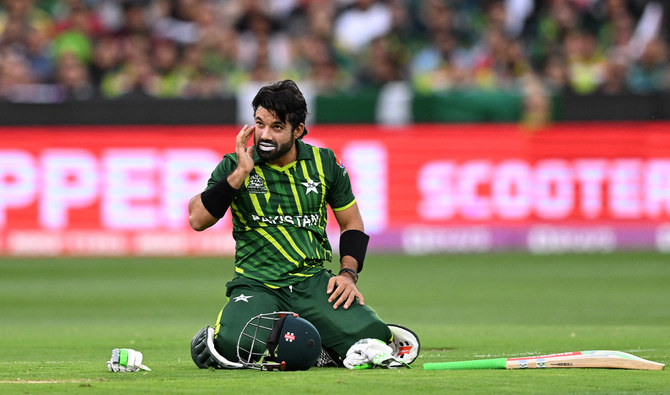
Pakistan's Muhammad Rizwan reacts after being hit by a delivery during the ICC men's Twenty20 World Cup 2022 final cricket match England and Pakistan at The Melbourne Cricket Ground in Melbourne, Australia, on November 13, 2022. (AFP/File)
Short Url
Updated 22 April 2024
Follow

As T20 World Cup looms, injuries become headache for Pakistan yet again

  • Star batter Muhammad Rizwan was pulled out of Sunday’s match against New Zealand after he felt discomfort in his hamstring
  • Pakistani wicketkeeper batter Azam Khan has been ruled out of the New Zealand series after he suffered a tear in his right calf muscle 

ISLAMABAD: The Pakistan Cricket Board (PCB) said on Sunday that star batter Muhammad Rizwan had been pulled out of the third T20I fixture against New Zealand in Rawalpindi after he felt discomfort in his hamstring, raising fears that the 2009 champions may once again be plagued by injuries before the mega T20 tournament kicks off in June. 

Rizwan, who was instrumental in Pakistan’s win in the second T20I over New Zealand on Saturday, was pulled from the match after scoring only 22 runs from 21 balls on Sunday. The PCB later released a statement saying the batter felt discomfort in his right hamstring, and that he would not take part in the rest of the match. 

If injured, Rizwan would add to a mounting list of Pakistani players who have suffered injuries in recent times. Wicketkeeper batter Azam Khan was ruled out of the New Zealand series last week after radiology reports confirmed a grade one tear in his right calf muscle. 

“Azam will now depart from the Pakistan men’s cricket team and report to the National Cricket Academy, where he will commence his rehabilitation process under the supervision of the PCB medical panel,” the PCB said in a statement on Sunday. 

Express Pakistani pacer Ihsanullah has also been out of action since he made his ODI debut for Pakistan in April 2023. Ihsanullah was initially sidelined with an elbow injury which, according to media reports, turned into a significantly more serious as it was misdiagnosed by the PCB’s medical team. 

PCB Chairman Mohsin Naqvi said on Sunday that the cricket body had decided to constitute an independent board “to analyze if Ihsanullah’s medical case was handled properly by PCB medical support team.”

The South Asian team suffered a massive blow last year when right-arm pacer Naseem Shah, a regular member of the Pakistan cricket team in all three formats of the game, suffered a serious shoulder injury and was ruled out of the 50-over World Cup in India months before it was scheduled to take place. Pakistan ended up not qualifying for the semifinal stages of the tournament on account of their poor bowling and batting performances. 


Pakistan announces four-day work week among austerity measures to offset impact of Middle East crisis

Updated 54 min 30 sec ago
Follow

Pakistan announces four-day work week among austerity measures to offset impact of Middle East crisis

  • The development comes as ongoing US-Israeli strikes on Iran disrupt oil supplies in Strait of Hormuz, push prices past $119 a barrel
  • Islamabad bans government purchases, cuts fuel allocation for vehicles as well as workforce in public and private offices by 50 percent

ISLAMABAD: Prime Minister Shehbaz Sharif on Monday announced austerity measures, including a four-day work week and cuts in government expenditures, to offset the impact of rising global oil prices due to an ongoing conflict in the Middle East.

Global fuel supply lines have been disrupted in the Strait of Hormuz, which supplies nearly a fourth of world oil consumption, after Tehran blocked it following United States-Israeli strikes on Iran and counterattacks against US interests in the Gulf region.

Oil prices surged more than 25 percent globally on Monday to $119.50 a barrel, the highest levels since mid-2022, as some major producers cut supplies and fears of prolonged shipping disruptions gripped the market due to the expanding US-Israeli war with Iran.

In his televised address on Sunday night, Sharif said global oil prices were expected to rise again in the coming days but vowed not to let the people bear their brunt, announcing austerity measures to lessen the impact of fuel price hikes.

“Fifty percent staff in public and private entities will work from home,” he announced, adding this would not be applicable to essential services. “Offices will remain open for four days a week. One-day additional off is being given to conserve oil, but it would not be applicable to banks.”

Sharif didn’t specify working days of the week and the government was likely to issue a notification in this regard.

He said a decrease of 50 percent was being made in fuel allocation for government vehicles immediately for the next two months, but they would not include ambulances and public buses.

“Cabinet members, advisers and special assistants will not draw salaries for the next two months, 25 percent salaries of parliamentarians are being deducted, two-day salaries of Grade 20 and above officers, or those who are paid Rs300,000 ($1,067) a month, are being deducted for public relief,” he said.

Similarly, there will be 20 percent reduction in public department expenses and a complete ban on the purchase of cars, furniture, air conditioners and other goods, according to the prime minister.

Foreign trips of ministers and other government officials will also be banned along with government dinners and iftar buffets, while teleconferences and online meetings will be given priority.

Sharif’s comments were aired hours after Pakistani authorities said the country had “comfortable levels” of petroleum stocks and the supply chains were functioning smoothly, despite intensifying Middle East conflict.

Petroleum Minister Ali Pervaiz Malik said three oil shipments were due to reach Pakistan this week, state media reported.

Meanwhile, Pakistan Navy (PN) launched ‘Operation Muhafiz-ul-Bahr’ to safeguard national energy shipments, the Pakistani military said on Monday, amid disruptions to critical sea lanes due to the conflict.

The navy is conducting escort operations in close coordination with the Pakistan National Shipping Corporation (PNSC), according to the Inter-Services Public Relations (ISPR), the military’s media wing. It is fully cognizant of the prevailing maritime situation and is actively monitoring and controlling the movement of merchant vessels to ensure their safe and secure transit.

“With approximately 90 percent of Pakistan’s trade conducted via sea, the operation aims to ensure that vital sea routes remain safe, secure, and uninterrupted,” the ISPR said on Monday. “Currently, PN ships are escorting 2 x Merchant Vessels, one of which is scheduled to arrive Karachi today.”