

Deepfakes of Bollywood stars spark worries of AI meddling in India election

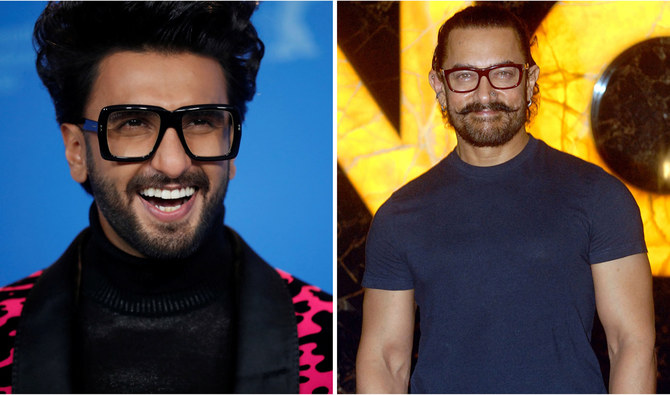
The collage of images created on April 22, 2024 shows actors of Indian cinema Ranveer Singh (left) and Aamir Khan. (REUTERS/AFP)
Short Url
Updated 22 April 2024
Follow

Deepfakes of Bollywood stars spark worries of AI meddling in India election

  • In fake viral videos, two A-lister Bollywood stars are seen criticizing PM Modi, asking people to vote for Congress
  • Deepfakes are being increasingly used in elections elsewhere in the world, including US, Pakistan and Indonesia

MUMBAI: In fake videos that have gone viral online, two of India’s A-lister Bollywood actors are seen criticizing Prime Minister Narendra Modi and asking people to vote for the opposition Congress party in the country’s ongoing general election.

In a 30-second video that shows Aamir Khan and another 41-second clip of Ranveer Singh, the two Bollywood actors purportedly say Modi failed to keep campaign promises and failed to address critical economic issues during his two terms as prime minister.

Both AI-generated videos end with the Congress election symbol and slogan: “Vote for Justice, Vote for Congress.”

The two videos have been viewed on social media more than half a million times since last week, a Reuters review shows.

Their spread underlines the potential role such AI (artificial intelligence)-generated content can play in the mammoth Indian election that started on Friday and will continue until June. AI and AI-generated fakes, or deepfakes, are being increasingly used in elections elsewhere in the world, including in the US, Pakistan and Indonesia.

Campaigning in India has long focused on door-to-door outreach and public rallies, but extensive use of WhatsApp and Facebook as campaigning tools started in 2019. This year’s general election — in which Modi is expected to secure a rare third term — is the first in which AI is being used.

A Congress spokesperson, Sujata Paul, shared actor Singh’s video with her 16,000 followers on X on April 17 and by Saturday afternoon, her post had been reshared 2,900 times, liked 8,700 times and received 438,000 views.

Paul told Reuters by telephone she was aware the video was marked “manipulated media” by X, but she did not want to delete it as, while posting, she thought the person was a look alike of Singh and “it has creativity for sure.”

The post was no longer visible on X on Sunday, hours after Reuters sent a request for comment to Congress’ head of social media cell, who did not respond.

Both actors have said the videos are fake. Facebook, X and at least eight fact-checking websites have said they are altered or manipulated, which the Reuters digital verification unit has also confirmed.

Reuters could not ascertain who created the videos. Khan was “alarmed” by the viral “fake” video and Singh’s team was looking into the matter, according to a spokesperson for both actors. Singh wrote on X on Friday: “Beware of deepfakes, friends.”

Modi’s office, and the IT head of his Bharatiya Janata Party, did not respond to requests for comment.

POLICE PROBE

Nearly 900 million people in India have access to the Internet and a survey conducted by research organization Esya Center and the Indian Institute of Management business school showed an average Indian spends over three hours a day on social media. The country has nearly one billion voters.

Some versions of the videos have been blocked on social media but at least 14 were still visible on X on Saturday. Facebook deleted two videos Reuters flagged to the company but one other was still visible.

Facebook in a statement said it has “removed the videos” for violation of its policies. X did not respond to Reuters queries.

The videos have sparked one police investigation with Khan registering a case in Mumbai against unnamed persons on April 17 for alleged impersonation and cheating for creating the fake video.

Mumbai police did not return a request for comment, but two officers working on Khan’s case, who declined to be named, said they wrote to Facebook and X to take down the video and the companies had said it was done.

The officers said they were up until 2 a.m. on Friday, refreshing pages to check if Khan’s online videos were removed. Asked about progress in the case, one of them said: “Such technical investigations take time.”

AI VIDEO OF DEAD FATHER

In this year’s election, politicians are using AI in other ways.

In southern India, Congress leader Vijay Vasanth’s spokesperson said his team has created a 2-minute audio-video clip using AI that was shared on social media platforms and shows his now dead but more popular politician father, H. Vasanthakumar, seeking votes for him.

The late politician is seen saying “even though my body left you all, my soul is still around.”

In videos put out on YouTube by the Communist Party of India-Marxist (CPM), Samata, an AI-generated anchor dressed in a traditional saree and speaking in a style that mimics regular news channels, criticizes the ruling party in West Bengal state.

In one clip, the anchor alleges the party does not care about the environment as many water bodies have vanished due to illegal construction.

A spokesperson for the ruling party denied the allegation and said the state government has ensured no such construction takes place. The CPM did not respond to requests for comment.

In the video, which has been seen 12,000 times, anchor Samata declares: “These are questions that we the citizens of this city need to ponder over.”


Venezuela begins ‘large’ prisoner release amid US pressure

Updated 4 sec ago
Follow

Venezuela begins ‘large’ prisoner release amid US pressure

  • The releases are the first since Maduro’s former deputy Delcy Rodriguez took over, with the backing of President Donald Trump
  • The releases were announced by Rodriguez’s brother, parliament speaker Jorge Rodriguez

CARACAS: Venezuela on Thursday began releasing a “large number” of political prisoners, including several foreigners, in an apparent concession to the United States after its ouster of ruler Nicolas Maduro.
The releases are the first since Maduro’s former deputy Delcy Rodriguez took over, with the backing of President Donald Trump, who says he is content to let her govern as long as she gives Washington access to oil.
The White House credited Trump with securing the prisoners’ freedom.
“This is one example of how the president is using maximum leverage to do right by the American and Venezuelan people,” Deputy Press Secretary Anna Kelly said in a statement to AFP.
The releases were announced by Rodriguez’s brother, parliament speaker Jorge Rodriguez, a key figure in “chavismo,” the anti-US socialist movement founded by Maduro’s predecessor Hugo Chavez.
He said “a large number of Venezuelan and foreign nationals” were being immediately freed for the sake of “peaceful coexistence.”
He did not say which prisoners would be released, nor how many or from where.
Renowned Spanish-Venezuelan activist Rocio San Miguel, imprisoned since February 2024 over a purported plot to assassinate Maduro, was among five Spanish citizens freed, according to Spain’s foreign ministry.
Security was stepped up Thursday afternoon outside the notorious El Helicoide detention center in Caracas, used by the intelligence services to jail political and other prisoners.
Miguel was held in El Helicoide after her arrest.
Leading opposition figure Alfredo Diaz, who died in December in custody, was also held at the facility.
Families gathered outside on Thursday for news of their loved ones.
“I’m nervous. Please God may it be reality,” the mother of a detained activist from the party of opposition leader Maria Corina Machado told AFP.
On Tuesday, Trump had told Republican lawmakers that Rodriguez’s administration was closing a torture chamber “in the middle of Caracas” but gave no further details.
His remarks had sparked speculation that Venezuelan authorities had agreed to close El Helicoide.
Venezuelan rights NGO Foro Penal estimates over 800 political prisoners are languishing in the country’s jails.
It welcomed the government’s plans to liberate some of them but was still verifying releases.
As tensions with Washington climaxed in the past month Venezuela had already released dozens of dissenters in two phases.

- Trump rebuked by Senate -

Thursday’s move by Caracas came as Trump suggested the United States could run Venezuela and tap into its oil reserves for years.
Shortly after Maduro’s seizure in US airstrikes and a special forces raid that left 100 people dead, according to Caracas, Trump announced that the US would “run” the Caribbean country for a transitional period.
“Only time will tell” how long Washington will demand direct oversight of the country, he told The New York Times in an interview published Thursday.
When asked whether that meant three months, six months or a year, he replied: “I would say much longer.”
Meanwhile, the US Senate on Thursday took a major step toward passing a resolution to rein in military actions against Venezuela.
The Democratic-led legislation, expected to pass a vote next week, reflects widespread disquiet among lawmakers over Saturday’s secretive capture of Maduro, conducted without their express approval.
It is expected to face resistance in the Republican-dominated House, however.

- Millions of barrels of crude -

Oil has emerged as the key to US control over Venezuela, which has the world’s largest proven reserves.
Trump announced a plan earlier this week for the United States to sell between 30 million and 50 million barrels of Venezuelan crude, with Caracas then using the money to buy US-made products.
Delcy Rodriguez on Wednesday called the US attack to depose Maduro, who was taken to New York with his wife to face trial on drugs charges, a “stain” on relations with the United States.
But she also defended the planned oil sales to Washington.
On the streets of Caracas, opinions remain mixed about the plan.
“I feel we’ll have more opportunities if the oil is in the hands of the United States than in the hands of the government,” said Jose Antonio Blanco, 26.
The Wall Street Journal reported that Trump, who will meet oil executives on Friday, is also considering a plan for the US to exert control over Venezuela’s state oil company PDVSA.
Trump has warned Rodriguez she will pay “a very big price, probably bigger than Maduro” if she does not comply with his agenda.
“Her power comes from Washington, not from the internal structure. If Trump decides she’s no longer useful, she’ll go like Maduro,” Venezuela’s former information minister Andres Izarra told AFP in an email.