Iranian president arrives in Pakistan for three-day visit to bolster ties

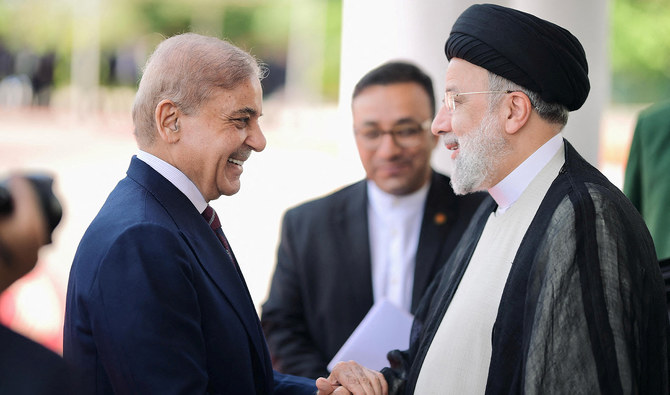
Pakistan's Prime Minister Shehbaz Sharif greets Iranian President Ebrahim Raisi on his three-day official visit in Islamabad, Pakistan April 22, 2024. (PM Office)
Short Url
Updated 22 April 2024
Follow

Iranian president arrives in Pakistan for three-day visit to bolster ties

  • Ebrahim Raisi arrives in Islamabad with high-level delegation and “large” team of businesspersons, says foreign office
  • Raisi’s visit to Pakistan takes place amid surging Middle East tensions following Israel’s airstrikes against Iran last week

ISLAMABAD: Iranian President Ebrahim Raisi arrived in Islamabad on Monday for a three-day visit to the country, Pakistan’s foreign office said, with his trip aimed at strengthening bilateral ties between the two countries amid surging tensions in the Middle East.

The Iranian president arrived in the federal capital with his spouse, a high-level delegation of cabinet members and a team of businesspersons. He was welcomed at the Islamabad Airport by Pakistan’s Federal Minister for Housing and Works Mian Riaz Hussain Pirzada and Pakistan’s Ambassador to Iran Mudassir Tipu.

Raisi’s visit takes place days after Iran and Israel exchanged drone and missile strikes, escalating tensions in the already volatile Middle East.

“Prime Minister Shehbaz Sharif welcomed Iran’s President Ebrahim Raisi at the Prime Minister’s House,” Sharif’s office said in a statement. “Both representatives exchanged good wishes for one another.”
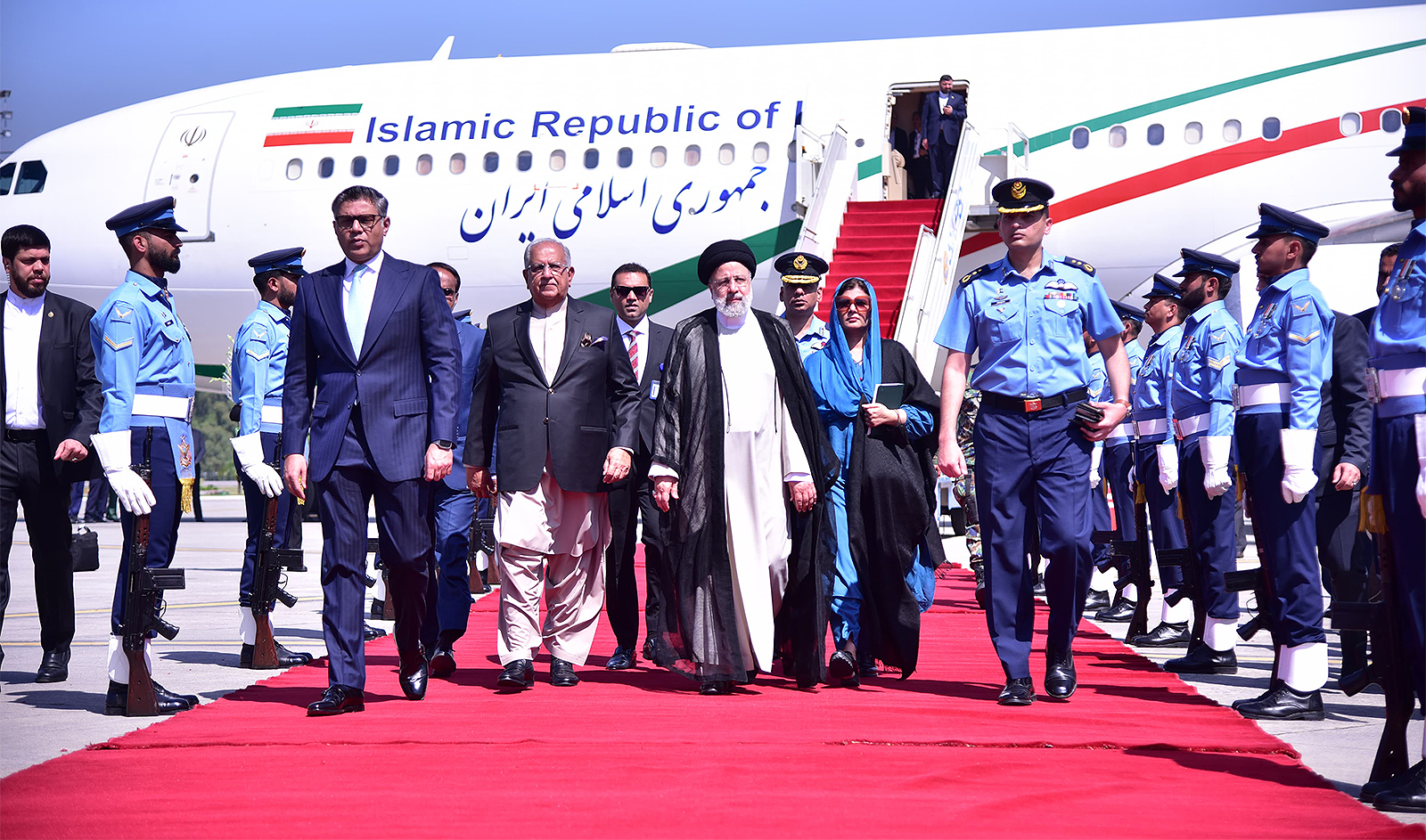


Iranian President Ebrahim Raisi (center) arrives in Islamabad, Pakistan on April 22, 2024. (Government of Pakistan)

Raisi was presented with a guard of honor by a Pakistan Army contingent upon his arrival at the Prime Minister’s House. Sharif and the Iranian president then planted a sapling at the Prime Minister’s House to mark the annual Earth Day. 

The Iranian president also met Pakistan’s Foreign Minister Ishaq Dar, during which the two agreed to enhance cooperation in various areas. “They also discussed regional and global developments and affirmed commitment to peace and constructive dialogue for resolving regional challenges,” the foreign office said. 
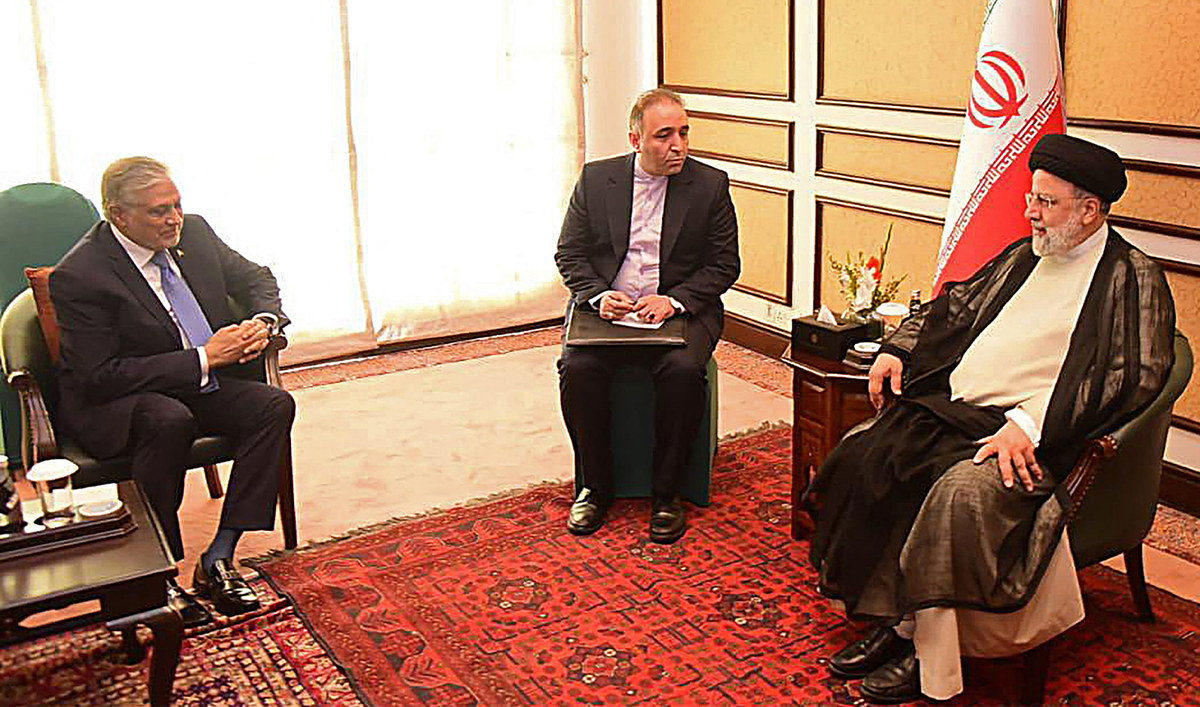


This handout photograph taken and released by the Pakistan Foreign Office on April 22, 2024, shows Iran’s President Ebrahim Raisi (R) speaking with Pakistan's Foreign Minister Ishaq Dar (L) during their meeting in Islamabad, Pakistan. (Pakistan's Foreign Office)

During his visit from April 22-24, the Iranian head of state is scheduled to meet Pakistan’s prime minister, president, Senate chairman and National Assembly speaker, the foreign office said in a statement on Friday, adding that he would also visit Karachi and Lahore cities to meet the country’s provincial leadership.

Raisi’s visit will be the first by any head of state to Pakistan after the contentious elections of February 2024.

Pakistan and Iran are often at odds with each other over instability on their shared porous border, with both countries routinely trading blame for not rooting out militancy.

Tensions surged in January when Pakistan and Iran exchanged airstrikes, both claiming to target alleged militant hideouts in each other’s countries. Both sides have since then undertaken peace overtures and restored bilateral ties.

“The two sides will have a wide-ranging agenda to further strengthen Pakistan-Iran ties and enhance cooperation in diverse fields including trade, connectivity, energy, agriculture, and people-to-people contacts,” the foreign office said.

Discussions would also focus on regional and global developments as well as bilateral cooperation to combat “terrorism,” the statement added.

“Pakistan and Iran enjoy strong bilateral ties anchored in history, culture and religion,” the foreign office said. “This visit provides an important opportunity to further strengthen Pakistan-Iran relations.”


‘Fully stand with Bangladesh’: Pakistan PM backs decision to boycott India match

Updated 04 February 2026
Follow

‘Fully stand with Bangladesh’: Pakistan PM backs decision to boycott India match

  • Pakistan’s government have not allowed the national cricket team to play its World Cup match against India on Feb. 15
  • Pakistan has accused India of influencing ICC decisions, criticized global cricket body for replacing Bangladesh in World Cup

ISLAMABAD: Prime Minister Shehbaz Sharif on Wednesday backed his government’s decision to bar the national men’s cricket team from playing against India in the upcoming T20 World Cup tournament, reaffirming support for Bangladesh. 

Pakistan’s government announced on social media platform X last week that it has allowed its national team to travel to Sri Lanka for the World Cup. However, it said the Green Shirts will not take the field against India on their scheduled match on Feb. 15. 

Pakistan’s participation in the tournament was thrown into doubt after Pakistan Cricket Board (PCB) Chairman Mohsin Naqvi criticized the International Cricket Council (ICC) for replacing Bangladesh with Scotland. The decision was taken after Bangladesh said it would not let its team travel to India out of security concerns. 

During a meeting of the federal cabinet, Sharif highlighted that Pakistan has said that politics should be kept away from sports. 

“We have taken this stand after careful consideration and in this regard, we should stand fully with Bangladesh,” Sharif said in televised remarks. 

“And I believe this is a very reasonable decision.”

Pakistan has blamed India for influencing the ICC’s decisions. The global cricket governing body is currently led by Jay Shah, the head of the Board of Control for Cricket in India. Shah is the son of Indian Home Minister Amit Shah. 

Pakistan’s boycott announcement has triggered media frenzy worldwide, with several Indian cricket experts and analysts criticizing Islamabad for the decision. An India-Pakistan cricket contest is by far the most lucrative and eagerly watched match of any ICC tournament. 

The ICC has ensured that the two rivals and Asian cricket giants are always in the same group of any ICC event since 2012 to capitalize on the high-stakes game. 

The two teams have played each other at neutral venues over the past several years, as bilateral cricket remains suspended between them since 2013 due to political tensions. 

Those tensions have persisted since the two nuclear-armed nations engaged in the worst fighting between them since 1999 in May 2025, after India blamed Pakistan for an attack in Indian-administered Kashmir that killed tourists. 

Pakistan denied India’s allegations that it was involved in the attack, calling for a credible probe into the incident.