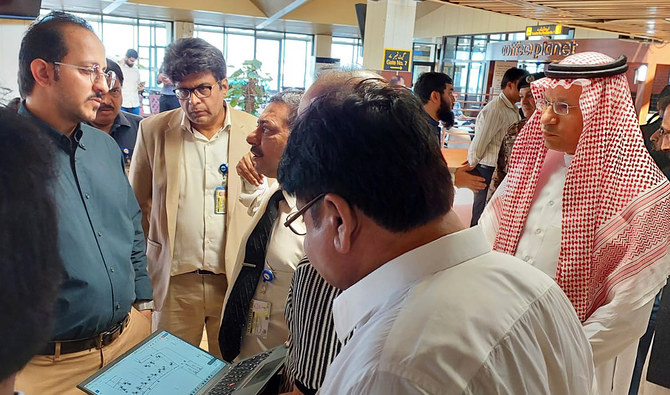
Saudi delegation inspects facilities at Karachi airport for Makkah Route initiative

Pakistani officials brief Saudi officials about the airport terminal at the Jinnah International Airport in Karachi on April 21, 2024, as 2-member delegation from Saudi Arabia visits Karachi for Makkah Route Initiative’s expansion to ease Hajj journey. (Photo courtesy: CAA)
Short Url
Updated 22 April 2024
Follow

Saudi delegation inspects facilities at Karachi airport for Makkah Route initiative

  • The initiative allows for the completion of immigration procedures at the pilgrims’ country of departure
  • More than 60% of Pakistani pilgrims on government program are likely to benefit from the initiative this year

KARACHI: A two-member delegation from Saudi Arabia on Sunday visited the Jinnah International Airport in Karachi to inspect facilities there for the Makkah Route initiative aimed at facilitating local Hajj pilgrims, the Pakistan Civil Aviation Authority (PCAA) said.
Launched in 2019, the initiative allows for the completion of immigration procedures at the pilgrims’ country of departure. This makes it possible to bypass long immigration and customs checks upon reaching Saudi Arabia, which significantly reduces the waiting time and makes the entry process smoother and faster.
Pakistani pilgrims performing Hajj under the government scheme have been availing this facility at the airport in Islamabad for the last couple of years. But the government wants the initiative to be extended to other cities as well.
The two-member delegation, which was accompanied by officials of the Saudi consulate, was warmly welcomed by PCAA officials upon arrival at the Karachi airport.
“The purpose of their visit was to inspect the airport’s facilities and discuss the arrangements for the Route to Makkah project,” the PCAA said in a statement. “During their visit, APM (airport manager) provided the delegation with a comprehensive tour of the airport’s facilities.”
The delegation showed particular interest in the entry process for intending pilgrims and the allocation of immigration space, according to the PCAA. Other key points discussed were related to the allocation of an immigration hall, and differentiating between government and private scheme pilgrims.
Pakistan’s religious affairs ministry last month announced completion of a survey for the Makkah Route initiative at the Karachi airport ahead of the Hajj season.
The South Asian country expects more than 60 percent of pilgrims performing Hajj this year to benefit from the initiative. People opting for the private Hajj scheme can also avail the facility, given the tour operators providing them services have contacted the Pakistani religious ministry for the purpose.
Saudi Arabia last year restored Pakistan’s pre-pandemic Hajj quota of 179,210 pilgrims and abolished the upper age limit of 65 years. More than 81,000 Pakistani pilgrims performed Hajj under the government scheme in 2023, while the rest used private tour operators.
This year’s pilgrimage is expected to run from June 14 till June 19.


Pakistan says it backs Gaza peace plan, hopes next phase leads to Palestinian state

Updated 9 sec ago
Follow

Pakistan says it backs Gaza peace plan, hopes next phase leads to Palestinian state

  • Foreign Office says it is not concerned about who joins or stays out of the Abraham Accords
  • Pakistan reaffirms rejection of Israel’s recognition of Somaliland, warns of regional instability

ISLAMABAD: Pakistan’s Foreign Office said on Thursday it supported the Gaza peace plan endorsed by the United Nations Security Council, expressing hope its next phase would stabilize the situation in the war-ravaged territory, scale up humanitarian assistance and lead to an independent Palestinian state.

The United States said on Wednesday it was moving into the next phase of a Gaza ceasefire plan. President Donald Trump’s Middle East envoy Steve Witkoff said in a post on X that the second phase will establish “a transitional technocratic Palestinian administration in Gaza” and mark the beginning of “the full demilitarization and reconstruction of Gaza, primarily the disarmament of all unauthorized personnel.”

Commenting on the development, Foreign Office Spokesperson Tahir Andrabi said Pakistan had taken note of the announcement.

“We have seen this social media post about the next phase of the ceasefire agreement in Gaza, and we express the hope that these steps will lead to further stabilization of the situation, and upscaling the humanitarian assistance and end of the sacrifices of the people,” he said while addressing his weekly news conference.

Andrabi said Pakistan had been engaged in the Gaza peace effort as part of a group of Arab and Islamic countries since the initiative was presented by the US president and supported both the plan and the UN Security Council resolution endorsing it.

“We also hope that these efforts will lead to a credible time bound, political process consistent with international legitimacy and relevant UN resolutions to establish an independent, sovereign, contiguous state of Palestine, based on pre-1967 borders with East Jerusalem as its capital,” he added.

Asked about Pakistan’s position on the Abraham Accords, a series of US-brokered agreements normalizing relations between Israel and several Arab states, Andrabi said Islamabad’s stance remained unchanged.

“Our position with respect to it is that there are certain benchmarks that have to be achieved ... And [these relate do] a viable, contiguous state of Palestine, with East Jerusalem as its capital.”

He said Pakistan did not judge other countries’ choices on the accords.

“We are not concerned about who does or who does not join the Abraham Accords,” he said.

SOMALILAND ISSUE

Earlier in his opening remarks, Andrabi reiterated Pakistan’s rejection of Israel’s recognition of Somaliland, a self-declared breakaway region of Somalia, calling the move illegal and warning it could destabilize the Horn of Africa and Red Sea region.

Somaliland declared independence from Somalia in 1991 but is not recognized by the United Nations or the African Union.

Israel’s recent steps to recognize the territory have drawn criticism from Somalia and several Muslim-majority countries.

Pakistan’s Deputy Prime Minister and Foreign Minister Ishaq Dar raised the issue during the 22nd Extraordinary Session of the Organization of Islamic Cooperation Council of Foreign Ministers held in Jeddah on Jan. 10.

“In his address, the DPM-FM strongly condemned the illegal and unlawful recognition by Israel of the Somaliland region, as well as subsequent unwarranted and highly provocative visits of Israeli officials to the territory,” the Foreign Office spokesman said.

“He termed such acts as political aggression and a direct assault on Somalia’s internationally recognized borders, setting a perilous precedent and threatening peace and security in the Horn of Africa, the Red Sea region, and beyond.”

Andrabi said Dar also addressed the Palestinian issue during the session, rejecting proposals for the displacement of Palestinians and reaffirming Pakistan’s long-standing support for a two-state solution.