Moldova faces new challenge from restive Gagauzia region

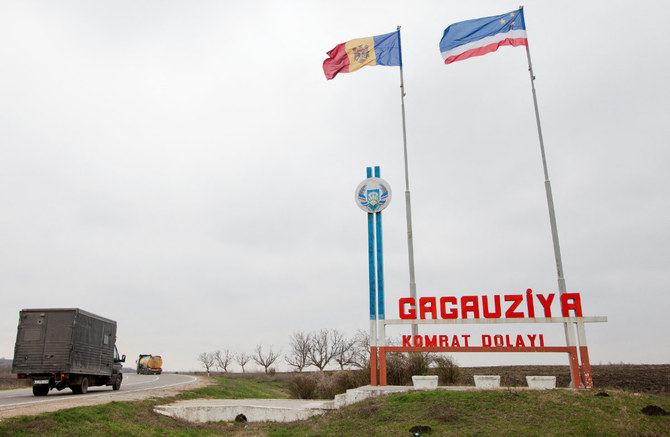
A sign informs motorists of entering the territory of the autonomous Moldovan province of Gagauzia. (REUTERS/File Photo)
Short Url
Updated 21 April 2024
Follow

Moldova faces new challenge from restive Gagauzia region

  • Gagauzia’s 140,000 residents, mainly ethnic Turks, have had uneasy relations with central authorities since Moldova threw off Soviet rule in 1991
  • President Maia Sandu has identified Russia as the biggest threat to her country and wants Moldova to join the European Union

CHISINAU: Moldova’s pro-European government faces a new challenge from its restive pro-Moscow Gagauzia region after its leaders denounced proposed judicial reforms and demanded enhanced status for the Russian language.
Gagauzia’s 140,000 residents, mainly ethnic Turks who adhere to Orthodox Christianity, have had uneasy relations with central authorities since Moldova threw off Soviet rule in 1991.
On Friday, Gagauzia’s local assembly rejected judicial reforms which would shut down an appeal court in the region and called for special status for Russian, alongside Moldova’s sole state language, Romanian.
Under Moldova’s constitution, Gagauzia’s leader, or bashkan, is automatically a member of the government in the country lying between Ukraine and Romania.
But President Maia Sandu refuses to sign an enabling decree on grounds that the current bashkan, Yevgenia Gutul, was elected on the ticket of a banned pro-Russian political party led by fugitive businessman Ilan Shor, convicted of mass fraud.


Moldovan President Maia Sandu. (Reuters)

Prime Minister Dorin Recean stood by the judicial reforms and said the courts would uproot what he called criminal elements running the region.
“The judicial system will do what it has to and bring to account all members of these groups,” he told a television interviewer on Friday evening. “There are absolutely no grounds for confrontation. Our goal is to build Europe.”
Sandu has identified Russia as the biggest threat to her country and called a referendum for later in the year on joining the European Union alongside a presidential election.
Gutul is deeply suspicious of the EU plan, accuses Sandu of victimizing her region and has made two trips to Russia in the past month and asked Kremlin leader Vladimir Putin for help.
Political analyst Vitalie Andrievschi said the region’s demands, including its call for improved status for the Russian language, were part of a campaign endorsed by the Kremlin — and Shor — to disrupt political activity in Moldova.
“They need this to stir things up in a year with a presidential election and referendum on the agenda in order to undermine stability and divide the country,” he told Reuters.


Philippines convicts journalist on terror charge called ‘absurd’

Updated 2 sec ago
Follow

Philippines convicts journalist on terror charge called ‘absurd’

  • Community journalist and radio broadcaster Frenchie Cumpio is the first Filipino journalist to be prosecuted under the terror financing laws
TACLOBAN, Philippines: A young Philippine journalist who spent nearly six years in a crowded provincial prison was found guilty of terror financing on Thursday in a case rights groups and a UN expert labelled a “travesty of justice.”
Community journalist and radio broadcaster Frenchie Cumpio, 26, is the first Filipino journalist to be prosecuted under the terror financing laws, which defense lawyer Julianne Agpalo said have become the government’s “weapon of choice” for silencing dissent.
Cumpio and former roommate Marielle Domequil broke down in tears and hugged each other as the guilty verdict was read and they were sentenced to up to 18 years in prison by judge Georgina Uy Perez of the Tacloban regional court.
The duo, who were both acquitted on a lesser weapons charge, will be eligible for parole in about 12 and a half years.
In a copy of the decision seen by AFP, the court said it was convinced by the testimony of former rebels who said the pair had provided the New People’s Army (NPA), a designated terrorist group, with cash, arms and fabric for clothing.
The Samar-Leyte region that is home to Tacloban is one of the last remaining operating areas of the Maoist insurgency.
Both Cumpio and her advocates have insisted she was a victim of “red-tagging,” in which the government links its critics to the communist forces to silence them.
Speaking outside the courthouse, lawyer Norberto Robel said his team would file an appeal.
“Despite this (ruling), there is still a legal remedy and pending application for bail,” he said.
The case has been closely monitored by human rights groups including Amal Clooney’s Clooney Foundation for Justice, which in October questioned the lengthy detainment, citing “repeated postponements and slow progress.”
UN Special Rapporteur Irene Khan had previously said the charges against Cumpio appeared to be “in retaliation for her work as a journalist.”
Cumpio and Domequil were arrested in February 2020 on weapons charges, accused of possessing a handgun and a grenade.
More than a year later, the terror financing charge, which carried a potential 40-year jail sentence, was added.
‘Absurd verdict’
On Thursday, Beh Lih Yi, Asia-Pacific director of the Committee to Protect Journalists (CPJ), condemned the court’s decision.
“This absurd verdict shows that the various pledges made by President Ferdinand Marcos Jr. to uphold press freedom are nothing but empty talk,” she said, adding it was the first time a journalist had been charged with financing terrorism in the Philippines.
“The ruling underscores the lengths that Philippine authorities are willing to go to silence critical reporting.”
Aleksandra Bielakowska, advocacy manager for Reporters Without Borders, said the verdict demonstrated a “blatant disregard for press freedom.”
“The Philippines should serve as an international example of protecting media freedom — not a perpetrator that red-tags, prosecutes and imprisons journalists simply for doing their work,” she said.
Prosecutors declined to speak with AFP outside the courthouse.
In September, more than 250 journalists and media groups called on President Marcos to release Cumpio, calling the charges “trumped up.”
Following an evening mass on Wednesday, Cumpio’s mother, Lala, told AFP that she visited her daughter in prison once each month, bringing her groceries, medication and chicken from Jollibee.
Bringing in the gravy and soft drinks that accompanied the fast food meals was prohibited by guards, she added.
“Of course, I’m worried,” Lala said of the looming decision. “My youngest keeps asking when his big sister will come home.”
She broke down in tears alongside her two sons outside the courthouse as the verdict was announced.