

IMF, World Bank steering committee stresses accountability as reforms advance

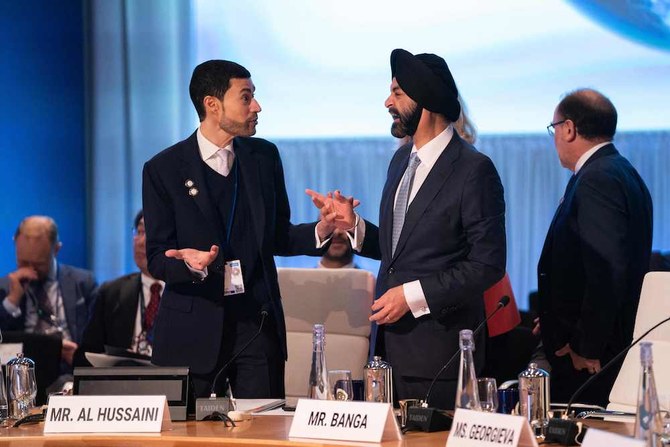
United Arab Emirates Finance Minister and chairman of the World Bank Development Committee Mohamed bin Hadi Al Hussaini speaks with World Bank Group President Ajay Banga during a meeting of the World Bank Development Committee during the IMF-World Bank Group spring meetings at World Bank headquarters in Washington DC. (AFP)
Short Url
Updated 20 April 2024
Follow

IMF, World Bank steering committee stresses accountability as reforms advance

  • Governors of the institutions urged the World Bank to continue to bolster global and regional partnerships

WASHINGTON DC: The steering committee for both International Monetary Fund and the World Bank on Saturday emphasized the need for broader accountability as the institutions implemented reforms to help countries grapple with climate change and other shocks.

“We must hold ourselves accountable more broadly as we become a better and bigger bank,” said Mohammed bin Hadi Al Husseini, the United Arab Emirates’ minister of state for finance, who heads the joint Development Committee this year.

Al-Husseini issued a chair’s statement, rather than a communique, amid disagreements over wars in the Middle East and Ukraine, but referenced economic risks posed by the conflicts. The statement came as this week’s meetings of the IMF and World Bank drew to a close.

Governors of the institutions urged the World Bank to continue to bolster global and regional partnerships, and asked its management to push ahead with country engagement reforms and enhanced country diagnostics.

They also encouraged further collaboration between the World Bank and IMF to help countries mobilize more revenues at home, and on issues such as climate change and pandemic preparedness, as well as debt sustainability.


Emerging markets should depend less on external funding, says Nigeria finance minister

Updated 10 February 2026
Follow

Emerging markets should depend less on external funding, says Nigeria finance minister

RIYADH: Developing economies must rely less on external financing as high global interest rates and geopolitical tensions continue to strain public finances, Nigeria’s finance minister told Al-Eqtisadiah.

Asked how Nigeria is responding to rising global interest rates and conflicts between major powers such as the US and China, Wale Edun said that current conditions require developing countries to rethink traditional financing models.

“I think what it means for countries like Nigeria, other African countries, and even other developing countries is that we have to rely less on others and more on our own resources, on our own devices,” he said on the sidelines of the AlUla Conference for Emerging Market Economies.

He added: “We have to trade more with each other, we have to cooperate and invest in each other.” 

Edun emphasized the importance of mobilizing domestic resources, particularly savings, to support investment and long-term economic development.

According to Edun, rising debt servicing costs are placing an increasing burden on developing economies, limiting their ability to fund growth and social programs.

“In an environment where developing countries as a whole — what we are paying in debt service, what we are paying in terms of interest costs and repayments of our debt — is more than we are receiving in what we call overseas development assistance, and it is more than even investments by wealthy countries in our economies,” he said.

Edun added that countries in the Global South are increasingly recognizing the need for deeper regional integration.

His comments reflect growing concern among developing nations that elevated borrowing costs and global instability are reshaping development finance, accelerating a shift toward domestic resource mobilization and stronger economic ties among emerging markets.