

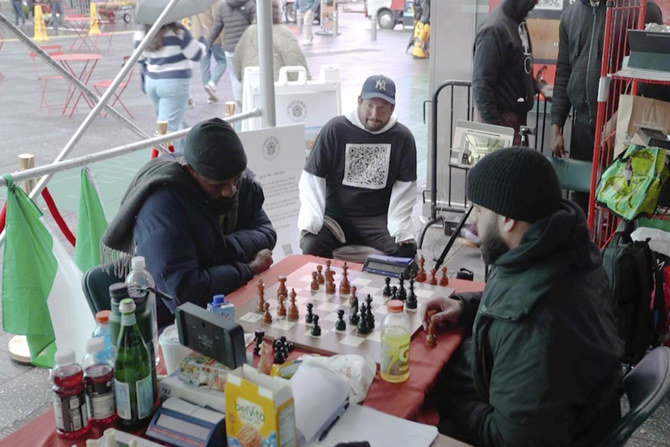
A Nigerian chess champion is trying to break the world record for the longest chess marathon

1 / 2
In this screen grab taken from video, Nigerian chess champion Tunde Onakoya, left, play a chess game in Times Square, New York, on April, 18, 2024. (AP)
2 / 2
Tunde Onakoya, a Nigerian chess champion and child education advocate, plays a chess game in Times Square on April 19, 2024 in New York. (AP Photo)
Short Url
Updated 20 April 2024
Follow

A Nigerian chess champion is trying to break the world record for the longest chess marathon

  • Tunde Onakoya, 29, is playing against Shawn Martinez, an American chess champion, in line with Guinness World Record
  • Onakoya, who founded Chess in Slums Africa, hopes to raise $1 million for children’s education across Africa

NEW YORK: A Nigerian chess champion and child education advocate is attempting to play chess nonstop for 58 hours in New York City’s Times Square to break the global record for the longest chess marathon.

Tunde Onakoya, 29, hopes to raise $1 million for children’s education across Africa. He is playing against Shawn Martinez, an American chess champion, in line with Guinness World Record guidelines that any attempt to break the record must be made by two players who would play continuously for the entire duration.
Onakoya had played chess for 42 hours by 10:00 a.m. GMT on Friday. Support is growing online and at the scene, where a blend of African music is keeping onlookers and supporters entertained amid cheers and applause.
The current chess marathon record is 56 hours, 9 minutes and 37 seconds, achieved in 2018 by Hallvard Haug Flatebø and Sjur Ferkingstad, both from Norway.
The record attempt is “for the dreams of millions of children across Africa without access to education,” said Onakoya, who founded Chess in Slums Africa in 2018. The organization wants to support education of at least 1 million children in slums across the continent.
“My energy is at 100 percent right now because my people are here supporting me with music,” Onakoya said Thursday evening after the players crossed the 24-hour mark.
On Onakoya’s menu: Lots of water and jollof rice, one of West Africa’s best known dishes.
For every hour of game played, Onakoya and his opponent get only five minutes’ break. The breaks are sometimes grouped together, and Onakoya uses them to catch up with Nigerians and New Yorkers cheering him on. He even joins in with their dancing sometimes.
A total of $22,000 was raised within the first 20 hours of the attempt, said Taiwo Adeyemi, Onakoya’s manager.
“The support has been overwhelming from Nigerians in the US, global leaders, celebrities and hundreds of passersby,” he said.
Onakoya’s attempt is closely followed in Nigeria where he regularly organizes chess competitions for young people living on the streets to boost his cause. More than 10 million children are out of school in the West African country — one of the world’s highest rates.
Among those who have publicly supported him are celebrities and public office holders, including Nigeria’s former Vice President Yemi Osinbajo, who wrote to Onakoya on X, formerly Twitter: “Remember your own powerful words: ‘It is possible to do great things from a small place.’“
The Guinness World Record organization has yet to publicly comment about Onakoya’s attempt, which could reach 58 hours by midnight on Friday. It sometimes takes weeks for the organization to confirm any new record.


In southeast Pakistan, Ramadan brings Hindus and Muslims closer

Updated 10 March 2026
Follow

In southeast Pakistan, Ramadan brings Hindus and Muslims closer

MITHI: Partab Shivani, a Hindu in Muslim-majority Pakistan, has fasted on and off during Ramadan for years, but this time is different as he practices abstinence for the entire holy month.
Every year, he and his friends in the southeastern city of Mithi arrange iftar, when Muslims break their daily fast, to foster peace and solidarity between the two religions.
“I believe we need to promote interfaith harmony. First, we are humans — religions came later,” Shivani, a 48-year-old social activist, told AFP, adding that he also reads the teachings of the Buddha.
“His message is about peace and ending war. Peace can spread through solidarity and by standing with one another. Distance only widens the gap between people,” he added.
Ninety-six percent of Pakistan’s 240 million people are Muslim. Just two percent are Hindu, most of them living in rural areas of Sindh province where Mithi is located.
In Mithi itself, most of the 60,000 inhabitants are Hindu.
Many of the city’s Hindus also observe Ramadan and iftar has become a social gathering where people from both faiths happily participate.
“This has been a wonderful tradition of ours for a very long time,” said Mir Muhammad Buledi, a 51-year-old Muslim friend who attended Shivani’s iftar gathering.
“It is a beautiful example of harmony between the two communities.”
Like brothers
Discrimination against minorities runs deep in Pakistan.
Following the end of British rule in South Asia in 1947, the subcontinent was partitioned into mainly Hindu India and Muslim-majority Pakistan.
That triggered widespread religious bloodshed in which hundreds of thousands were killed and millions displaced.
According to the Human Rights Commission of Pakistan, freedom of religion or belief is under constant threat, with religiously motivated violence and discrimination increasing yearly.
State authorities, often using religious unrest for political gain, have failed to address the crisis, the independent non-profit says.
But such tensions are absent in Mithi.
“I am a Hindu but I keep all the fasts during this month,” said Sushil Malani, a local politician. “I feel happy standing with my Muslim brothers.
“We celebrate Eid together as well. This tradition in the region is very old.”
Restaurants and tea stalls are closed across Pakistan during Ramadan.
Ramesh Kumar, a 52-year-old Hindu man who sells sweets and savoury items outside a Muslim shrine, keeps his push cart covered and closed until iftar.
“There is no discrimination among us if someone is Muslim or Hindu. I have been seeing this since my childhood that we all live together like brothers,” he said.
Muslim shrine, Hindu caretaker
Locals say Mithi’s peaceful religious coexistence can be traced to its remote location, emerging from the sand dunes of the Tharparkar desert, which borders the modern Indian state of Rajasthan.
Cows — considered sacred in Hinduism — roam freely in Mithi city, as they do in neighboring India.
At two Sufi Muslim shrines in the middle of the city, Hindu families arrange meals, bringing fruit, meals and juices for their Muslim neighbors to break their fasts.
“We respect Muslims,” said Mohan Lal Malhi, a Hindu caretaker of one of the shrines.
Mohan said his parents and elders taught him to respect people regardless of religion or color, and the traditions pass from one generation to the next.
Local residents said both communities consider their social relationships more important than their religious identity.
“You will see a (Sikh) gurdwara, a mosque, and a shrine standing side by side here,” Mohan said. “The atmosphere of this area teaches humanity.”