

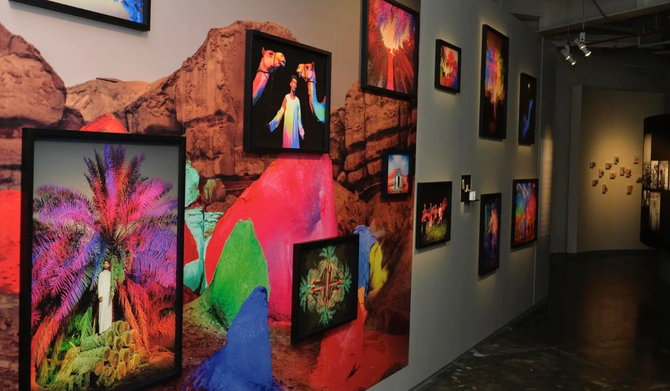
Art Jameel announces open call for Hayy Jameel Facade Commission

The commission encourages artists to consider the site-specific nature of the project and the technical requirements of a public work. (SPA)
Short Url
Updated 19 April 2024
Follow

Art Jameel announces open call for Hayy Jameel Facade Commission

  • Antonia Carver, director of Art Jameel, said: “At Art Jameel, we are committed to fostering the role of the arts in public life

JEDDAH: The Hayy Jameel Facade Commission is inviting new and established artists in Saudi Arabia to reimagine the facade of the Hayy Jameel art building in Jeddah.

In its fourth year and third open call process, the commission will select a winning artwork that serves as conversation starter between the complex, the community it serves and the broader public.

Antonia Carver, director of Art Jameel, said: “At Art Jameel, we are committed to fostering the role of the arts in public life.

“Through this annual commission which positions the facade as the first point of contact with the Hayy Jameel community, we are providing a platform that propels mid-career artists forward and challenges them to produce a large-scale, highly imaginative work that remains in-situ, front and center in Jeddah, for around 10 months.”

The commission encourages artists to consider the site-specific nature of the project and the technical requirements of a public work.

Sustainability considerations are also appreciated in managing the carbon footprint of the artwork and its installation.

Eligibility is open to all Saudi and Saudi-based artists and collectives, with at least one member required to be a Saudi citizen or resident if applying as a collective.

The commissioned artists will receive a work fee and a production budget managed by Art Jameel.

The jury, consisting of local and international art professionals, curators, artists and museum directors, will select a single work for production.

Applicants are required to submit a concept statement (200-500 words), up to four sketches and diagrams, and an estimated production schedule through the application portal.

The deadline for the facade submission has been extended to May 1, with the launch scheduled for October. Following the unveiling, there will be a public viewing period from October 2024 to September 2025.

Previous works displayed on the building have showcased the talent of artists such as Nasser Al-Mulhim, Tamara Kalo, Mohammad Al-Faraj and Dr. Zahrah Al-Ghamdi.


Report: Low light pollution in Northern Borders is ideal for astronomers

Updated 11 sec ago
Follow

Report: Low light pollution in Northern Borders is ideal for astronomers

  • Region has a vast desert horizon and few tall buildings
  • Rare meteorological event recently in Northern Borders

RIYADH: The Kingdom’s Northern Borders, characterized by significantly lower levels of light pollution, is a prime destination for astronomical observation, the Saudi Press Agency reported on Friday.

The SPA quoted from a recent report from the Visible Infrared Imaging Radiometer Suite which is circling in space.

The VIIRS is a whiskbroom scanner radiometer that collects imagery and radiometric measurements of land, atmosphere, cryosphere, and oceans in the visible and infrared bands of the electromagnetic spectrum.

This lower level of light pollution, according to the VIIRS, is found in the open areas surrounding Turaif, east of Rafha, and west of the city of Arar.

The Bortle Scale, which measures night-sky brightness, shows readings allowing the Milky Way to be seen with the naked eye on clear nights.

“The vast desert horizon and the scarcity of tall buildings contribute to improved astronomical observation conditions by minimizing ambient light and enhancing viewing quality,” the SPA reported.

“This allows celestial phenomena, such as meteor showers and planetary conjunctions, to be observed with greater precision.”

The report added: “Due to these factors, the region is an ideal destination for amateur astrophotographers and astrophysicists seeking a dark, expansive sky that enables them to observe celestial objects with greater clarity.”

Recently a striking astronomical and optical phenomenon was observed in the Northern Borders, as light pillars appeared in the sky, drawing the attention of locals and enthusiasts of natural phenomena.

A light pillar is an optical phenomenon that occurs in the atmosphere as a vertical column extending above or below its source. This effect is caused by the reflection of light on tiny ice crystals suspended in clouds or the air.

Abouazza El-Mhamdi, an associate professor in the physics and astronomy department at King Saud University, told Arab News at that it was a “rare meteorological event — the vibrant light pillars that illuminated the night sky, was crucial for astronomy and astro tourism in the region.”

“Although these pillars are common in Arctic climates like Canada or Russia, their appearance in the Northern Border region is a remarkable anomaly, highlighting the unique and intense winter conditions affecting the Kingdom’s northern reaches,” said El-Mhamdi.