

Ukraine seeks urgent G7, NATO help for battered air defenses

1 / 4
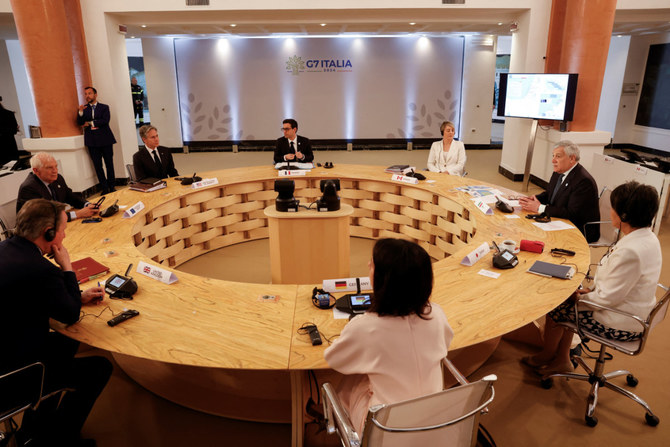
Foreign ministers of the Group of Seven (G7) nations gather on the second day of their meeting on Capri island, Italy, on April 18, 2024. (REUTERS/Pool)
2 / 4
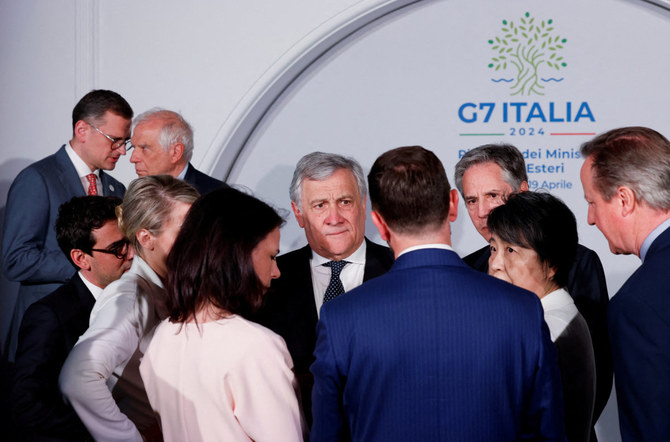
Foreign ministers of the Group of Seven (G7) nations gather on the second day of their meeting on Capri island, Italy, on April 18, 2024. (REUTERS/Pool)
3 / 4
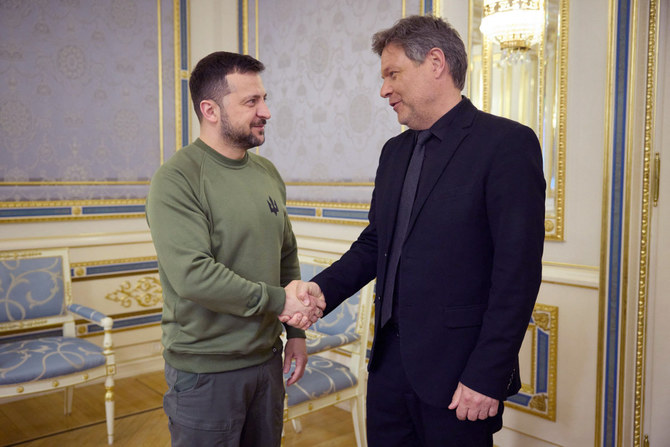
Ukraine's President Volodymyr Zelensky (L) meets with Germany's Vice Chancellor Robert Habeck in Kyiv on April 18, 2024. (Ukrainian Presidential Press Service handout photo/ AFP)
4 / 4
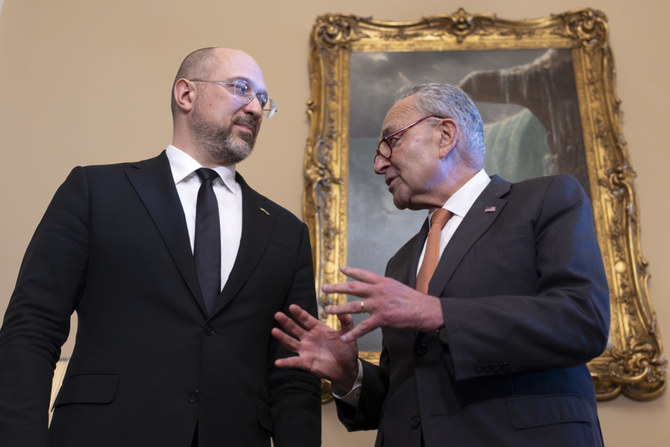
Ukraine's Prime Minister Denys Shmyhal, left, is welcomed by Senate Majority Leader Chuck Schumer at the Capitol in Washington, D.C., on April 18, 2024, as the US Congress moved to advance an emergency aid package for Ukraine Israel and Taiwan. (AP Photo)
Short Url
Updated 19 April 2024
Follow

Ukraine seeks urgent G7, NATO help for battered air defenses

  • NATO chief says working on a solution
  • UK seeks ‘creative’ deal on seized Russian assets

CAPRI, Italy: Ukraine warned foreign ministers from the Group of Seven (G7) major powers on Thursday they had to change strategy if they wanted Kyiv to withstand increasingly destructive Russian air assaults.

The G7 ministers meeting on the island of Capri acknowledged the need to get more air defense systems to Ukraine and applauded Ukrainian Foreign Minister Dmytro Kuleba as he joined them on the second day of their three-day gathering.
The G7, comprising Italy, Canada, France, Germany, Japan, Britain, the United States and European Union representatives, has been fiercely critical of Russia’s two-year long invasion of Ukraine.
However, military aid to Kyiv has slowed in recent months, with European partners apparently running low on ammunition and vital US funding blocked by Republicans in Congress.
Speaking to reporters as he arrived in Capri, Kuleba bemoaned the fact that while US, British and French forces had intervened on Saturday to help prevent Iranian missiles from hitting Israel, his own country lacked vital defenses.
“The strategy of our partners in Israel seems to be in preventing damage and death. ... In the last months, the strategy of our partners in Ukraine seems to be in helping (us) to recover from damage,” he said.
“So our job today is to find a way where our partners will design a mechanism, a way that will allow us also to avoid death and destruction in Ukraine.”
NATO Secretary General Jens Stoltenberg also took part in Thursday’s G7 meetings, telling reporters beforehand that the military alliance was actively seeking to send more air defense systems as quickly as possible.
“We are working at the possibility of (dispatching) more Patriot batteries to Ukraine. We are in dialogue with some specific countries,” he said.
In Washington, Ukrainian Prime Minister Denys Shmyhal told reporters that Ukraine had asked for additional air defense equipment and another Patriot missile battery, adding that Kyiv was looking for a minimum of seven Patriot systems.
Shmyhal declined to say how many Patriot systems Ukraine had currently, saying that was classified information.
He said US and White House officials had assured the Ukrainian delegation that weapons would be supplied in a matter of weeks, not months, once a $60.8 billion US aid package for Ukraine was approved by Congress.
“We hope it will take days, but not more than weeks,” he said.
Domestic political wrangling has delayed delivery of the US aid, but the US House of Representatives might finally get to vote on the package this weekend, bringing some hope to G7 ministers.

Looking to Washington
Germany has already said it would hand over one Patriot system. European Union foreign policy chief Josep Borrell urged other EU nations to do likewise to help stave off concerted Russian attacks on vital Ukrainian infrastructure.
“Otherwise the electricity system of Ukraine will be destroyed. And no country can fight without having electricity at home, in the factories, online, for everything,” he told reporters in Capri.
“In these turbulent times, it is a hopeful sign that there are now signals from the Republicans in the US that support for Ukraine can be continued intensively,” German Foreign Minister Annalena Baerbock told a news conference.
Another key issue under review is how to use profits from some $300 billion of sovereign Russian assets held in the West to help Ukraine, as European Union member states hesitate over concerns about the legality of such a move.
“It’s important we try and get agreement. ... That’s what we’re discussing here. I’m in no doubt we will find a way, but we’re going to have to be creative. We’ll have to be flexible,” said British Foreign Secretary David Cameron.
Shmyhal told reporters in Washington that he had detailed discussions with US and G7 officials about how to use the frozen Russian assets, and he expected some results on that front this year.
Kuleba said he hoped to get immediate pledges this week on the delivery of more Patriot and SAMP/T air defense systems and also new Western sanctions targeting Iran’s production of armed drones, which are being exported to Russia.
Hours later, the United States and Britain announced they would introduce new sanctions on Iran targeting its drone program in retaliation for the April 13 strike on Israel.
But some G7 ministers also urged Israel not to exacerbate an already tense situation with a major retaliation of its own.
“Our appeal is always for prudence and de-escalation,” said Italian Foreign Minister Antonio Tajani. “We hope that Israel’s response, which will probably come, will be a targeted response and not something that provokes escalation.”


UK pays Guantanamo detainee ‘substantial’ compensation over US torture questions

Updated 12 January 2026
Follow

UK pays Guantanamo detainee ‘substantial’ compensation over US torture questions

  • Abu Zubaydah has been held at Guantanamo Bay without charge for 20 years
  • British security services knew he was subjected to ‘enhanced interrogation’ but failed to raise concerns for 4 years

LONDON: A Saudi-born Palestinian being held without trial by the US has received a “substantial” compensation payment from the UK government, the BBC reported.

Abu Zubaydah has been imprisoned at Guantanamo Bay in Cuba for almost 20 years following his capture in Pakistan in 2002, and was subjected to “enhanced interrogation” techniques by the CIA.

He was accused of being a senior member of Al-Qaeda in the aftermath of the Sept. 11 terror attacks on the US. The allegations were later dropped but he remains in detention.

The compensation follows revelations that UK security services submitted questions to the US to be put to Abu Zubaydah by their US counterparts despite knowledge of his mistreatment.

He alleged that MI5 and MI6 had been “complicit” in torture, leading to a legal case and the subsequent compensation.

Dominic Grieve, the UK’s former attorney general, chaired a panel reviewing Abu Zubaydah’s case.

He described the compensation as “very unusual” but said the treatment of Abu Zubaydah had been “plainly” wrong, the BBC reported.

Grieve added that the security services had evidence that the “Americans were behaving in a way that should have given us cause for real concern,” and that “we (UK authorities) should have raised it with the US and, if necessary, closed down co-operation, but we failed to do that for a considerable period of time.”

Abu Zubaydah’s international legal counsel, Prof. Helen Duffy, said: “The compensation is important, it’s significant, but it’s insufficient.”

She added that more needs to be done to secure his release, stating: “These violations of his rights are not historic, they are ongoing.”

Duffy said Abu Zubaydah would continue to fight for his freedom, adding: “I am hopeful that the payment of the substantial sums will enable him to do that and to support himself when he’s in the outside world.”

He is one of 15 people still being held at Guantanamo, many without charge. Following his initial detention, he arrived at the prison camp having been the first person to be taken to a so-called CIA “black site.”

He spent time at six such locations, including in Lithuania and Poland, outside of US legal jurisdiction. 

Internal MI6 messages revealed that the “enhanced interrogation” techniques he was subjected to would have “broken” the resolve of an estimated 98 percent of US special forces members had they been subjected to them.

CIA officers later decided he would be permanently cut off from the outside world, with then-President George W. Bush publicly saying Abu Zubaydah had been “plotting and planning murder.”

However, the US has since withdrawn the allegations and no longer says he was a member of Al-Qaeda.

A report by the US Senate Select Committee on Intelligence said Abu Zubaydah had been waterboarded at least 83 times, was locked in a coffin-like box for extended periods, and had been regularly assaulted. Much of his treatment would be considered torture under UK law.

Despite knowledge of his treatment, it was four years before British security services raised concerns with their American counterparts, and their submission of questions within that period had “created a market” for the torture of detainees, Duffy said.

A 2018 report by the UK Parliament’s Intelligence and Security Committee was deeply critical of the behavior of MI5 and MI6 in relation to Abu Zubaydah. 

It also criticized conduct relating to Guantanamo detainee Khalid Sheikh Mohammed, widely regarded as a key architect of the Sept. 11 attacks, warning that the precedent set by Abu Zubaydah’s legal action could be used by Mohammed to bring a separate case against the UK.

MI5 and MI6 failed to comment on Abu Zubaydah’s case. Neither the UK government nor Mohammed’s legal team would comment on a possible case over his treatment.