

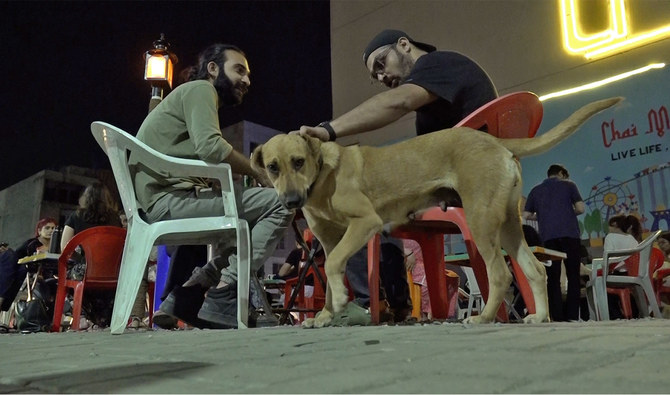

KARACHI: At a popular tea cafe in Karachi, customers sip piping hot cups of tea and chat with friends. An armed guard keeps watch for something suspicious, and with him, seven unlikely helpers: stray dogs adopted by the cafe owner.
This is the scene at Karachi’s popular tea cafe Chai Master, located in the city’s Defense Housing Authority neighborhood in a vacant plot. Pakistan’s financial hub has seen a surge in street crimes, with the Citizen Police Liaison Committee (CPLC) reporting 6,102 cases of mobile snatching from January to March 2024. Sixty persons who resisted street muggings were shot dead this year, according to police data.
The surge in street crimes in the metropolis has forced restaurants and tea cafes to hire armed guards for protection. Haris Ibrahim, Chai Master’s 33-year-old owner, did the same but found security guards were not enough for the job.
But an incident three years ago opened his eyes to a unique, yet more effective solution: stray dogs.
In 2021, a drug addict entered Chai Master premises and started harassing Ibrahim’s customers. While his security guard proved ineffective, a stray escorted the addict out of the place, much to everyone’s relief.
“I was like, wow, this is amazing. This is brilliant,” Ibrahim told Arab News. “This is better than having an armed, like gunmen, so then I was like, ‘Okay, you know what, I’m doubling down on the dogs’.”
Now, Chai Master has seven stray dogs: Tails, Spot, Speedy, Snoopy, Dozzer, Minnie, and Buddy. Ibrahim, an animal lover, has deployed all seven at the tea cafe as a security measure for his customers.
“I slowly started constructing this pack,” he explained, adding that all the dogs are neutered, spayed, vaccinated, and properly trained to perform their duties of keeping customers safe from muggers.
To train these strays, Ibrahim began with feeding them to build a bond.
“Once a bond was developed, I used the carrot and the stick method. Meaning I would reward for behavior I encourage. For that I would have dog treats lying around,” he said.
“Penalizing for undesired behavior, for which they would get a slap from me.”
For the dogs, Ibrahim said, the undesirable behavior meant barking at customers or fighting with each other.
But how do they keep the customers safe?
“Anybody who they think is catchy or could be a problem, they bark and it alerts us,” Ibrahim said. “It alerts my guard. It’s brilliant.”
Ibrahim likes to keep the dogs in their natural habitat, the streets, after he closes up. When Chai Master opens during the evenings, the strays return.
The customers are fond of the dogs too. Zahra Tafseer, an IT professional who refers to herself as a ‘cat person,’ has bonded over time with the dogs at Chai Master.
“Thanks to this place, and the dogs over here, I have sort of started to bond with dogs as well,” she told Arab News. “I’ve never found them to be scary.”
Mossa Khan, a 30-year-old who works at an advertisement agency, says he finds it comforting to be around animals at the cafe.
“So that’s the miraculous thing about animals, they can sense danger,” he said. “So, if there’s someone who’s out of place, somehow, they have a sixth sense, they know that something is off and they should be alerted.”
Ibrahim agreed, recounting an incident when the stray dogs raised alarm when a man tried to steal a side mirror from a car.
“The dogs are definitely to make this place safer for customers to feel safer,” he said.
Tafseer said the dogs were a “success story” of what one can achieve with a little bit of love.
“These dogs are the prime example of a success story, basically, of what can be achieved when you give the love and care to this species, because they’re a living thing,” she said.
Ibrahim says customers who throw stones at the dogs or act violently toward them are not welcome at his cafe.
“If you cannot respect another living creature, we do not want you as a customer,” he said.


