WASHINGTON: President Joe Biden on Wednesday misstated key details about his uncle’s death in World War II as he honored the man’s wartime service and said Donald Trump was unworthy of serving as commander in chief.
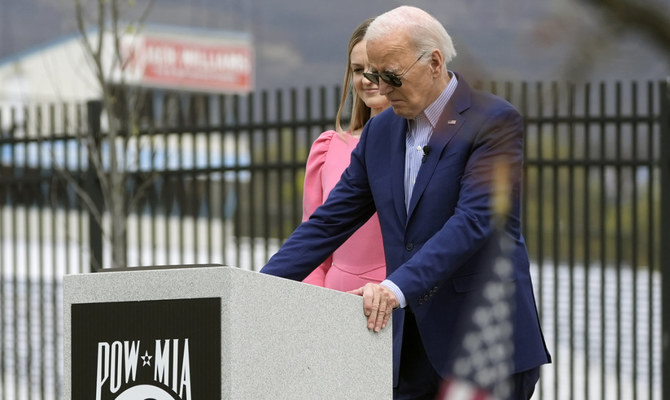
While in Pittsburgh, Biden spoke about his uncle, 2nd Lt. Ambrose J. Finnegan Jr., aiming to draw a contrast with reports that Trump, while president, had called fallen service members “suckers” and “losers.”
Finnegan, the brother of Biden’s mother, “got shot down in New Guinea,” Biden said. The president said Finnegan’s body was never recovered and “there used to be a lot of cannibals” in the area. Biden, who also relayed a version of the story earlier in the day after stopping by the memorial in Scranton, was off on the particulars.
The US government’s record of missing service members does not attribute Finnegan’s death to hostile action or indicate cannibals were any factor.
“We have a tradition in my family my grandfather started,” said Biden, a toddler at the time of his uncle’s death in 1944. “When you visit a gravesite of a family member — it’s going to sound strange to you — but you say three Hail Marys. And that’s what I was doing at the site.”
Referring to Trump, the presumptive GOP presidential nominee, Biden said, “That man doesn’t deserve to have been the commander in chief for my son, my uncle.”
Biden’s elder son, Beau, died in 2015 of brain cancer, which the president has stated he believes was linked to his son’s yearlong deployment in Iraq, where the military used burn pits to dispose of waste.
Some former Trump officials have claimed the then-president disparaged fallen service members as “suckers” and “losers” when, they said, he did not want to travel in 2018 to a cemetery for American war dead in France. Trump denied the allegation, saying, “What animal would say such a thing?”
According to the Pentagon’s Defense POW/MIA Accounting Agency, Biden’s uncle, known by the family as “Bosie,” died on May 14, 1944, while a passenger on an Army Air Forces plane that, “for unknown reasons,” was forced to ditch in the Pacific Ocean off the northern coast of New Guinea. “Both engines failed at low altitude, and the aircraft’s nose hit the water hard,” the agency states in its listing of Finnegan. “Three men failed to emerge from the sinking wreck and were lost in the crash.”
The agency said Finnegan was a passenger on the plane when it was lost. “He has not been associated with any remains recovered from the area after the war and is still unaccounted-for,” according to the agency.
White House spokesman Andrew Bates did not address the discrepancy between the agency’s records and Biden’s account when he issued a statement on the matter.
“President Biden is proud of his uncle’s service in uniform,” Bates said, adding Finnegan ”lost his life when the military aircraft he was on crashed in the Pacific after taking off near New Guinea.”
Biden “highlighted his uncle’s story as he made the case for honoring our ‘sacred commitment ... to equip those we send to war and take care of them and their families when they come home,’ and as he reiterated that the last thing American veterans are is ‘suckers’ or ‘losers.’”
The Democratic president also misstated when uncles enlisted in the military, saying they joined “when D-Day occurred, the next day,” in June 1944, when they actually joined weeks after the Dec. 7, 1941, attack on Pearl Harbor.
After Finnegan’s death, a local newspaper published a telegram from Gen. Douglas MacArthur expressing condolences to Finnegan’s family:
“Dear Mr. Finnegan: In the death of your son, Second Lt. Ambrose J. Finnegan Jr., while in service of his country, you have my profound sympathy. Your consolation may be that he died in the uniform of our beloved country, serving in a crusade from which a better world for all will come. Very faithfully, Douglas MacArthur.”
Biden, in his 2008 book “Promises to Keep,” made only brief mention of his uncle, describing him as flyer who was killed in New Guinea.


![]()

Biden is off on details of his uncle’s WWII death as he calls Trump unfit to lead the military
Short Url
https://arab.news/2g4a8
Biden is off on details of his uncle’s WWII death as he calls Trump unfit to lead the military
- The US government’s record of missing service members does not attribute Finnegan’s death to hostile action or indicate cannibals were any factor


Latest updates







© 2026 SAUDI RESEARCH & PUBLISHING COMPANY, All Rights Reserved And subject to Terms of Use Agreement.