

Qatar re-evaluating its role as mediator in Gaza ceasefire talks

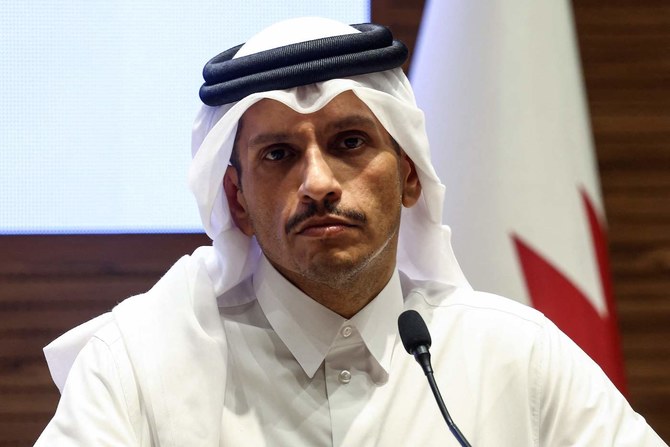
Qatar’s Prime Minister and Foreign Minister Sheikh Mohammed bin Abdulrahman Al-Thani in Doha on April 17, 2024. (AFP)
Short Url
Updated 17 April 2024
Follow

Qatar re-evaluating its role as mediator in Gaza ceasefire talks

  • Sheikh Mohammed underscored on Wednesday that the role of mediator has limits: “(Mediators) cannot provide things that the parties themselves refrain from (offering)”
  • Qatari PM said talks on Gaza ceasefire and a release of hostages were at a “delicate phase”

DOHA: Qatar is re-evaluating its role as mediator in ceasefire talks between Israel and Hamas, citing concerns that its efforts are being undermined by politicians seeking to score points, its prime minister said on Wednesday.
Qatari Prime Minister Sheikh Mohammed bin Abdulrahman Al Thani, who is also foreign minister, said there was a “misuse of this mediation for narrow political interests, and this necessitated Qatar to undertake a full evaluation of this role.”
Sheikh Mohammed did not identify any politicians by name.
Qatar’s embassy in Washington on Tuesday criticized comments made by US Democratic congressman Steny Hoyer, in which he called on the US to “reevaluate” its relationship with Qatar.
Hoyer said on Monday that Qatar must threaten Hamas with “repercussions” if the militant Palestinian group “continues to block progress toward releasing the hostages and establishing a temporary ceasefire.”
Some other US lawmakers have suggested in recent months that Qatar supports Hamas, an accusation rejected by the Gulf state, which hosts some 10,000 US troops, the largest US military presence in the Middle East.
Sheikh Mohammed underscored on Wednesday that the role of mediator has limits: “(Mediators) cannot provide things that the parties themselves refrain from (offering).”
Earlier on Wednesday Sheikh Mohammed said the talks on a Gaza ceasefire and a release of hostages were at a “delicate phase.”
“We are trying as much as possible to address this stumbling block,” he added, without giving further details.
Qatar’s premier also condemned what he described as a policy of “collective punishment” being pursued by Israel in its war in Gaza against Hamas as well as the latest escalation of violence in the Israeli-occupied West Bank.
The ceasefire discussions, mediated by Qatar and Egypt, are being held against the backdrop of a humanitarian disaster in Gaza, where Palestinians are suffering severe shortages of food, medicine and other essentials.
The war was triggered when Hamas attacked southern Israel from Gaza on Oct. 7, killing 1,200 people and taking 253 hostages into the enclave, according to Israeli tallies.
Israel has retaliated by pounding Gaza in an air and ground offensive which has killed almost 34,000 Palestinians, according to Gaza health authorities. 

The children in Israel’s prisons
Ongoing hostage-for-prisoners exchange opens the world’s eyes to arrests, interrogations, and even abuse of Palestinian children by Israeli authorities

Enter


keywords

UN-sanctioned migrant smuggler killed in western Libya

A boat used by migrants is seen near the western town of Sabratha, Libya March 19, 2019. (REUTERS)
Updated 4 sec ago
Follow

UN-sanctioned migrant smuggler killed in western Libya

  • In June 2018, the UN Security Council imposed sanctions on Al-Dabbashi, along with another five Libyan traffickers

CAIRO: A notorious militia leader in Libya, sanctioned by the UN for migrant trafficking across the Mediterranean Sea, was killed on Friday in a raid by security forces in the west of the country, according to Libyan authorities.
Ahmed Oumar Al-Fitouri Al-Dabbashi, nicknamed Ammu, was killed in the western city of Sabratha when security forces raided his hideout. The raid came in response to an attack on a security outpost by Al-Dabbashi’s militia, which left six members of the security forces severely wounded, according to a statement issued by the Security Threat Enforcement Agency, a security entity affiliated with Libya’s western government.
Al-Dabbashi, who was also sanctioned by the US Treasury for trafficking, was the leader of a powerful militia, the “Brigade of the Martyr Anas Al-Dabbashi,” in Sabratha, the biggest launching point in Libya for Europe-bound African migrants.
Al-Dabbashi’s brother Saleh Al-Dabbashi, another alleged trafficker, was arrested in the same raid, added the statement.
In June 2018, the UN Security Council imposed sanctions on Al-Dabbashi, along with another five Libyan traffickers. At the time, the UN report said that there was enough evidence that Al-Dabbashi’s militia controlled departure areas for migrants, camps, safe houses and boats.
Al-Dabbashi himself exposed migrants, including children, to “fatal circumstances” on land and at sea, and of threatening peace and stability in Libya and neighboring countries, according to the same report.
Al-Dabbashi was also sanctioned by the US Treasury for the same reason.
Libya has been a main transit point for migrants fleeing war and poverty in Africa and the Middle East. The country was plunged into chaos following a NATO-backed uprising that toppled and killed longtime autocrat Muammar Qaddafi in 2011.
The country has been fragmented for years between rival administrations based in the east and the west of Libya, each backed by various armed militias and foreign governments.