SYDNEY: The father of a boy accused of stabbing two Christian clerics in Australia saw no signs of his son’s extremism, a Muslim community leader said on Wednesday as police prepared to file charges against rioters who besieged a Sydney church demanding revenge.
The 16-year-old boy spoke in Arabic about the Prophet Muhammad after he stabbed Bishop Mar Mari Emmanuel and the Rev. Isaac Royel during a church service on Monday night that was being streamed online. Neither cleric sustained life-threatening injuries.
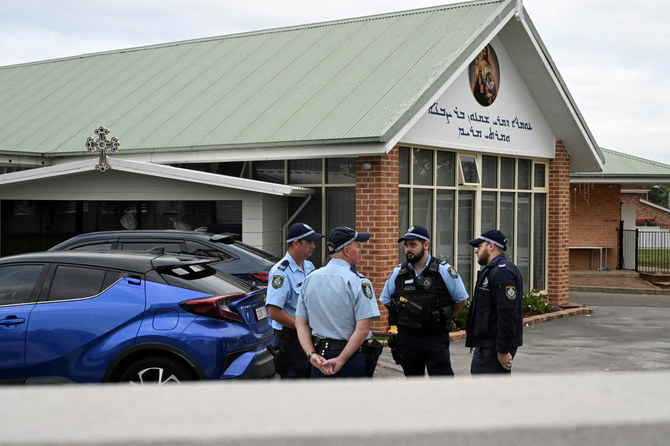
The Orthodox Assyrian congregation overpowered the boy and he remained in an undisclosed hospital on Wednesday under police guard. He sustained severe hand wounds in the struggle.
Lebanese Muslim Association secretary Gamel Kheir, an advocate for Sydney’s largest Muslim community, said he spent two hours with the boy’s distraught father at the family home soon after the attack. The family has since left their home for fear of retaliation.
“He was in shock,” Kheir told Australian Broadcasting Corp. of the father, who has not been identified.
“He was not aware of any signs of becoming more extreme other than the fact that he was becoming more disobedient to his father. But that was about it. He didn’t see any tell-tale signs, so to speak,” Kheir added.
Kheir is among several community leaders who have accused police of unnecessarily raising community tensions with a premature declaration on Tuesday that the attack at Christ the Good Shepherd Church fit the definition of a terrorist act under New South Wales state law.
“I’m concerned that we’ve rushed to a pre-judgment of a 16-year-old child,” Kheir said.
“He used the language of religion, we’re not debating that at all. In a sense that he targeted another religion, that’s not debatable,” Kheir said.
“What’s debatable is what mental state was this child in? Was he of a sane mind to even make such a rational call? All we’re saying is surely there was time for the police to do a more thorough investigation and a review before they labelled it a terrorist act,” Kheir added.
New South Wales Police Commissioner Karen Webb on Wednesday stood by her declaration of a terrorist incident as defined by the Terrorism (Police Powers) Act 2002.
The act gives police expanded powers to stop and search people, premises and vehicles without a warrant and to detain suspects in response to a terrorist attack or an imminent threat of an attack.
The church attack met the act’s criteria of having a political, religious or ideological motivation and was intended to cause intimidation, she said.
“I was satisfied based on the information that was provided very early Tuesday morning that it met that criteria and I made that declaration without any hesitation,” Webb said.
She said whether the boy would be charged with terrorism offenses was a separate consideration and would depend on the results of the police investigation.
According to media reports, the boy had been convicted in January of a range of offenses including possession of a switchblade knife, being armed with a weapon with an intention to commit an indictable offense, stalking, intimidation and damaging property. He was released from court on a good behavior bond.
Police are also investigating the conduct of 600 people who converged on the church on Monday night and demanded police hand over the boy, who was temporarily barricaded inside for his own safety.
The crowd hurled bricks, bottles and fence boards at police. Two police officers were hospitalized and several police vehicles were damaged.
Webb said police were attempting to identify perpetrators of crimes during the riot from various sources of video and from fingerprints left on police cars. She expected arrests to be made as early as Wednesday.
“Not all those people there were rioting against the police, but those people who were, they can expect to be identified and arrested and put before the courts,” Webb said.
The Lebanese Muslim Association runs Australia’s largest mosque in the Sydney suburb of Lakemba. Security has been elevated at that mosque and several others since Monday when fire bombing threats were made.
Security has also been increased at shopping malls around Australia after a lone assailant stabbed six people to death at Sydney’s Westfield Bondi Junction mall on Saturday. The rampage ended when the 40-year-old assailant, who had a history of mental illness and no apparent motive, was shot dead by police. No terror declaration was made in that case.
Westfield Bondi Junction will open its doors on Thursday for the first time since it was shut down on Saturday as a crime scene. Shops will remain closed for what is described as a “community reflection day.”
Elliott Rusanow, chief executive of Scenter Group, which owns the mall, said families of victims made private visits on Tuesday.
The church attack is only the third to be classified by Australian authorities as a terrorist act since 2018.
Two police officers and a bystander were shot dead in an ambush by three Christian fundamentalists near the community of Wieambilla in Queensland state in December 2022. The shooters were later killed by police.
In November 2018, a Somalia-born Muslim stabbed three pedestrians in a downtown Melbourne street, killing one, before police shot him dead.


![]()

Father of boy accused of stabbing 2 Sydney clerics saw no signs of extremism, Muslim leader says
Short Url
https://arab.news/j8zht
Father of boy accused of stabbing 2 Sydney clerics saw no signs of extremism, Muslim leader says


Latest updates


© 2026 SAUDI RESEARCH & PUBLISHING COMPANY, All Rights Reserved And subject to Terms of Use Agreement.