

Condolences from Pakistan as at least 66 killed in Afghanistan rains, flash floods

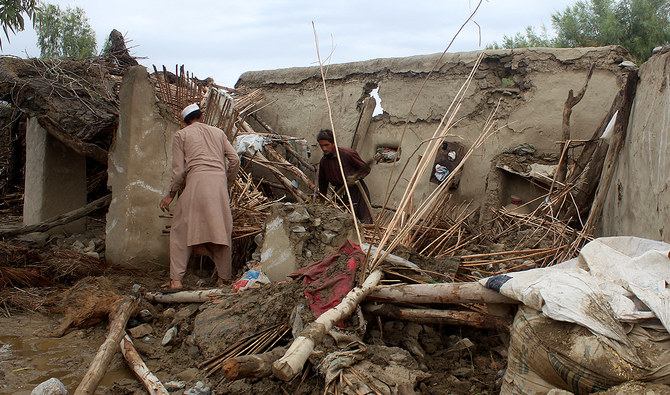
People remove debris of a damaged house following a flash flood in Gulgad village in Lal Pur district of Nangarhar province, Afghanistan, April 15, 2024. (REUTERS)
Short Url
Updated 17 April 2024
Follow

Condolences from Pakistan as at least 66 killed in Afghanistan rains, flash floods

  • Number of reported casualties has doubled since Sunday, many were killed when their homes collapsed 
  • Storms adding to challenges facing Afghanistan, still recovering from decades of conflict and natural disasters

ISLAMABAD: Pakistan on Tuesday offered condolences to neighboring Afghanistan as heavy rains and flash floods killed at least 66 people, damaged homes, infrastructure, and farmlands across provinces.

The storms, which started over the weekend, are adding to the challenges facing Afghanistan, which is still recovering from decades of conflict and natural disasters, including unprecedented droughts in the past four years, as well as a series of deadly earthquakes.

“The Government and people of Pakistan express deepest sympathies and condolences at the loss of precious lives and livelihoods and damage to properties caused by heavy rains and flash flooding in several provinces of Afghanistan,” the Pakistan foreign office said in a statement.

“We pray that the Almighty may grant patience and fortitude to the bereaved families to bear the irreparable loss and wish a swift recovery to the injured.”

Janan Sayeq, the spokesperson for the National Disaster Management Authority, told Arab News at least 66 people had been killed and 36 injured as per preliminary reports.

The number of reported casualties had doubled since Sunday, raising fears the actual toll could be higher. Many of the victims were killed when their homes collapsed on them.

Sayeq said 1,235 houses were destroyed.

Flash floods were reported in 23 of the country’s 34 provinces, damaging crops ahead of the harvest season, and badly hitting food security in the country as UN agencies estimate more than half of its population is in need of humanitarian assistance.

“The wheat crops will be ready for collection in a few weeks. But the rainfalls could destroy most of it,” said Gul Hussain, a farmer from the eastern Laghman province, which is one of the main agricultural regions.

The impact of drought, and now also floods, has been devastating for rural families struggling with access to water.

“The floods have had severe effects on the lives of people in the southeast, southwest and east of the country and have caused loss of life and damage to houses, as well as economic and agricultural effects as crops are destroyed and livestock are killed,” Najibullah Sadid, a hydromophologist, told Arab News.

The country’s mountainous topography and reduced vegetation are leaving little to no space for people to escape flood events, as preparedness and prevention in the face of the changing climate are almost nonexistent.

Water management infrastructure — such as check dams, trenches, terraces, and reservoirs that could help reduce flooding — is insufficient.

“For instance, Iran has 22 times more storage capacity and Pakistan 13 times more storage capacity than Afghanistan, making the country more vulnerable to floods during rainfalls,” Sadid said.

“Considering the increasing climate change effects as well as frequency and intensity of rainfalls, steps taken during the past two decades and now are limited and are not sufficient to control the situation.”


Islamabad steps up vehicle checks to boost security as 166,000 cars get electronic tags

Updated 4 sec ago
Follow

Islamabad steps up vehicle checks to boost security as 166,000 cars get electronic tags

  • Authorities say over 3,000 vehicles registered in past 24 hours as enforcement intensifies
  • Extended service hours introduced to push full compliance with digital monitoring system

ISLAMABAD: Authorities in the Pakistani capital have intensified enforcement against vehicles without mandatory electronic tags with more than 166,000 cars now registered, according to data released on Sunday evening, as Islamabad moves to strengthen security and digital monitoring at key entry and exit points.

The Islamabad Capital Territory (ICT) administration introduced the electronic tagging system late last year as part of a broader effort to regulate traffic, improve record-keeping and enhance surveillance in a city that hosts the country’s main government institutions, foreign missions and diplomatic enclaves.

Under the system, vehicles are fitted with electronic tags that can be read automatically by scanners installed at checkpoints across the capital, allowing authorities to identify unregistered vehicles without manual inspections. Vehicles already equipped with a motorway tag, or m-tag, are exempt from the requirement.

“A total of 166,888 vehicles have successfully been issued M-Tags so far, including 3,130 vehicles in the last 24 hours,” the ICT administration said, according to the Excise Department.

Officials said readers installed at checkpoints across Islamabad are fully operational and are being used to stop vehicles still without tags, as enforcement teams carry out checks across the city.

To facilitate compliance, authorities have expanded installation facilities and extended operating hours. The Excise Department said m-tag installation is currently available at 17 booth locations, while select centers have begun operating beyond normal working hours.

According to Director General Excise Irfan Memon, m-tag centers at 26 Number Chungi and 18 Meel are providing services round the clock, while counters at Kachnar Park and F-9 Park remain open until midnight to accommodate motorists unable to visit during daytime hours.

Officials said the combination of enforcement and facilitation was aimed at achieving full compliance with minimal disruption, adding that operations would continue until all vehicles operating in the capital are brought into the system.

The enforcement drive builds on a wider push by the federal government to integrate traffic management, emergency response and security monitoring through technology-driven “safe city” initiatives. Last month, Interior Minister Mohsin Naqvi reviewed Islamabad’s surveillance infrastructure and said reforms in monitoring systems and the effective use of technology were the “need of the hour.”

Authorities have urged motorists to obtain electronic tags promptly to avoid delays and penalties at checkpoints as enforcement continues across the capital.
