

Washington urges Pakistan to prioritize economic reforms amid push for new IMF bailout

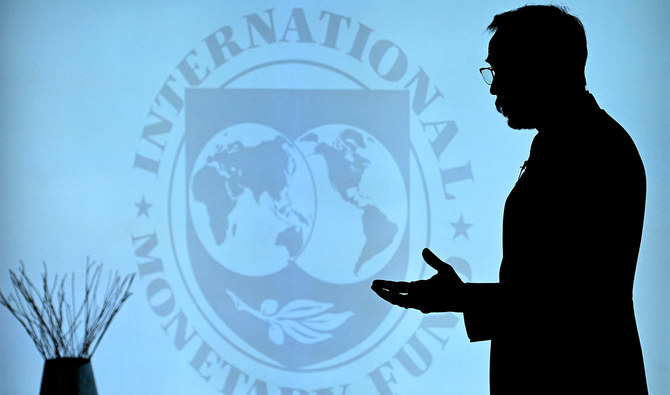
International Monetary Fund (IMF) Chief Economist Pierre Olivier Gourinchas speaks during an interview with AFP at the IMF headquarters in Washington, DC, on July 26, 2022. (AFP/File)
Short Url
Updated 17 April 2024
Follow

Washington urges Pakistan to prioritize economic reforms amid push for new IMF bailout

  • Pakistan is seeking at least a three-year multi-billion dollar loan package from IMF
  • US urges Pakistan and India to avoid escalation, find resolution through dialogue 

ISLAMABAD: The United States on Tuesday urged Pakistan to expand and prioritize economic reforms as Islamabad goes into negotiations for a new multi-year loan program from the International Monetary Fund. 

An ongoing nine-month, $3 billion IMF bailout designed to tackle a balance-of-payments crisis which brought Pakistan to the brink of default last summer will expire this month. Finance Minister Muhammad Aurangzeb, who is on a visit to Washington for spring meetings organized by the International Monetary Fund and World Bank, has said Pakistan will be seeking an at least three-year new program worth “billions” of dollars.

“Pakistan has made progress to stabilize its economy, and we support its efforts to manage its daunting debt burden,” State Department Spokesperson Matthew Miller said when asked about Pakistan going into negotiations with the IMF for a new loan deal.

“We encourage the government to prioritize and expand economic reforms to address its economic challenges. Our support for the country’s economic success is unwavering, and we will continue to engage with Pakistan through technical agreements, as well as through our trade and investment ties, all of which are priorities of our bilateral relationship.”

Speaking about remarks made by Indian Defense Minister Rajnath Singh that India would enter Pakistan to kill anyone who escapes over its border after trying to carry out militant attacks, Miller said:

“The United States is not going to get in the middle of this, but we do encourage both India and Pakistan to avoid escalation and find a resolution through dialogue.”

Singh’s comments earlier this month came after the Guardian newspaper published a report stating the Indian government had killed about 20 people in Pakistan since 2020 as part of a broader plan to target “terrorists residing on foreign soil.”

Relations between India and Pakistan have worsened since a 2019 suicide bombing of an Indian military convoy in Kashmir that New Delhi said was traced to Pakistan-based militants and which prompted it to carry out an airstrike on what it said was a militant base in Pakistan. Islamabad denies state complicity in the suicide bombing or that India hit militant targets in Pakistan. 

Pakistan said earlier this year it had credible evidence linking Indian agents to the killing of two of its citizens on its soil. This week Pakistan said investigations had suggested India was behind the death of a Pakistani man suspected of killing alleged Indian spy Sarabjit Singh in 2013.

Canada and the United States last year accused India of killing or attempting to kill people in those countries.

Canada said in September that it was pursuing “credible allegations” linking India to the death of a Sikh separatist leader shot dead in June — claims that India said were “absurd and motivated.” 

The US similarly said in November that it had thwarted an Indian plot to kill a Sikh separatist leader and announced charges against a person it said had worked with India to orchestrate the attempted murder. 

Prime Minister Narendra Modi has said India will investigate any information it receives on the matter.


Pakistan announces four-day work week among austerity measures to offset impact of Middle East crisis

Updated 5 sec ago
Follow

Pakistan announces four-day work week among austerity measures to offset impact of Middle East crisis

  • The development comes as ongoing US-Israeli strikes on Iran disrupt oil supplies in Strait of Hormuz, push prices past $119 a barrel
  • Islamabad bans government purchases, cuts fuel allocation for vehicles as well as workforce in public and private offices by 50 percent

ISLAMABAD: Prime Minister Shehbaz Sharif on Monday announced austerity measures, including a four-day work week and cuts in government expenditures, to offset the impact of rising global oil prices due to an ongoing conflict in the Middle East.

Global fuel supply lines have been disrupted in the Strait of Hormuz, which supplies nearly a fourth of world oil consumption, after Tehran blocked it following United States-Israeli strikes on Iran and counterattacks against US interests in the Gulf region.

Oil prices surged more than 25 percent globally on Monday to $119.50 a barrel, the highest levels since mid-2022, as some major producers cut supplies and fears of prolonged shipping disruptions gripped the market due to the expanding US-Israeli war with Iran.

In his televised address on Sunday night, Sharif said global oil prices were expected to rise again in the coming days but vowed not to let the people bear their brunt, announcing austerity measures to lessen the impact of fuel price hikes.

“Fifty percent staff in public and private entities will work from home,” he announced, adding this would not be applicable to essential services. “Offices will remain open for four days a week. One-day additional off is being given to conserve oil, but it would not be applicable to banks.”

Sharif didn’t specify working days of the week and the government was likely to issue a notification in this regard.

He said a decrease of 50 percent was being made in fuel allocation for government vehicles immediately for the next two months, but they would not include ambulances and public buses.

“Cabinet members, advisers and special assistants will not draw salaries for the next two months, 25 percent salaries of parliamentarians are being deducted, two-day salaries of Grade 20 and above officers, or those who are paid Rs300,000 ($1,067) a month, are being deducted for public relief,” he said.

Similarly, there will be 20 percent reduction in public department expenses and a complete ban on the purchase of cars, furniture, air conditioners and other goods, according to the prime minister.

Foreign trips of ministers and other government officials will also be banned along with government dinners and iftar buffets, while teleconferences and online meetings will be given priority.

Sharif’s comments were aired hours after Pakistani authorities said the country had “comfortable levels” of petroleum stocks and the supply chains were functioning smoothly, despite intensifying Middle East conflict.

Petroleum Minister Ali Pervaiz Malik said three oil shipments were due to reach Pakistan this week, state media reported.

Meanwhile, Pakistan Navy (PN) launched ‘Operation Muhafiz-ul-Bahr’ to safeguard national energy shipments, the Pakistani military said on Monday, amid disruptions to critical sea lanes due to the conflict.

The navy is conducting escort operations in close coordination with the Pakistan National Shipping Corporation (PNSC), according to the Inter-Services Public Relations (ISPR), the military’s media wing. It is fully cognizant of the prevailing maritime situation and is actively monitoring and controlling the movement of merchant vessels to ensure their safe and secure transit.

“With approximately 90 percent of Pakistan’s trade conducted via sea, the operation aims to ensure that vital sea routes remain safe, secure, and uninterrupted,” the ISPR said on Monday. “Currently, PN ships are escorting 2 x Merchant Vessels, one of which is scheduled to arrive Karachi today.”