KARACHI: Finance Minister Muhammad Aurangzeb highlighted key economic reforms undertaken by Islamabad and the potential for investment in the South Asian country, in his meetings with representatives of the World Bank and other international financial institutions in Washington on Tuesday, the finance ministry said.
Aurangzeb arrived in Washington on Sunday to participate in spring meetings organized by the IMF and World Bank. His tour is an important one for the South Asian country as an ongoing nine-month, $3 billion loan program with the IMF designed to tackle a balance-of-payments crisis, is set to expire this month.
With the final $1.1 billion tranche of that deal likely to be approved later this month, Pakistan has begun negotiations for a new multi-year IMF loan program worth “billions” of dollars, according to the finance ministry.
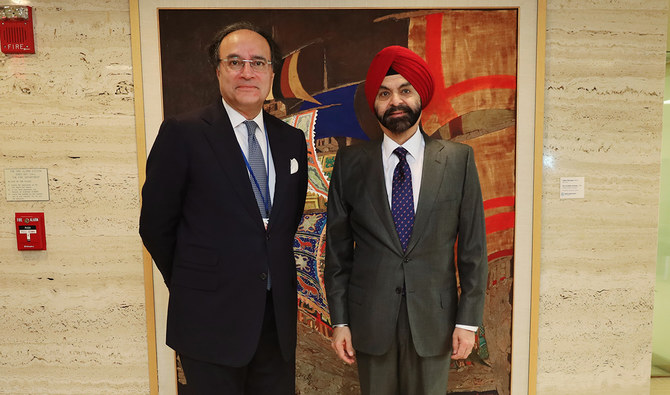
“The minister highlighted Pakistan’s progress under the 9-month [Stand-by Arrangement] SBA program and ongoing reforms in priority areas of taxation, energy and privatization,” the Pakistani finance ministry said in a statement after Aurangzeb met Ajay Banga, the president of the World Bank Group, on Tuesday.
“Both sides agreed on the need for a rolling Country Framework Plan for 10 years.”
The statement said the World Bank president assured his “full support” for Pakistan’s reforms and digitalization programs to stabilize the economy and enhance revenues.
In an interview on Monday, Aurangzeb had said Pakistan would seek at least a three-year IMF program and plans to continue with necessary policy reforms to rein in deficits, build up reserves and manage soaring debt servicing.
Aurangzeb also separately met Masatsugu Asakawa, the president of the Asian Development Bank (ADB) in Washington on Tuesday.
“Discussions focused on further strengthening Pakistan’s partnership with ADB, protecting country envelope of concessional financing and future project pipeline,” the finance ministry said.
Aurangzeb met Hela Cheikhrouhou, the regional vice president for MCT at the International Finance Corporation (IFC) to brief her on the government’s structural reform agenda on taxation, privatization and energy.
“He encouraged IFC to scale up its engagement and work with Pakistan in the priority areas of securitization of remittances, mining, airport management and capacity building,” the statement said.
The Pakistani finance minister also met Scott Nathan, CEO of the US International Development Finance Corporation (DFC).
“The Minister highlighted the government’s commitment to attract investments across various sectors in Pakistan, including priority areas of agriculture, IT, extractive industry and renewable energy,” the finance ministry said.
He hoped the DFC would expand its portfolio in Pakistan following the resolution of outstanding issues and tap “significant investment opportunities” by leveraging private sector investments and public-private partnerships, the statement added.
The Pakistani minister separately met Saudi Arabia’s Finance Minister Mohammed Al-Jadaan during which he appreciated the Kingdom for its “steadfast financial support” to Pakistan as it faces an economic crisis.
“Both sides exchanged views on deepening economic and investment relations between the two countries,” the finance ministry said. “They also explored new avenues for collaboration to further strengthen trade and investment ties in diverse areas.”
Aurangzeb then attended the G-24 Finance Ministers and Central Bank Governors’ Meeting on the sidelines of the Spring meetings in Washington D.C. and participated in discussions centered around sustainable economic growth and financial stability.
“The Minister highlighted that the government undertook difficult but necessary reforms to move the economy in the right direction,” the statement said.
Aurangzeb was referring to several IMF-mandated reforms Pakistan implemented after its loan program was approved by the international lender. These included budget adjustments, increasing interest rates, and higher energy prices.
Aurangzeb also separately met Turkish Finance Minister Mehmet Şimşek during which the Pakistani minister acknowledged that the current bilateral trade between Pakistan and Türkiye “is not commensurate with existing potential.”
“Both sides agreed on the need to deepen cooperation by giving a fresh impetus to bilateral trade and investment and benefit from Turkiye’s experience in power generation and distribution,” the statement added.


![]()

Reforms on top of agenda as Pakistan finance chief meets global financial institutions’ representatives
Short Url
https://arab.news/mctmf
Reforms on top of agenda as Pakistan finance chief meets global financial institutions’ representatives
- Finance minister is in Washington for spring meetings organized by IMF, World Bank
- Aurangzeb meets World Bank president, finance ministers of Saudi Arabia and Turkiye
Latest updates




© 2026 SAUDI RESEARCH & PUBLISHING COMPANY, All Rights Reserved And subject to Terms of Use Agreement.