

Hosts Qatar defeat Indonesia as 2024 AFC U-23 Asian Cup begins

1 / 3
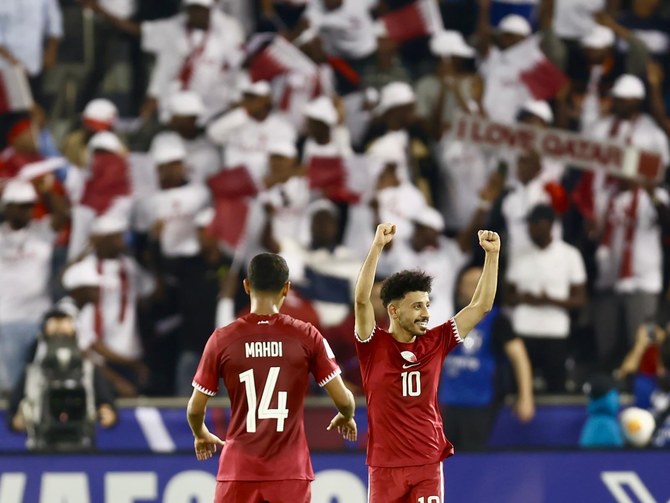
With Qatar controversially beating nine-man Indonesia 2-0 (X:@QSL_EN)
2 / 3
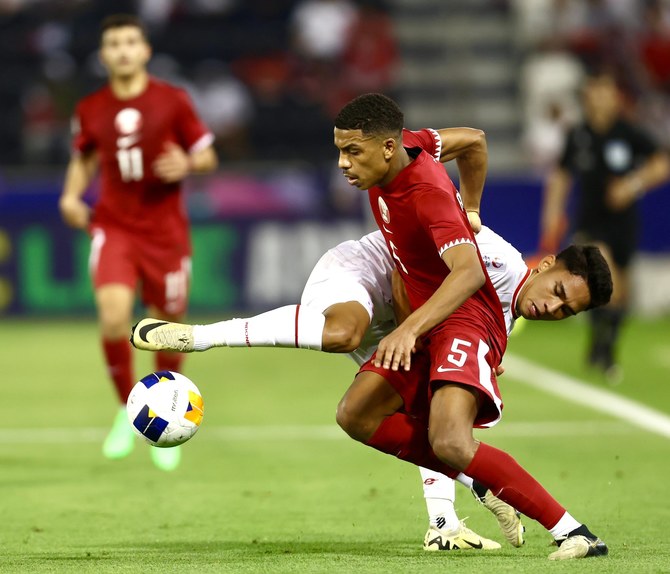
With Qatar controversially beating nine-man Indonesia 2-0 (X:@QSL_EN)
3 / 3
With Qatar controversially beating nine-man Indonesia 2-0 (X:@QSL_EN)
Short Url
Updated 17 April 2024
Follow

Hosts Qatar defeat Indonesia as 2024 AFC U-23 Asian Cup begins

  • Saudi Arabia kick off their campaign on Tuesday night, facing Tajikistan
  • The tournament provides a path to the 2024 Olympic Games

DOHA: The 2024 AFC U-23 Asian Cup kicked off on Monday with hosts Qatar controversially beating nine-man Indonesia 2-0. Australia and Jordan drew 0-0 earlier in the tournament opener.

The event, which runs until May 3, also acts as a route to the men’s football competition at the 2024 Olympic Games, which take place in Paris this summer.

Qatar took the lead just before half-time at Jassim Bin Hamad Stadium, with VAR intervening to award a penalty that Tajik referee Nasrullo Kabirov had missed. Khalid Ali Sabah duly converted from the spot.

Indonesia’s task became significantly harder after the break when Ivar Jenner was sent off for a second bookable offence. Qatar doubled their lead just seven minutes later with an excellent long-range free kick from Ahmed Al-Rawi.

The visitors’ misery was complete when, deep into stoppage time, Ramadhan Sananta received a straight red card.

In the competition opener, Australia played out a stalemate with Jordan — who saw Danial Afaneh sent off after 82 minutes — at Abdullah Bin Khalifa Stadium.

The results leave Qatar at the top of Group A with three points. Australia and Jordan lie joint second with a point apiece, while Indonesia are bottom of the table on zero.

Tuesday will see Japan take on China and South Korea face the UAE in Group B, while Group C action begins with Iraq v Thailand before Saudi Arabia take on Tajikistan.

The Green Falcons will then face Thailand on April 19 and Iraq on April 22.

The 2024 AFC U-23 Asian Cup sees 16 nations split into four groups of four with the top two from each progressing to the quarterfinals.

The winners of both semifinals secure automatic qualification to the Olympic Games, regardless of which team wins the final.

The two losing semifinalists will contest third place, with the winners also booking their spot in Paris. The fourth-place finishers have one final chance by taking part in a play-off against an African qualifier.


UAE National MMA Championship 1 launches new MMA season in Al-Ain

Updated 12 sec ago
Follow

UAE National MMA Championship 1 launches new MMA season in Al-Ain

  • Mohammed Bin Dalmouj Al-Dhaheri: The strong preparation by clubs and academies shows how much mixed martial arts has grown in the UAE
  • Al-Dhaheri: Teams now take part with clear training plans and ongoing development programs

AL-AIN: The UAE Jiu-Jitsu and Mixed Martial Arts Federation’s season-opener, the UAE National MMA Championship 1, is set to take place at the UAE University in Al-Ain from Jan. 10-11.

With hundreds of athletes across various age groups taking part, the championship is part of the Federation’s wider plan to strengthen the long-term development of MMA in the country, building on past achievements and supporting athletes’ technical and mental preparation.

The competition will feature Youth D (10–11 years), Youth C (12–13 years), Youth B (14–15 years), Youth A (16–17 years), and Adults (18 years and above), offering the chance for all age groups to take part.

Mohammed Bin Dalmouj Al-Dhaheri, UAE Jiu-Jitsu and Mixed Martial Arts Federation board member, said: “We want the first championship of the new season to be a strong platform that reflects our strategy, especially in identifying talent, developing athletes and building future champions. We have clear goals for 2026 to develop mixed martial arts further, and this championship is the first step towards achieving them.

“The strong preparation by clubs and academies shows how much mixed martial arts has grown in the UAE. Teams now take part with clear training plans and ongoing development programs. This is reflected in the higher quality of competition, the range of fighting styles and the dedication shown by athletes, which increases the championship’s value and strengthens its role in developing talent.”