

Pakistani charities say donations for Palestine have surpassed local causes since Oct. 7

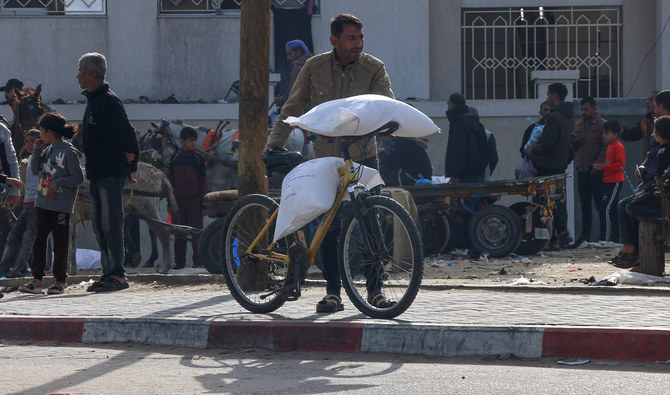
Palestinians receive bags of flour at the United Nations Relief and Works Agency for Palestine Refugees (UNRWA) distribution center in the Rafah refugee camp in the southern Gaza Strip on November 21, 2023, (AFP/File)
Short Url
Updated 16 April 2024
Follow

Pakistani charities say donations for Palestine have surpassed local causes since Oct. 7

  • Al-Khidmat Foundation says donations for Palestine have increased by about 60 percent
  • Baitussalam Welfare Trust also confirms its donations were now more for Palestinians 

KARACHI: Major Pakistani charities have said this week they have received more donations for humanitarian aid to Palestine than for charitable causes at home since the beginning of Israel’s war on Gaza on Oct. 7.

The ongoing Israeli air strikes and ground offensive have killed more than 33,000 Palestinians with tens of thousands more wounded, and many feared still trapped under the rubble of destroyed buildings and infrastructure. The majority of Gaza’s 2.3 million people have been displaced and international aid agencies and concerned nations have warned famine is imminent.

As the human toll of the war continues to rise, Pakistani charities say people in Pakistan have “overwhelmingly” supported their efforts to provide aid to Gazans. 

“The people are now contributing more for Palestine than the local cause as the flow of donations has increased by about 55-60 percent for the people of Palestine,” Syed Waqas Jafri, secretary-general of the Al-Khidmat Foundation Pakistan, one of Pakistan’s largest charities, told Arab News.

The Al-Khidmat Foundation Pakistan, which has an international footprint, distributes food stamps, runs orphanages, and does rehabilitation work during natural disasters in Pakistan.

Since Oct. 7, the organization, which was already working in Palestine through local and international partners, has expedited its efforts to collect donations and send humanitarian aid for the people of Palestine, Jafri said.

“As soon as we came to know that there is a humanitarian crisis on a large scale and the space we had in a given situation was only for food and medicine, so we worked with Pakistan’s NDMA (National Disaster Management Authority) and Pakistan Air Force to send aid,” Jafri said.

“There have been five chartered flights and the sixth one is via a vessel which has 20 containers containing 300 tons of goods. So these six consignments have gone from Pakistan. The value of the goods sent to Palestine is about Rs1.6 billion ($5.7 million).”
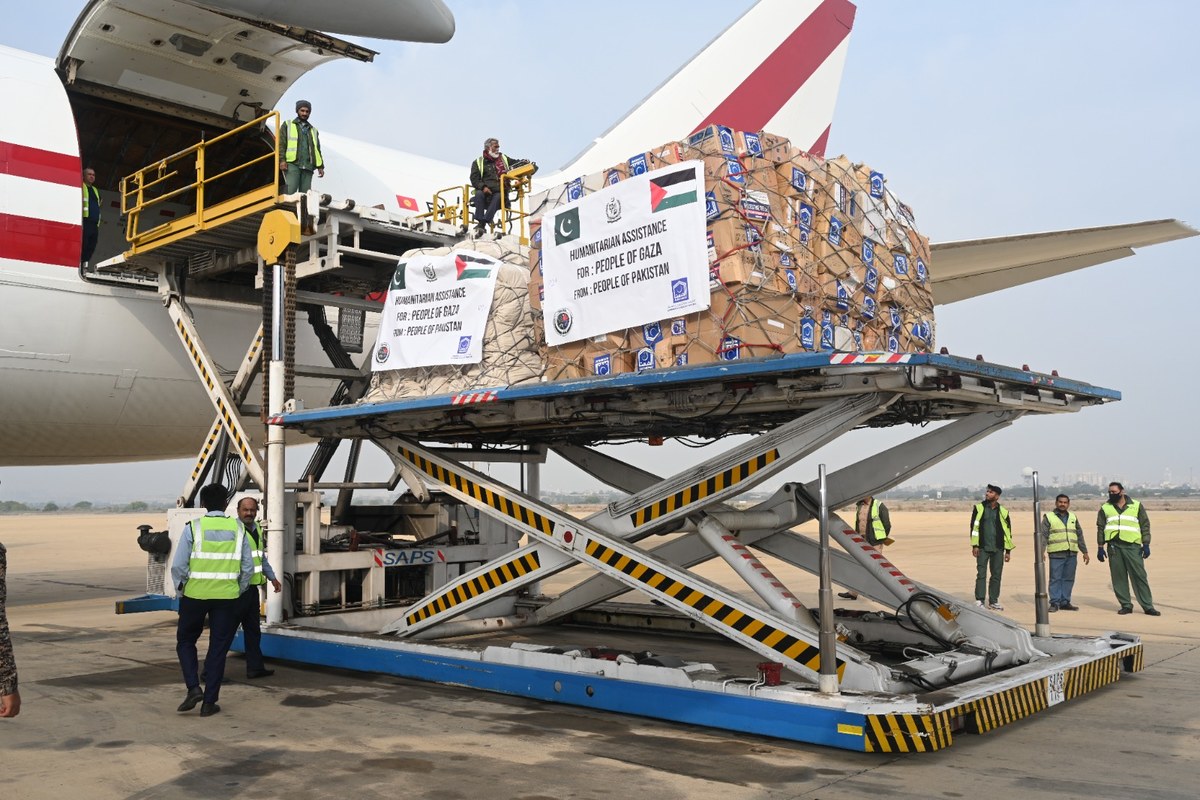


The picture shared on February 6, 2024, shows Pakistani authorities loading boxes of humanitarian aid onto a plane in Islamabad, Pakistan, for the people of Palestine. (NDMA)

The organization has rented warehouses in Cairo and is now purchasing goods from the local market for delivery to the besieged Palestinian territory, Jafri said, adding that the need for tents had multiplied as roughly 90 percent of Gaza had been rendered inhabitable by the Israeli military actions.

The Baitussalam Welfare Trust (BWT), another non-profit organization working to provide relief to Palestinian refugees, confirmed donation inflows to the charity were now more for Palestine.

“The flow of donation is about 50-60 percent for Palestine while the number of donors has also increased in recent months,” Huzaifa Rafique, a BWT spokesman, told Arab News on Monday.

The BWT is operating in Palestine in coordination with Turkish government organizations and providing health care, education and emergency relief, Rafique said. 

“The Baitussalam Welfare Trust is operating bread plants, taking care of orphans, and providing ready food to the people in affected areas,” Rafique said.

BWT also distributed cash among Palestinian children during the Eid Al-Fitr holiday last week.

Saylani Welfare International, another large Pakistani charity, also said donations were coming in for Palestine, while people were also supporting local projects.

“The flow of funds for Palestine is about 5-10 percent, while the rest of the donations are coming for local projects,” Muhammad Ghazzal, SWI chief operating officer, told Arab News, adding that his organization had so far dispatched goods worth Rs200 million for the people of Palestine.

Ghazzal said the SWI was working with Turkish and Pakistani government entities, including the NDMA, to dispatch aid via Egypt and Turkiye.

“The goods dispatched to Palestine included food, medicine and tents,” he added.


Tens of thousands flee northwest Pakistan over fears of military operation

Updated 28 January 2026
Follow

Tens of thousands flee northwest Pakistan over fears of military operation

  • More than 70,000 people, mostly women and children, have fled remote Tirah region bordering Afghanistan 
  • Government says no military operation underway or planned in Tirah, a town in Khyber Pakhtunkhwa province

BARA, Pakistan: More than 70,000 people, mostly women and children, have fled a remote region in northwestern Pakistan bordering Afghanistan over uncertainty of a military operation against the Pakistani Taliban, residents and officials said Tuesday.

Pakistan’s Defense Minister Khawaja Mohammad Asif has denied the claim by residents and provincial authorities. He said no military operation was underway or planned in Tirah, a town in Khyber Pakhtunkhwa province.

Speaking at a news conference in Islamabad, he said harsh weather, rather than military action, was driving the migration. His comments came weeks after residents started fleeing Tirah over fears of a possible army operation.

The exodus began a month after mosque loudspeakers urged residents to leave Tirah by Jan. 23 to avoid potential fighting. Last August, Pakistan launched a military operation against Pakistani Taliban in the Bajau r district in the northwest, displacing hundreds of thousands of people.

Shafi Jan, a spokesman for the provincial government in Khyber Pakhtunkhwa, posted on X that he held the federal government responsible for the ordeal of the displaced people, saying authorities in Islamabad were retracting their earlier position about the military operation.

Khyber Pakhtunkhwa Chief Minister Suhail Afridi, whose party is led by imprisoned former Prime Minister Imran Khan, has criticized the military and said his government will not allow troops to launch a full-scale operation in Tirah.

The military says it will continue intelligence-based operations against Pakistani Taliban, who are known as Tehrik-e-Taliban Pakistan, or TTP. Though a separate group, it has been emboldened since the Afghan

Taliban returned to power in 2021. Authorities say many TTP leaders and fighters have found sanctuary in Afghanistan and that hundreds of them have crossed into Tirah, often using residents as human shields when militant hideouts are raided.

Caught in the middle are the residents of Tirah, who continued arriving in Bara.

So far, local authorities have registered roughly 10,000 families — about 70,000 people — from Tirah, which has a population of around 150,000, said Talha Rafiq Alam, a local government administrator overseeing the relief effort. He said the registration deadline, originally set for Jan. 23, has been extended to Feb. 5.

He said the displaced would be able to return once the law-and-order situation improves.

Among those arriving in Bara and nearby towns was 35-year-old Zar Badshah, who said he left with his wife and four children after the authorities ordered an evacuation. He said mortar shells had exploded in villages in recent weeks, killing a woman and wounding four children in his village. “Community elders told us to leave. They instructed us to evacuate to safer places,” he said.

At a government school in Bara, hundreds of displaced lined up outside registration centers, waiting to be enrolled to receive government assistance. Many complained the process was slow.

Narendra Singh, 27, said members of the minority Sikh community also fled Tirah after food shortages worsened, exacerbated by heavy snowfall and uncertain security.

“There was a severe shortage of food items in Tirah, and that forced us to leave,” he said.

Tirah gained national attention in September, after an explosion at a compound allegedly used to store bomb-making materials killed at least 24 people. Authorities said most of the dead were militants linked to the TTP, though local leaders disputed that account, saying civilians, including women and children, were among the dead.