

Pakistan raises petroleum prices citing ‘increasing trend’ in international market

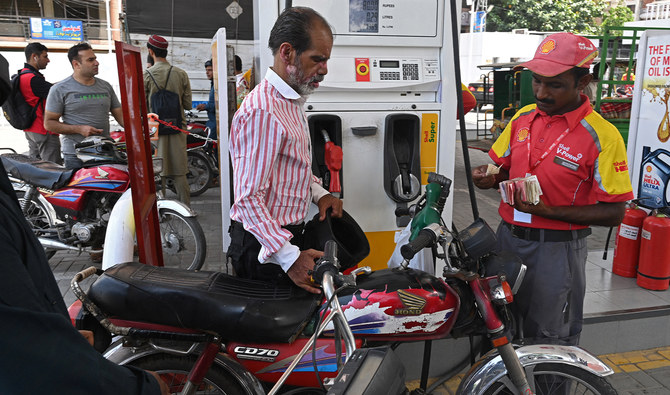
An employee fills petrol in a motorcycle at a fuel station in Lahore on August 1, 2023. (AFP/File)
Short Url
Updated 16 April 2024
Follow

Pakistan raises petroleum prices citing ‘increasing trend’ in international market

  • Pakistan has increased the prices of petrol by 4.53 rupees ($0.016) to 293.94 rupees
  • Government also increases price of high speed diesel by 8.14 rupees to 290.38 rupees

KARACHI: Pakistan has increased the price of petrol by 4.53 rupees ($0.016) to 293.94 rupees with effect from today, Tuesday, the finance ministry said in a statement, citing rising petroleum prices internationally. 

The government also increased the price of high speed diesel by 8.14 rupees to 290.38 rupees, the post said.

The price hikes come as Pakistan has initiated discussions with the IMF over a new multi-billion-dollar loan agreement as its current nine-month, $3 billion loan program expires with the disbursement of a final $1.1 billion tranche likely to be approved later this month.

Reforms linked to that bailout, including an easing of import restrictions and a demand that subsidies be removed, fueled record inflation, with the rupee hitting all-time lows. Authorities also raised petrol and diesel prices to record highs to meet conditionalities. 

“The prices of Petroleum products have seen an increasing trend in the international market during the last fortnight,” the finance ministry said as it announced the new prices. 

“The Oil & Gas Regulatory Authority (OGRA) has worked out the consumer prices, based on the price variations in the international market.”

Under the last IMF bailout, Pakistan was told to prevent further accumulation of circular debt in its power sector, arising from subsidies and unpaid bills. For a new program, the South Asian nation will need to implement reforms to reduce costs by improving electricity transmission and distribution, moving captive power into the grid, improving governance, and combating theft. 

It will also have to maintain power and gas tariffs at levels that ensure cost recovery, with adjustments made to safeguard the financially vulnerable, through existing progressive tariff structures.

In a report released in January, the IMF noted Pakistan missed its target for power sector arrears, largely due to lower-than-expected recoveries and tariffs.


Pakistan, ADB sign $730 loan agreements to boost SOE reforms, energy infrastructure

Updated 25 December 2025
Follow

Pakistan, ADB sign $730 loan agreements to boost SOE reforms, energy infrastructure

  • Both sign $330 million Power Transmission Strengthening Project and $400 million SOE Transformation Program loan agreements
  • Economic Affairs Division official says Transmission Project will secure Pakistan’s energy future by strengthening national grid’s backbone

KARACHI: Pakistan and the Asian Development Bank (ADB) on Thursday signed two loan agreements totaling $730 million to boost reforms in state-owned enterprises (SOEs) and energy infrastructure in the country, the bank said.

The first of the two agreements pertains to the SOE Transformation Program worth $400 million while the second loan, worth $330 million, is for a Power Transmission Strengthening Project, the lender said. 

The agreements were signed by ADB Country Director for Pakistan Emma Fan and Pakistan’s Secretary of Economic Affairs Division Humair Karim. 

“The agreements demonstrate ADB’s enduring commitment to supporting sustainable and inclusive economic growth in Pakistan,” the ADB said. 

Pakistan’s SOEs have incurred losses worth billions of dollars over the years due to financial mismanagement and corruption. These entities, including the country’s national airline Pakistan International Airlines, which was sold to a private group this week, have relied on subsequent government bailouts over the years to operate.

The ADB approved the $400 million loan for SOE reforms on Dec. 12. It said the program seeks to improve governance and optimize the performance of Pakistan’s commercial SOEs. 

Karim highlighted that the Power Transmission Strengthening Project will enable reliable evacuation of 2,300 MW from Pakistan’s upcoming hydropower projects, relieve overloading of existing transmission lines and enhance resilience under contingency conditions, the Press Information Department (PID) said. 

“The Secretary emphasized that both initiatives are transformative in nature as the Transmission Project will secure Pakistan’s energy future by strengthening the backbone of the national grid whereas the SOE Program will enhance transparency, efficiency and sustainability of state-owned enterprises nationwide,” the PID said. 

The ADB has supported reforms by Pakistan to strengthen its public finance and social protection systems. It has also undertaken programs in the country to help with post-flood reconstruction, improve food security and social and human capital. 

To date, ADB says it has committed 764 public sector loans, grants and technical assistance totaling $43.4 billion to Pakistan.