Gaza’s historic treasures saved by ‘irony of history’

1 / 5
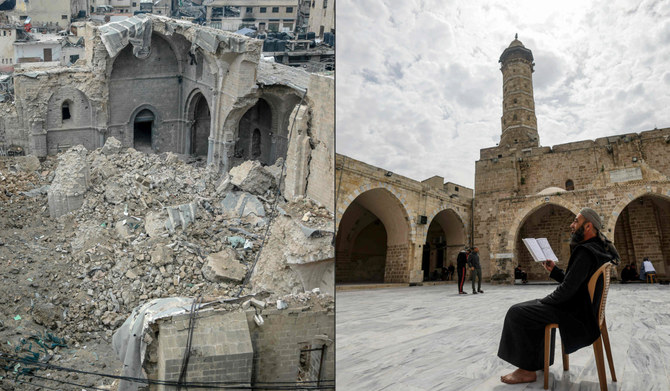
This combination of pictures created on January 11, 2024, shows Gaza City's Omari Mosque on January 5, 2024, the oldest mosque in Gaza, damaged in Israeli bombardment during the ongoing battles between Israel and the Palestinian Hamas movement(L) and a file picture of a Palestinian man reading the Koran in the courtyard of the same mosque on the first day of the Muslim holy month of Ramadan on March 23, 2023. (AFP)
2 / 5
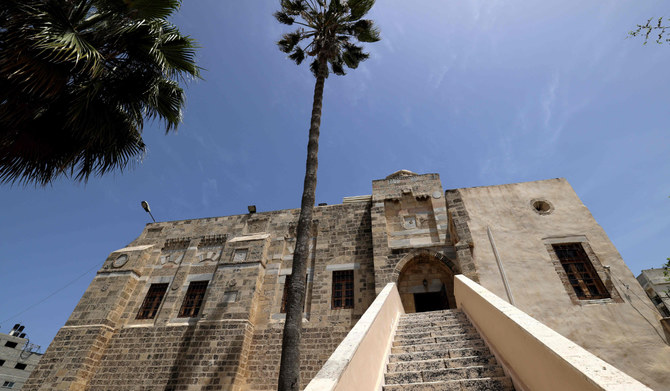
This picture taken on April 21, 2021 shows an exterior view of Qasr al-Basha in Gaza City, where Napoleon Bonaparte slept for several nights during his campaign in Egypt and Palestine. (AFP)
3 / 5
A picture taken on January 5, 2024 shows Gaza City's 17th century Qasr al-Basha or the Pasha's Palace, also known as Radwan dynasty castle, which houses a museum and a girls'school, damaged in Israeli bombardment during the ongoing battles between Israel and the Palestinian Hamas movement. (AFP)
4 / 5
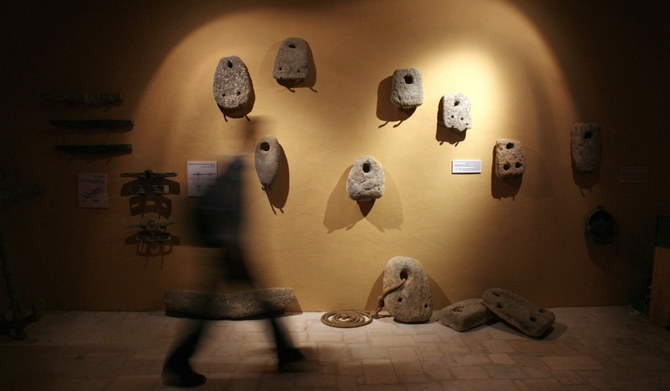
Artifacts are on display in the first ever National Museum of Archaeology in Gaza opend recently by Jawdat Khoudary, a Palestinian businessman and collector, on July 28, 2008. (AFP)
5 / 5
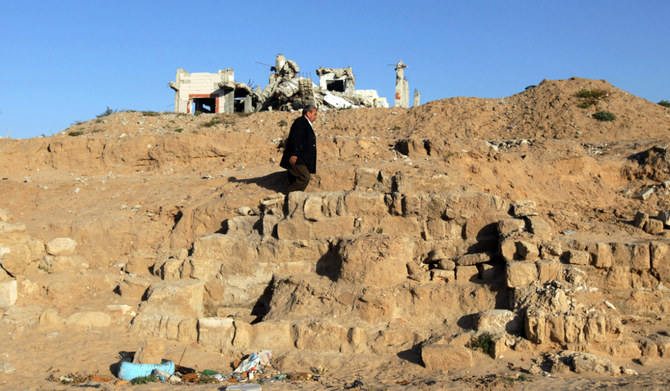
A Palestinian worker inspects the ancient archaeological site of Anthedon Harbour, also know as "al-Blakhiyah", which is located next to a training site for Hamas military, in Gaza City on April 25, 2013. (AFP)
Short Url
Updated 16 April 2024
Follow

Gaza’s historic treasures saved by ‘irony of history’

  • Israel has killed more than 33,797 Palestinians in Gaza, mostly women and children, according to the health ministry in the Hamas-run territory
  • A Palestinian worker inspects the ancient archaeological site of Anthedon Harbour, also know as "al-Blakhiyah", which is located next to a training site for Hamas military, in Gaza City on April 25, 2013

JERUSALEM: Gaza’s ancient Greek site of Anthedon has been bombed, its “Napoleon’s Palace” destroyed and the only private museum burned down: the war has taken a terrible toll on the rich heritage of the Palestinian territory.
But in a strange twist of fate, some of its greatest historical treasures are safe in a warehouse in Switzerland.
And ironically, it is all thanks to the blockade that made life in the Gaza Strip such a struggle for the past 16 years.
Based on satellite images, the UN cultural organization reckons some 41 historic sites have been damaged since Israel began pounding the besieged territory after the October 7 Hamas attack.
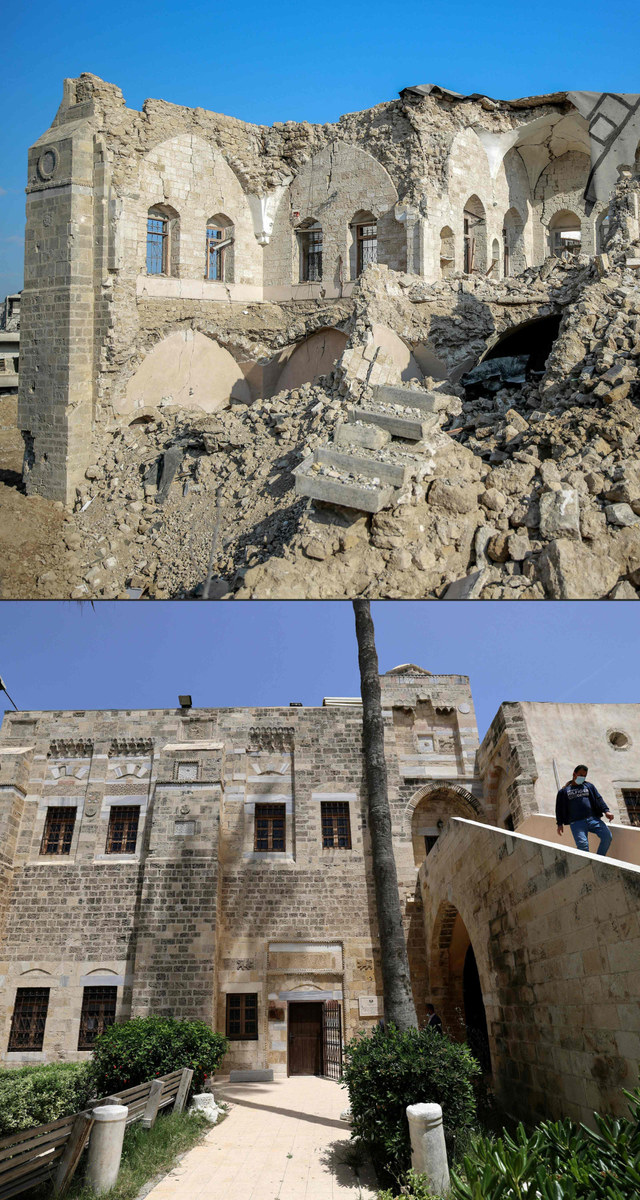


This combination of pictures created on January 11, 2024, shows a file picture of the 17th century Qasr al-Basha in Gaza City on April 21, 2021, where Napoleon Bonaparte slept for several nights during his campaign in Egypt and Palestine (bottom), and the same building severely damaged in Israeli bombardment during the ongoing battles between Israel and the Palestinians. (AFP)

On the ground, Palestinian archaeologist Fadel Al-Otol keeps tabs on the destruction in real time.
When he has electricity and Internet access, photos pour into a WhatsApp group he set up with 40 or so young peers he mobilized to watch over the territory’s vast array of ancient sites and monuments.
As a teenager in the 1990s, Otol was hired by European archaeological missions before going on to study in Switzerland and at the Louvre Museum in Paris.
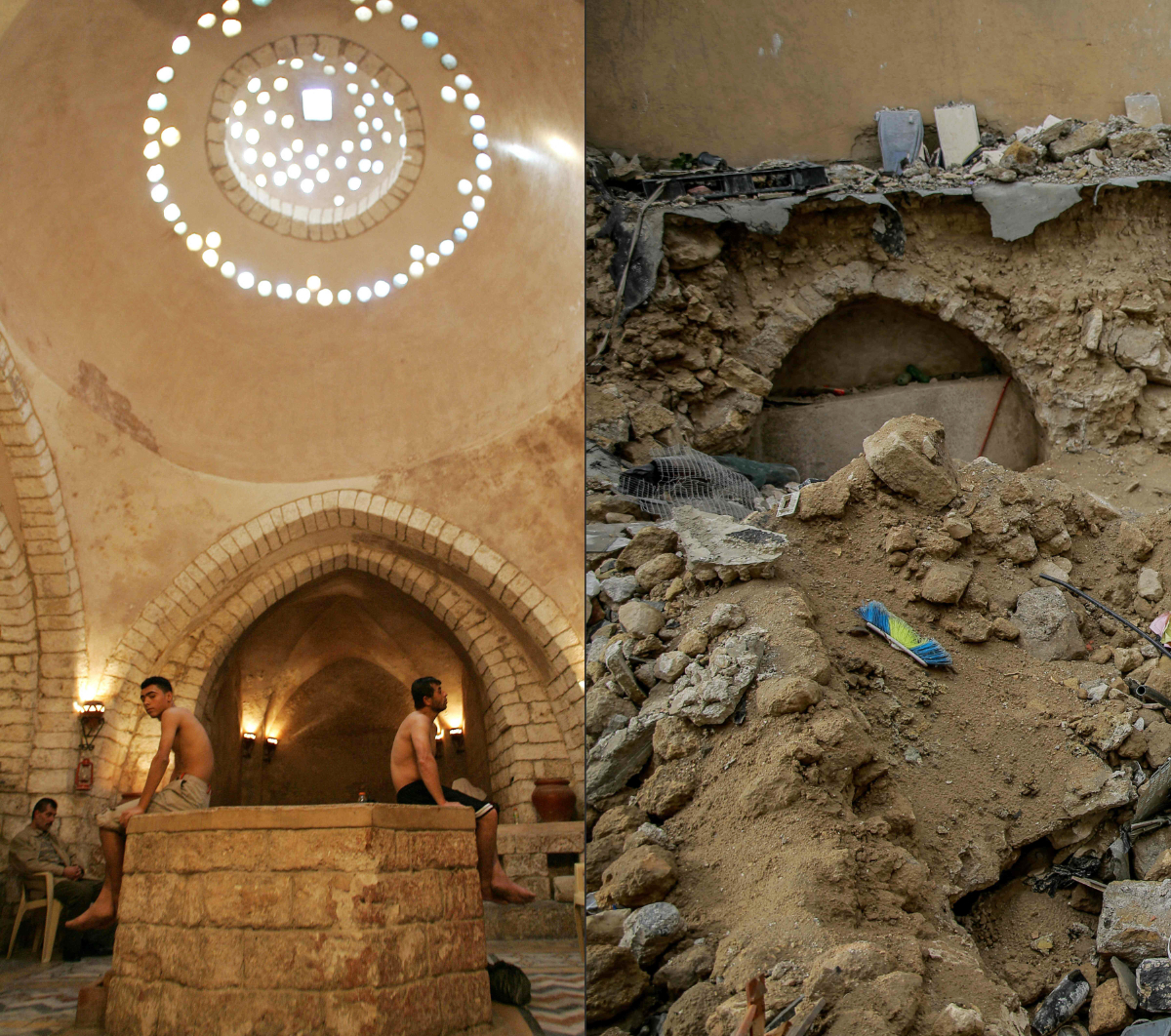


This combination of pictures shows one taken on January 5, 2024 of Gaza City's historic Hammam Al-Samra, which used to be the only active traditional Turkish bath remaining in Gaza, located in the Zeitun quarter of the old city before it was destroyed in Israeli bombardment during the ongoing battles between Israel and the Palestinian Hamas movement and another one (L) dating back to December 4, 2005 with Palestinian youths relaxing in the same steam bath. (AFP)

“All the archaeological remains in the north have been hit,” he told AFP by phone from Gaza.
The human toll since the October 7 Hamas attack has been chilling.
A total of 1,170 people were killed in the unprecedented raid on Israel, according to an AFP tally of Israeli official figures.
Almost 34,000 have died in Gaza in unrelenting Israeli retaliation, according to the territory’s health ministry.
The damage to Gaza’s history has also been immense.
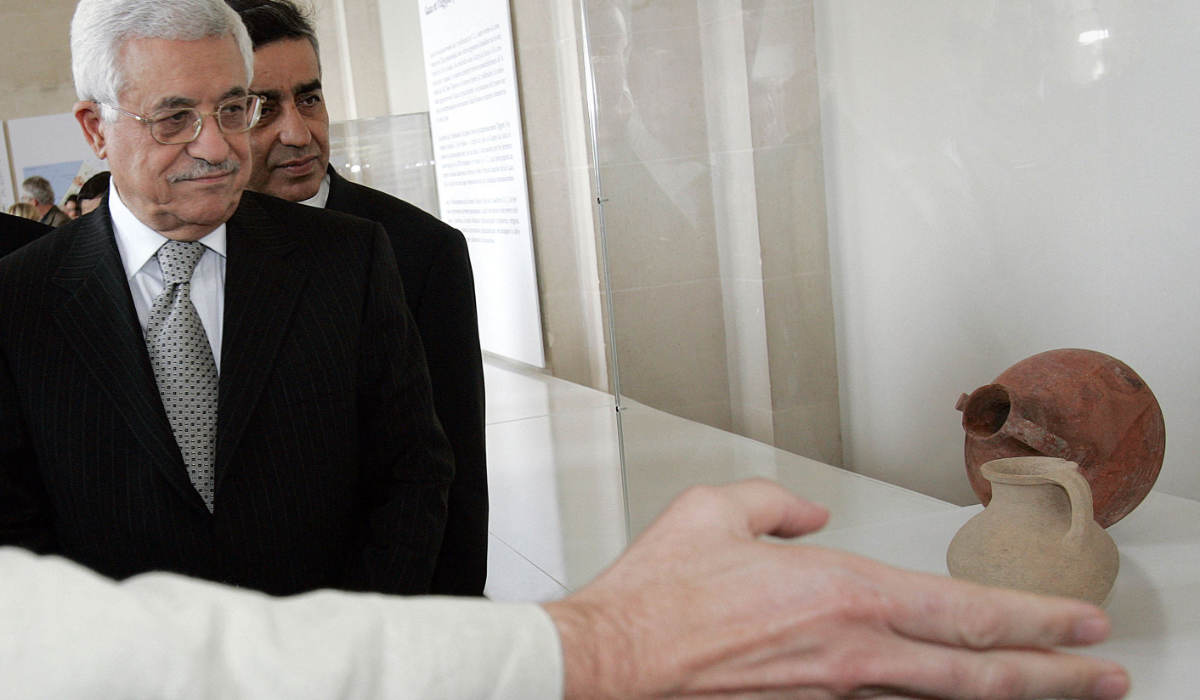


Palestinian President Mahmud Abbas views pottery specimens during his visit to the exhibition "Gaza, at the crossroad of civilizations" at the Art and History Museum in Geneva on April 26, 2007. (AFP)

“Blakhiya (the ancient Greek city of Anthedon) was directly bombed. There’s a huge hole,” said Otol.
He said part of the site, near a Hamas barracks where “we hadn’t started excavating,” was hit.
The 13th-century Al-Basha palace in Gaza City’s old town “has been completely destroyed. There was bombing and (then) it was bulldozed.
“It held hundreds of ancient objects and magnificent sarcophagi,” Otol added as he shared recent photos of the ruins.
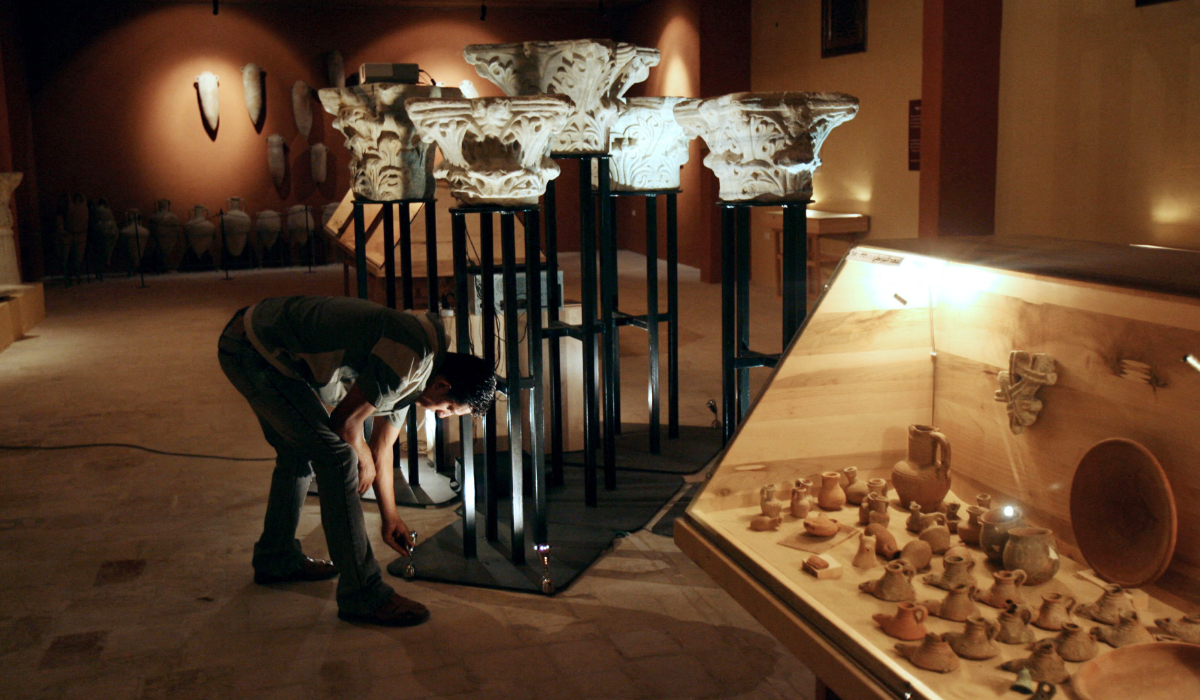


Artifacts are on display in the first ever National Museum of Archaeology in Gaza opend recently by Jawdat Khoudary, a Palestinian businessman and collector, on July 28, 2008. (AFP)

Napoleon is said to have based himself in the ochre stone edifice at the disastrous end of his Egyptian campaign in 1799.
The room where the French emperor supposedly slept was full of Byzantine artefacts.
“Our best finds were displayed in the Basha,” Jean-Baptiste Humbert of the French Biblical and Archaeological School in Jerusalem (EBAF) told AFP.
But we know little of their fate, he said. “Did someone remove the objects before blowing the building up?“
Nerves were frayed even further when the director of Israeli Antiquities, Eli Escusido, posted a video on Instagram of Israeli soldiers surrounded by vases and ancient pottery in the EBAF warehouse in Gaza City.
Much of what has been unearthed in digs in Gaza was stored either at the Al-Basha museum or the warehouse.
Palestinians quickly accused the army of pillaging. But EBAF archaeologist Rene Elter said he has seen no evidence of “state looting.”
“My colleagues were able to return to the site. The soldiers opened boxes. We don’t know if they took anything,” he told AFP.
However, he added: “Every day when Fadel (al-Otol) calls me, I’m afraid he’ll tell me that one of our colleagues has died or that such and such a site has been destroyed.”
Archaeology is a highly political issue in Israel and the Palestinian territories, with discoveries often used to justify the claims of the two warring peoples.
While Israel has an army of archaeologists who have unearthed an impressive number of ancient treasures, Gaza remains relatively untouched by the trowel despite a rich past stretching back thousands of years.

The only sheltered natural harbor between the Sinai and Lebanon, Gaza has been for centuries a crossroads of civilizations.
A pivot point between Africa and Asia and a hub of the incense trade, it was coveted by the Egyptians, Persians, Greeks, Romans and Ottomans.
A key figure in excavating this glorious past over the last few decades has been Jawdat Khoudary, a Gazan construction magnate and collector.
Gaza, with its “seafront real estate,” had a property boom in the 1990s after the Oslo peace accords and the creation of the Palestinian Authority.
When building workers dug up the soil, they came across lots and lots of ancient objects. Khoudary amassed a treasure trove of artefacts that he opened up to foreign archaeologists.
Marc-Andre Haldimann, then curator of MAH, Geneva’s art and history museum, couldn’t believe his eyes when he was invited to have a look around the garden of Khoudary’s mansion in 2004.
“We found ourselves in front of 4,000 objects, including an avenue of Byzantine columns,” he told AFP.
Quickly an idea took shape to organize a major exhibition to highlight Gaza’s past at the MAH, and then to build a museum in the territory itself so that the Palestinians could take ownership of their own heritage.
At the end of 2006, around 260 objects from the Khoudary collection left Gaza for Geneva, with some later going on to be part of another hit show at the Institut du Monde Arabe (IMA) in Paris.
But geopolitics changed along the way. In June 2007, Hamas drove the Palestinian Authority from Gaza. And Israel imposed its blockade.
As a result, the Gazan artefacts could no longer return home and remained stuck in Geneva, while the archaeological museum project fizzled out.
But Khoudary did not give up hope. He built a museum-hotel called Al-Mathaf, museum in Arabic, on the Mediterranean coast north of Gaza City.
But then came the Israeli ground offensive after the Hamas attack on October 7, which began in Gaza’s north.

“Al-Mathaf remained under Israeli control for months,” Khoudary, who fled Gaza for Egypt, told AFP. “As soon as they left, I asked some people to go there to see what state the place was in. I was shocked. Several items were missing and the hall had been set on fire.
His mansion was also destroyed during fierce fighting in the Sheikh Radwan neighborhood of Gaza City.
“The Israelis flattened the garden with bulldozers... I don’t know whether objects were buried (by the bulldozers) or whether the marble columns were broken or looted. I can’t find words,” he added.
The Israeli military did not comment on specific sites. But it accused Hamas of systematically using civilian structures like cultural heritage sites, government buildings, schools, shelters and hospitals for military purposes.
“Israel maintains its commitments to international law, including by affording the necessary special protections,” the army added in a statement.
While part of Khoudary’s collection has been lost, the treasures held in Switzerland remain intact, saved by the blockade and the red tape that delayed their return.
“There were 106 crates ready to go” for years, said Beatrice Blandin, the MAH museum’s current curator.
Safely far from the war raging in Gaza, “the objects are in good condition,” she added. “We restored some of the bronze pieces that were slightly corroded and repacked everything.
“We just had to be sure that the convoy would not be blocked,” she told AFP. “We were waiting for that green light.”
But with any return impossible for the moment, Blandin said “discussions are under way” for a new Gaza exhibition in Switzerland.
Khoudary is excited by the idea.
“The most important collection of objects on the history of Gaza is in Geneva. If there is a new show, it will allow the whole world to learn about our history,” he told AFP from Cairo.
“It’s an irony of history,” said Haldimann, who is trying to get his friend Fadel Al-Otol safely out of Gaza.
“A new Gaza exhibition would show once again that Gaza... is anything but a black hole.”

The children in Israel’s prisons
Ongoing hostage-for-prisoners exchange opens the world’s eyes to arrests, interrogations, and even abuse of Palestinian children by Israeli authorities

Enter


keywords

What next for Lebanon after army completes first phase of Hezbollah disarmament?

Updated 6 sec ago
Follow

What next for Lebanon after army completes first phase of Hezbollah disarmament?

  • Lebanese army says further Hezbollah disarmament hinges on Israeli actions, external backing, and hard limits on state capacity
  • Israel says Lebanon’s efforts remain “insufficient,” raising concerns over renewed military action without progress on ground

BEIRUT: The Lebanese army declared on Thursday that progress on the second phase of a plan to place all weapons under state authority depends on external factors, highlighting constraints facing the state.

These include continued Israeli attacks on Lebanese territory, the occupation of several Lebanese sites, the establishment of buffer zones, repeated violations of the ceasefire agreement, and delays in the delivery of promised military capabilities to the army.

The statements were made during a cabinet session on Thursday, where the army announced the successful completion of the first phase of Hezbollah disarmament south of the Litani River.

Army Commander Gen. Rodolphe Haykal briefed ministers on the progress and confirmed that preparations are underway to assess conditions for launching the second phase, which will extend northward to the area between the Litani and Awali rivers.

The Lebanese army’s stance comes at a time of mounting Israeli and US pressure on Lebanon to disarm Hezbollah across all Lebanese territory, alongside Israeli skepticism about the army’s ability to carry out such a task.

Meanwhile, Hezbollah has refused to surrender its weapons north of the Litani River, despite the Lebanese state’s commitment to restoring “security and stability to the southern border and preventing its use as a launch pad for any military operations, in accordance with its decision to extend its authority exclusively through its own forces over all Lebanese territory.”

A Lebanese official told Arab News that the army’s position is based on the fact that Lebanon has fulfilled all its obligations within the limits of the army’s available resources in implementing what is required under the ceasefire agreement south of the Litani River.

The Lebanese Army, the source said, is leaning toward adopting a “weapons containment” strategy north of the Litani River.

“Talking about north of the Litani River means all of Lebanon, and therefore it is impossible to set a timeframe for implementation, given the army’s limited logistical capabilities,” the source said.

The weapons containment option ensures that no weapons are moved, imported, smuggled, or used within Lebanon. “This should concern no one,” the source added.

The mechanism committee, tasked with monitoring the implementation of the Israel-Hezbollah 2024 ceasefire agreement, receives regular updates on the disarmament. 

Regarding whether Lebanon fears an Israeli military escalation in light of the army leadership’s stance, the source said that Lebanon is subjected to daily Israeli attacks despite fulfilling all its obligations. 

“South of the Litani River, the only positions that could be confiscated are those held by the Israeli army,” the source added.

Michael Young, senior editor at the Malcolm H. Kerr Carnegie Middle East Center in Beirut, said the likelihood of Lebanon entering a full-blown war with Israel remains minimal.

“If the Israelis and the Americans are pushing and the Lebanese are conceding, then the imperative to immediately escalate to a much larger conflict, which may not actually lead to any kind of decisive results, is going to be lessened,” he told Arab News. 

However, Young warned that if the implementation of disarmament is delayed or obstructed for too long, Israel may eventually decide to escalate militarily. 

Cabinet spokesman and Minister of Information Paul Morcos announced that the army will present a plan in February to begin the second phase of its deployment, aimed at withdrawing weapons from areas north of the Litani River.

Meanwhile, the cabinet commended the army’s achievements and called for the swift implementation of all phases of the disarmament plan.

The army command reiterated its ongoing coordination with UNIFIL and the ceasefire monitoring mechanism, which it said would contribute to greater stability south of the Litani River.

In a statement, the army thanked the countries participating in UNIFIL, highlighting the work of the US and French teams supporting the mechanism’s work. 

It also commended “the awareness and constructive cooperation of southern citizens, whose commitment to security and stability was crucial to the successful implementation of the first phase.”

The army added that the achievement reflects “deep mutual trust between the people and the military institution.”

The command further commended the dedication and sacrifices of its soldiers, noting they carried out their duties under harsh conditions and constant danger, from landmines and unexploded ordnance to direct Israeli strikes targeting their deployment zones.

Following the army’s announcement on completing the first phase of its disarmament plan, President Joseph Aoun said the state “stands firmly behind the Lebanese Armed Forces in their mission to extend authority and restore sovereignty, particularly in the south.”

Aoun emphasized that the army’s deployment south of the Litani River stems from a unified national decision rooted in the constitution and international commitments. 

He reiterated his call for a full Israeli withdrawal, release of prisoners, and respect for the cessation of hostilities as key to restoring state control, ensuring the safe return of displaced civilians to the southern regions, and enabling reconstruction.

Aoun also urged international backing to strengthen the army’s capabilities and prevent the transfer of arms to non-state actors. Praising the resilience of southern communities, he reaffirmed their trust in the army as Lebanon’s sole legitimate protector.

Parliament Speaker Nabih Berri voiced support for the army’s statement but stressed that “the mission remains incomplete due to Israel’s ongoing occupation of Lebanese territory, daily violations, and obstruction of the army’s work despite unfulfilled promises of military support.”

Berri warned that Israel’s actions, including the targeting of UNIFIL and calls to end their mandate, threaten the implementation of UN Resolution 1701.

He added that “the south longs for the presence and protection of its army,” and demanded Israel’s full withdrawal from Lebanese land and airspace.

Prime Minister Nawaf Salam also praised “the Lebanese command, officers and soldiers” for completing the first phase of disarmament, and paid tribute to the soldiers killed on that mission.

He stressed the urgent need for logistical and financial support to advance to the next phase and said securing the return of displaced residents and launching reconstruction in the south are top priorities over the coming weeks, pending parliament’s approval of a World Bank loan.

Salam also reaffirmed the state’s push for Arab and international support to pressure Israel to withdraw from occupied areas, end its attacks, and release Lebanese detainees — key steps to restoring full sovereignty.

UN Special Coordinator Jeanine Hennis-Plasschaert praised the progress of the Lebanese army in a post on X, saying: “Great to see the Lebanese army confirm it has assumed operational control south of the Litani.

“This is undeniable progress. Hard work lies ahead. But today’s milestone shows commitment and reinforces the role of the mechanism established by the November 2024 arrangement.”

For his part, UN Under-Secretary-General for Peace Operations Jean-Pierre Lacroix, concluding his visit to Lebanon before heading to Syria, emphasized the role of UNIFIL in maintaining stability and advancing the implementation of Resolution 1701 until the end of the mission’s mandate in December 2026, despite recent budget cuts.

In recent months, UNIFIL troops have come under Israeli fire amid tensions over their reports documenting Israeli violations south of the Litani River, particularly breaches of the Blue Line, including the construction of installations on Lebanese territory.

Israeli Prime Minister Benjamin Netanyahu’s office described Lebanon’s disarmament efforts as “encouraging but insufficient,” stressing that the ceasefire agreement requires Hezbollah’s full disarmament, which it called vital for both Israeli security and Lebanon’s future.

The statement also accused Iran of aiding Hezbollah’s rearmament. Meanwhile, the Israeli army claimed Hezbollah remains active south of the Litani River and said the Lebanese army’s declaration does not reflect “the reality on the ground.”

Young said Israel overstates the threat posed by Hezbollah to gain leverage in Washington, adding that Hezbollah has been significantly weakened despite its presence in the country.

He noted the party’s political isolation, lack of broader support, and growing internal pressure, particularly due to the displacement of “hundreds of thousands of Shiites whose villages are destroyed.”

“There is a terrible burden on the party,” he said. “It cannot indefinitely ignore the fate of these people.”

Young argued that Hezbollah is “not in a position to mount any kind of military operation across the border,” pointing to the fact that “both the Lebanese army, the Lebanese society and the Lebanese state — all of them oppose this.”

Israeli newspapers hinted that Israel is preparing for a large-scale operation in Lebanon. One paper, Maariv, accused Lebanese army commanders of presenting an “inaccurate narrative.”

It said the Israeli military plans to present photos and videos gathered by military intelligence and the Northern Command, allegedly showing Hezbollah weapons and missile storage sites, including buildings north of the Litani River.

It added that offensive plans are finalized and awaiting political approval.

Amid these developments, Iranian Foreign Minister Abbas Araghchi arrived in Beirut for meetings with Lebanon’s president, parliament speaker, prime minister, and foreign minister to discuss regional developments and bilateral relations.

His visit comes after a year of strained Lebanese-Iranian ties, marked by Iran’s pro-Hezbollah stance in its conflict with Israel — positions viewed by Beirut as interference in Lebanon’s sovereignty.

Facing pressure from both Israel and the US, Araghchi said: “Iran does not seek war, but it is ready for it.” He added that Tehran remains open to negotiations “based on mutual respect and shared interests,” asserting that US-Israeli strategies against Iran have “failed miserably.”

While Hezbollah did not issue an immediate response to the positions taken by the army and state officials, MP Kassem Hachem described the army’s statement as “expressing the will of the Lebanese people and the army’s commitment to Lebanon’s interests, free from any dictates or pressure.”

He told Arab News that Israel’s reaction to the army’s statement “only confirms the hostile intentions it has long harbored toward Lebanon,” stressing that the international community, particularly ceasefire sponsors, must recognize the risks of allowing Israel to evade accountability.

Hachem added that such impunity would undermine international norms and resolutions, especially as the Mechanism Committee continues to observe the “positive role” played by the Lebanese army and its actions on the ground.