

Pakistan Eid tourism surged by over 360 percent amid easing inflation — provincial data

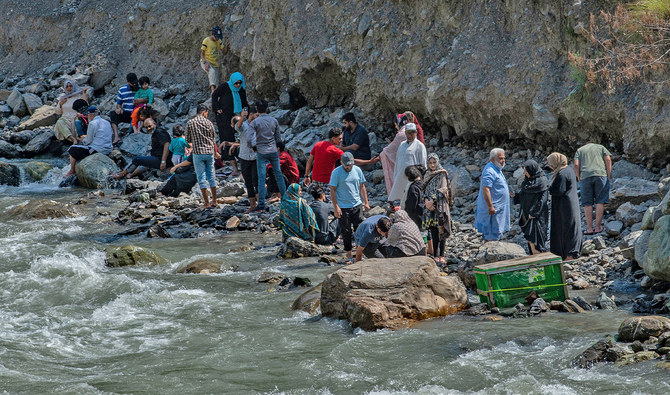
Visitors gather on a riverside in Naran valley, in Mansehra District of Khyber Pakhtunkhwa province on June 28, 2021. (AFP/File)
Short Url
Updated 15 April 2024
Follow

Pakistan Eid tourism surged by over 360 percent amid easing inflation — provincial data

  • Inflation in Pakistan fell to 20.7 percent in March, the country’s lowest in 23 months, data showed
  • Khyber Pakhtunkhwa’s Galiyat area saw highest number of tourists, 237,500, from April 10-14 last week

ISLAMABAD: Eid tourism in Pakistan’s northwestern Khyber Pakhtunkhwa (KP) province surged by over 360 percent this year, with over 580,000 tourists visiting the area’s scenic spots during the five-day holidays last week, data released by the provincial tourism authority on Monday showed, as inflation eases in the economically troubled country. 

Poor weather conditions and soaring inflation led to a staggering 74 percent decline in the number of tourists that visited KP last year during the Eid holidays, as per official figures, when over 125,000 tourists visited the province. The northwestern province is home to many picturesque locations and scenic spots such as Swat Valley, Malam Jabba, Abbottabad, Kaghan, and Shogran that Pakistanis from all over the country visit during the Eid holidays. 

As per figures shared by the Khyber Pakhtunkhwa Integrated Tourism Development Project (KITE), a provincial initiative by the provincial government to develop tourism in KP, 583,452 tourists in total visited the province from April 10-14. 

“Khyber Pakhtunkhwa’s tourist spots remained tourists’ first priority during Eid holidays,” the KP Culture and Tourism Authority said in a statement. “During the five days [April 10-14], over 583,000 tourists visited the tourist spots of Khyber Pakhtunkhwa.”

According to a breakdown shared by KITE, Galiyat saw the highest number of visitors with over 237,500 visiting the area during the five days while 151,900 visited Malam Jabba. As many as 92,470 tourists visited Kumrat Valley while 77,372 toured Naran and Kaghan areas, the data showed. 

Pakistan’s inflation last year peaked at 36.4 percent during April 2023 while food inflation surged to 49.1 percent. The South Asian country’s inflation outpaced price gains even in Sri Lanka as its currency depreciated and Pakistan hiked fuel and energy prices to comply with the International Monetary Fund (IMF). 

In March 2024, however, Pakistan’s inflation rate measured by the Consumer Price Index (CPI) fell to 20.7 percent, its lowest in 23 months. However, the country continues to face significant financial challenges, with dwindling foreign exchange reserves and a weak national currency.


Pakistan, Uzbekistan eye increasing bilateral trade to $2 billion within two years

Updated 7 sec ago
Follow

Pakistan, Uzbekistan eye increasing bilateral trade to $2 billion within two years

  • Pakistani PM’s aide on commerce, Ihsaan Afzal, meets Uzbekistan’s deputy investment minister in Tashkent
  • Uzbek delegation identifies textiles, leather, pharmaceuticals as sectors for joint ventures, technology transfer

ISLAMABAD: Senior officials from Pakistan and Uzbekistan have agreed to fast-track their countries’ Preferential Trade Agreement (PTA) to raise bilateral trade to $2 billion within the next two years, Pakistan’s commerce ministry said on Friday. 

Uzbekistan was the first Central Asian nation with which Pakistani officials signed a bilateral Transit Trade Agreement (UPTTA) and a Preferential Trade Agreement (PTA) covering 17 items. The PFA was signed between the two countries in March 2022 and became operational in 2023. 

The two sides discussed the PFA again in Tashkent on Dec. 11 when Ihsaan Afzal, coordinator to the Pakistani prime minister on commerce and industry, held in-depth talks with Shohrukh Gulamov, Uzbekistan’s deputy minister of investment, industry and trade. 

“Both sides reaffirmed their firm commitment to elevate bilateral trade to $2 billion within the next two years, in line with the vision of the Prime Minister of Pakistan and the President of Uzbekistan,” Pakistan’s commerce ministry said. 

Gulamov confirmed that the two countries are actively finalizing a “significantly broadened product list,” stating that a formal understanding on the expanded PTA is expected “very soon.”

Afzal stressed the need to standardize documentation, harmonize customs procedures and inspection protocols. The Pakistani officials also called for establishing digital connectivity to reduce delays and enhance trade predictability. 

Gulamov assured his full support to Pakistan, confirming that technical teams on both sides are working to operationalize an Electronic Data Interchange (EDI) system between the relevant authorities of the two countries.

“The Uzbek side identified textiles, leather, pharmaceuticals and surgical instruments as key sectors where Uzbekistan seeks joint ventures and technology transfer from Pakistan,” the statement said. 

Both delegations agreed to intensify business-to-business contacts and exchange of trade delegations to translate political will into “concrete commercial results.”

Uzbekistan, Central Asia’s largest consumer and its second-largest economy, is central to Pakistan’s plans to establish itself as a key transit and trade hub to landlocked Central Asian states. 

Islamabad has increasingly eyed greater trade and investment relations with regional allies as it targets sustained economic growth.