UNICEF hails KSrelief’s role in advancing education in Yemen

1 / 4
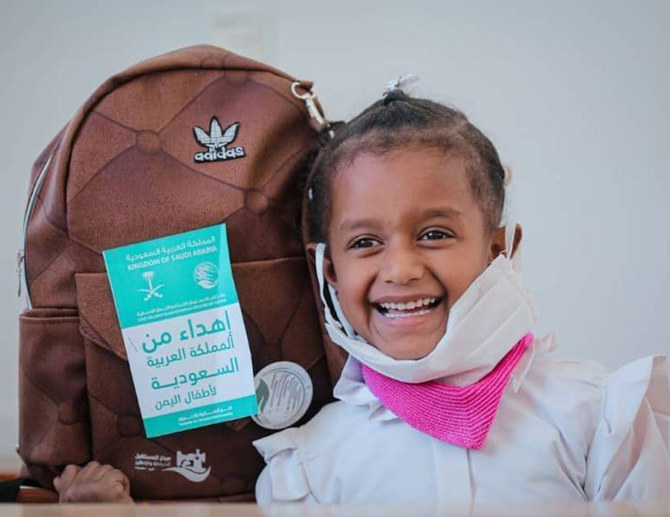
UNICEF recently noted that the funding provided by KSrelief has facilitated access to public and private education for girls and boys from vulnerable groups. (SPA)
2 / 4
UNICEF recently noted that the funding provided by KSrelief has facilitated access to public and private education for girls and boys from vulnerable groups. (SPA)
3 / 4
UNICEF recently noted that the funding provided by KSrelief has facilitated access to public and private education for girls and boys from vulnerable groups. (SPA)
4 / 4
UNICEF recently noted that the funding provided by KSrelief has facilitated access to public and private education for girls and boys from vulnerable groups. (SPA)
Short Url
Updated 14 April 2024
Follow

UNICEF hails KSrelief’s role in advancing education in Yemen

  • Over 800,000 children thriving through Saudi educational support, reports UN fund

RIYADH: Saudi Arabia, through its aid agency KSrelief, has allocated $6.2 million to support approximately 827,000 children in Yemen, ensuring their access to quality education opportunities. This initiative was undertaken in collaboration with the UN Children’s Fund, UNICEF.

UNICEF recently noted that the funding provided by KSrelief has facilitated access to public and private education for girls and boys from vulnerable groups, the Saudi Press Agency reported.

Peter Hawkins, the fund’s representative to Yemen, said: “One in every four primary school-aged children in Yemen is currently out of school. Moreover, educational outcomes for those able to attend do not align with their age.

“Thanks to contributions from partners such as KSrelief, UNICEF continues to address the educational needs of vulnerable girls and boys in Yemen.”

The funding enabled over 527,000 children to participate in national final exams for the 2022-2023 academic year.

Additionally, 300,000 male and female students received school bags and recreational supplies, aimed at motivating them to return to school while alleviating the financial burden on their families.

Moreover, the Kingdom’s support through KSrelief has enhanced teaching and learning practices in classrooms by training 7,520 male and female teachers across 17 governorates.

Additionally, hygiene supplies were distributed to 71,956 children and 120 schools.

KSrelief’s assistance also facilitated UNICEF’s outreach to nearly 4.9 million individuals, including caregivers, through the implementation of five awareness campaigns. Outreach activities reached approximately 26,000 community leaders and officials, as well as 2,500 families.

KSrelief remains a steadfast partner of UNICEF, providing continuous funding for life-saving interventions that enable UNICEF to address the most critical needs of vulnerable children in Yemen, SPA stated.

Meanwhile, in Yemen’s Hajjah governorate, KSrelief’s mobile medical clinic rendered essential medical services to 2,072 beneficiaries in one month. The clinic’s diverse services included treating patients for epidemiological diseases, providing emergency care, and offering internal medicine and reproductive health services.

In the Saada governorate of Yemen, KSrelief’s ongoing projects aim to address the primary healthcare and water needs of displaced individuals in the Razih district. In one month, medical clinics operating under this initiative treated patients for various ailments, including epidemic diseases, emergencies, internal medicine issues, and reproductive health concerns.

The project also provided nursing services, surgical assistance, and medical referrals, alongside conducting waste disposal programs and supplying potable water to the district.


Minzal brings Saudi traditions to life in Diriyah

Updated 9 sec ago
Follow

Minzal brings Saudi traditions to life in Diriyah

  • From leather crafts and archery to Saudi coffee, Minzal offers a lesson in ‘Sloum Al-Arab’

RIYADH: This season of Minzal places social norms and traditional etiquette at its center, with tents set up to teach what is locally known as “Sloum Al-Arab” alongside gatherings for coffee, dinner and stargazing around campfires.

“Sloum Al-Arab” refers to the unwritten customers and values that have shaped Arab and Bedouin society for centuries, including generosity, coffee preparation, courage and archery. 

In Saudi Arabia, these traditions are closely ties to cultural identity and religious belief. 

Leather products and the making of leather goods is one of the crafts featured at Minzal this year and is one of the oldest crafts still practiced in the kingdom.

“The most difficult thing I faced to work on was camel leather because it is a little tough,” Nada Samman, a leather trainer and craftsman at Minzal, told Arab News. 

Minzal continues to evolve with each season, offering activities that highlight Bedouin values, traditional skills and sports. (AN photo by Haifa Alshammari)

“The work on leather is wonderful whether it is goat leather, cow leather, Sawakni sheep, and of course, camel leather. At Minzal, we are offering multiple handicraft workshops, most specifically the leather handicrafts. We want visitors to spend time at something useful and fun."

Samman explained the workshops allowed participants to preserve heritage while engaging in meaning, hands on activities. 

Faisal Al-Khaled, a visual artist and craftsman specializing in Saudi designs at Minzal, shared a similar goal: “I want people to have, by the end of this experience, a unique and traditional art piece created by them, and that I know I helped them to preserve this craft.”

Minzal, which has been organized for several years now, continues to evolve with each season, offering activities that highlight Bedouin values, traditional skills and sports. Archery is a key feature, reflecting its deep roots in Arab and Islamic history.

Mohammed Al-Sharif, a certified archery player and coach with the Saudi Archery Federation since 2028, said the sport was closely connected to Saudi culture. It was encouraged by the Prophet Muhammad, which led people to learn and teach it through generations.

“Our traditional bow is considered one of the most important and widely used bows in Arab culture,” Al-Sharif said. “We have several styles, and professional archers specializing in traditional bow shooting … There are various types of archery, such as horseback archery and standing archery, where bow sizes vary according to specific needs, such as types used for hunting and others used during warfare.”

He explained that archery was historically part of daily life, used for protection and hunting. 

Saudi coffee also plays a significant role in the Minzal experience, with live demonstrations. One of the most frequently consumed beverages in the Kingdom, it is a symbol of hospitality and generosity.

Ahmed Al-Shuaibi explained how it was prepared at the Sloum tent, first by roasting the beans and then allowing them to cool. The beans are ground with spices in a Nigr.

“Coffee is passed from our grandparents,” he added. “In significant majlis, you see them offering our local coffee and not other types of coffee. We organized this corner so that young generations can visit and learn this.”