


JERUSALEM: Israeli Prime Minister Benjamin Netanyahu vowed on Sunday his country would achieve victory after the military said it shot down almost all the more than 300 drones and missiles launched by Iran in a sharp escalation of the Middle East conflict.
Tehran’s attacks late on Saturday, launched after a suspected Israeli air strike on its embassy compound in Damascus on April 1 that killed officers of the elite Islamic Revolutionary Guard Corps, raised the threat of a wider regional conflict.
Iran had relied on its proxies across the region to attack Israeli and US targets in a show of support for the Palestinian militant group Hamas in the Gaza war with Israel, which shows no sign of easing despite numerous mediations efforts.
“We intercepted, we repelled, together we shall win,” Netanyahu posted on X.
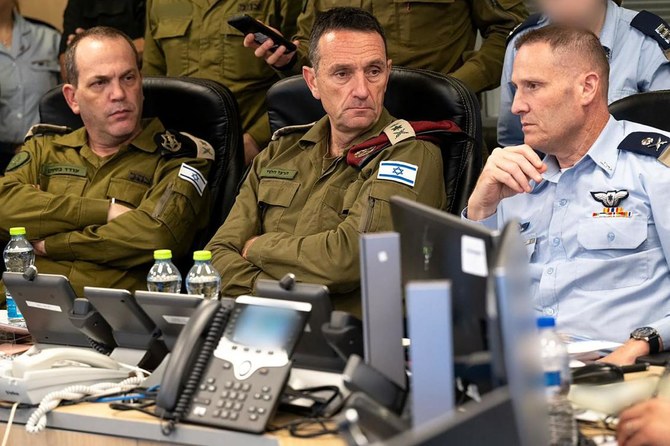
The Israeli military said the armed forces had shot down more than 99 percent of the Iranian drones and missiles and were discussing follow-up options.
Israel’s Channel 12 TV cited an unnamed Israeli official as saying there would be a “significant response” to the attack.
The war in Gaza, which Israel invaded after an attack by Iran-backed Hamas on Oct. 7, has ratcheted up tensions in the region, spreading to fronts with Lebanon and Syria and drawing long-range fire at Israeli targets from as far away as Yemen and Iraq.
Iran’s president Ebrahim Raisi warned Sunday Israel and its allies against any “reckless” actions after Tehran’s drone and missile attack in retaliation for a deadly strike on its Damascus consulate.
“If the Zionist regime (Israel) or its supporters demonstrate reckless behavior, they will receive a decisive and much stronger response,” Raisi said in a statement.
’Push toward escalation'
Iran’s most powerful ally in the region, the Lebanese Shiite group Hezbollah — which has been exchanging fire with Israel since the Gaza war began — said early on Sunday it had fired rockets at an Israeli base.
Drones were also reportedly launched against Israel by Yemen’s Iran-aligned Houthi group, which has attacked shipping lanes in an around the Red Sea to show solidarity with Hamas, British maritime security company Ambrey said in a statement.
Those clashes now threaten to morph into a direct open conflict pitting Iran and its regional allies against Israel and its main supporter, the United States. Regional power Egypt urged “utmost restraint.”
Israel’s chief military spokesperson, Rear Admiral Daniel Hagari, called Iran’s actions “very grave,” telling a televised briefing they “push the region toward escalation.”
Iran launched dozens of ground-to-ground missiles at Israel, including more than 10 cruise missiles, and most were intercepted outside Israeli borders, Hagari said.
The Iranian salvo caused light damage to one Israeli military facility, he said.
The Israeli military said it was not advising residents to prepare to take shelter, revising an earlier alert in an apparent signal of the end of the threat.
UN Security Council to meet
Iran had vowed retaliation for what it called the Israeli strike on its embassy compound that killed seven Revolutionary Guard officers, including two senior commanders. Tehran said its strike was punishment for “Israeli crimes.” Israel has neither confirmed nor denied responsibility for the consulate attack.
“Should the Israeli regime make another mistake, Iran’s response will be considerably more severe,” the Iranian mission to the United Nations said, warning the US to “stay away.” However, it also said Iran now “deemed the matter concluded.”
US President Joe Biden, who spoke by phone with Israeli Prime Minister Benjamin Netanyahu, said he would convene a meeting of leaders of the Group of Seven major economies on Sunday to coordinate a diplomatic response to what he called Iran’s brazen attack.
US Defense Secretary Lloyd Austin said America did not seek conflict with Iran but would not hesitate to act to protect US forces and support defense of Israel.
The UN Security Council was set to meet at 4 p.m. ET (2000 GMT) on Sunday after Israel requested it condemn Iran’s attack and designate the Revolutionary Guards a terrorist organization.
Iran’s Fars news agency quoted a source as saying Tehran was closely watching Jordan, which might become the next target is case of any moves in support of Israel.
Israel and Lebanon said they were closing their airspace on Saturday night. Israel reopened its airspace at 0430 GMT on Sunday, its airports authority said. Jordan, which lies between Iran and Israel, had readied air defenses to intercept any drone or missile that violated its territory, two regional security sources said.
Residents in several Jordanian cities said they heard heavy aerial activity.
Syria, an ally of Iran, said it was putting its ground-to-air defense systems around the capital and major bases on high alert, army sources there said.
The European Union, Britain, Japan, Czech Republic, Denmark, France, Mexico, the Netherlands and Norway condemned Iran’s attack.


