Saudi Arabia expresses concern over military escalation in Middle East

Short Url
Updated 14 April 2024
Follow

Saudi Arabia expresses concern over military escalation in Middle East

  • Arab states echoed Saudi sentiment, condemning regional escalation and call for restraint"

RIYADH: Saudi Arabia on Sunday expressed deep concern over the military escalation in the Middle East and urged all parties involved to exercise restraint, the Saudi Press Agency reported, citing a statement of the Ministry of Foreign Affairs.

The Ministry of Foreign Affairs warned of “serious repercussions” on the region and its peoples from the dangers of a wider war, according to SPA.


Iran on Saturday launched drones and missiles against Israel, making good its threat to retaliate against the Israeli air strike that destroyed an Iranian embassy annex building in Damascus, Syria, killing at least 13 people, including two generals of Iran’s elite Revolutionary Guard.

The Saudi ministry “affirmed the Kingdom’s position calling for the need for the Security Council to assume its responsibility towards maintaining international peace and security, especially in this region that is extremely sensitive to global peace and security, and to prevent the escalation of the crisis that will have serious consequences if it expands,” said the SPA report. 

The Saudi staement was echoed by the Secretary General of the Gulf Cooperation Council (GCC), Jasem Mohamed Albudaiwi, who emphasized the imperative of upholding regional and global security and stability amidst recent developments in the Middle East.

He urged, in a statement, all involved parties to exercise utmost restraint to forestall further escalation, which could endanger regional stability and civilian welfare. Albudaiwi underscored the necessity of collaborative efforts and diplomatic resolutions to address conflicts and ensure regional security.

He emphasized the pivotal role of the international community in bolstering these peace and stability endeavors, and warned of the potential ramifications of heightened tensions.

The UAE called for the exercise of the utmost restraint to avoid dangerous repercussions in the Middle East, the foreign ministry said in a statement on Sunday.

The UAE also called for resolving conflicts through dialogue and diplomatic channels.

Iran launched missiles and drones at Israel overnight in retaliation for a suspected Israeli air strike on Iran’s embassy compound in Damascus on April 1, raising the threat of a wider regional conflict.

Egypt also urged all parties to exercise utmost restraint to prevent further escalation in the region, aiming to safeguard its stability and the well-being of its inhabitants.

In a statement released by the Ministry of Foreign Affairs last night, Egypt underscored that the current dangerous escalation in the Iranian/Israeli arena is a direct consequence of previously highlighted concerns. Egypt has consistently warned against the perils of expanding conflicts in the region, particularly stemming from Israeli military actions in Gaza and provocative maneuvers in the area.

The statement emphasized Egypt’s continuous engagement with all relevant stakeholders to mitigate the situation, halt the escalation, and avert the region from spiraling into instability, thereby safeguarding the interests of its people.

Meanwhile, Jordan’s Minister of Foreign Affairs Ayman Al-Safadi emphasizes that stopping the Israeli aggression on Gaza, ending the occupation, and advancing the two-state solution are essential measures to halt the escalation in the region.


Defense Minister Prince Khalid bin Salman inaugurates 3rd World Defense Show in Riyadh

Updated 49 min 45 sec ago
Follow

Defense Minister Prince Khalid bin Salman inaugurates 3rd World Defense Show in Riyadh

  • Organized by the General Authority for Military Industries (GAMI), the five-day event will run until February 12
  • Prince Khalid launched several key initiatives, including the launch of several defense firms and signing of cooperation deals
  • The show is also serving as a launchpad for cutting-edge security technologies across various government sectors

RIYADH: Minister of Defense Prince Khalid bin Salman inaugurated the third edition of the World Defense Show (WDS) on Sunday on behalf of Crown Prince Mohammed bin Salman.

Organized by the General Authority for Military Industries (GAMI), the five-day event will run until February 12, showcasing the Kingdom’s rapid strides toward strategic independence and technological leadership in the defense sector.

The 2026 edition features a purpose-built venue with a 2,700-meter runway for live air and land demonstrations, underscoring the show’s status as a premier global defense event.

GAMI Governor Ahmad Al-Ohali emphasized that the show reflects Saudi Arabia's commitment to localizing over 50 percent of military spending in line with Vision 2030, fostering an integrated ecosystem where government bodies and international partners collaborate on innovation.

The event brings together official delegations, government entities, and leading international companies specializing in the defense and security sectors. (SPA)

Strategic agreements and major launches

The opening day witnessed significant activity at the Saudi Arabian Military Industries (SAMI) Group pavilion, where Prince Khalid launched several key initiatives:

New entities: The inauguration of SAMI Land Company, SAMI Autonomous Company, and the SAMI Land Industrial Complex.

Supply chain: The unveiling of the SAMI Local Content Program (RUKN) and the HEET Program.

International cooperation: A memorandum of understanding was signed between the Saudi General Authority for Defense Development and the Korean Agency for Defense Development to cooperate on advanced military research.

Defense deals: The Minister signed cooperation agreements with Slovakia, Malaysia, and Somalia.

Defense Minister Prince Khalid signed cooperation agreements with Slovakia, Malaysia, and Somalia. (SPA)

Technological debuts & innovations

The show is also serving as a launchpad for cutting-edge security technologies across various government sectors:

AI-Powered Lucid Gravity: Public Security debuted its advanced Lucid Gravity electric security vehicle at the Ministry of Interior's pavilion. The vehicle integrates state-of-the-art artificial intelligence and specialized security equipment designed to accelerate emergency response times and support field operations.

Public Security’s advanced Lucid Gravity electric security vehicle is displayed at the Ministry of Interior’s pavilion. (SPA)

This high-tech addition highlights Public Security’s shift toward smart, sustainable security solutions. By leveraging predictive intelligence and advanced command-and-control systems, the Lucid Gravity exemplifies the ministry’s commitment to protecting the Kingdom through integrated technological innovation and sustainable mobility.

Smart Helmet: Also at the Ministry of Interior’s pavilion, the General Directorate of Civil Defense unveiled its smart helmet. Designed to revolutionize public safety and emergency response, the helmet features day-and-night cameras and specialized sensors to detect hazardous materials in hard-to-reach locations.

The device serves as a mobile command node, delivering live video feeds directly to command-and-control centers. By enabling real-time data analysis and faster decision-making, the smart helmet significantly reduces incident response times and enhances personnel safety in high-risk environments.

The smart helmet features day-and-night cameras and specialized sensors to detect hazardous materials in hard-to-reach locations. (SPA)

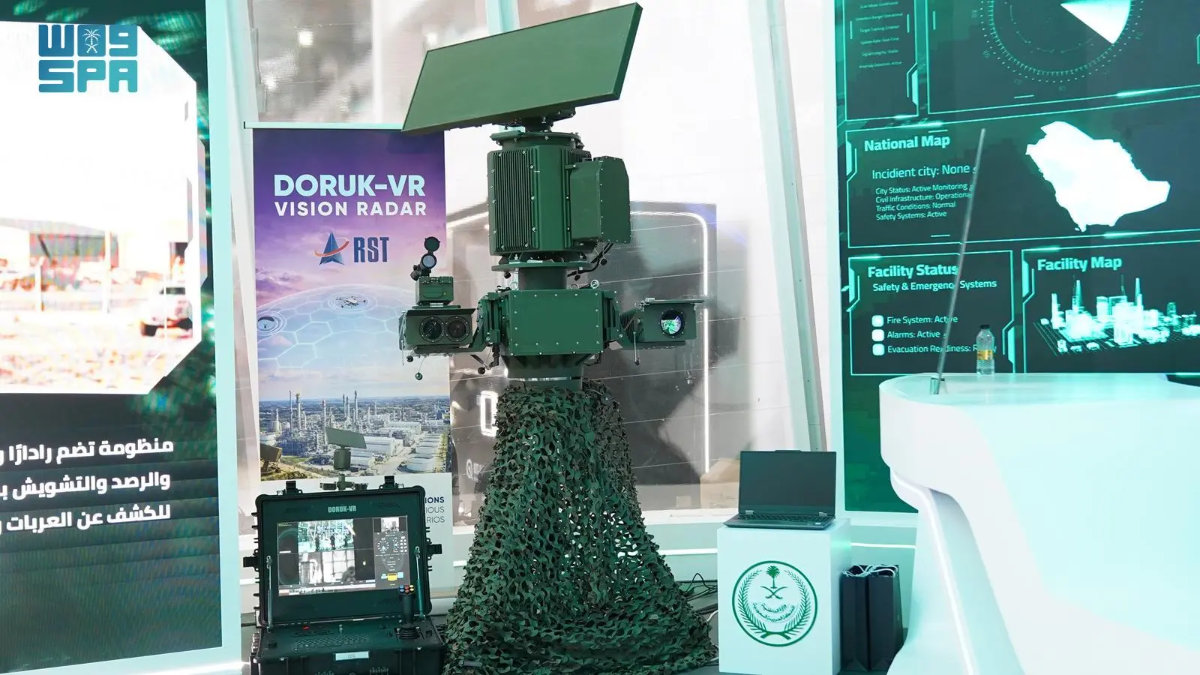
Border Security: The General Directorate of Border Guard (GDBG) showcased an integrated security system featuring radar and thermal cameras capable of detecting drones and classifying moving targets to protect critical infrastructure.

It also functions as an early warning system for critical facilities and border areas and is fully integrated with command and control systems.

Border Guard's ntegrated security system features radar and thermal cameras capable of detecting drones and classifying moving targets to protect critical infrastructure. (SPA)

Counter-Terrorism: The Islamic Military Counter Terrorism Coalition (IMCTC) presented a comprehensive framework integrating intellectual, media, and military domains to combat extremism and terror financing.

Visitors are briefed on specialized programs designed to raise the readiness of national personnel and foster sustainable institutional cooperation among member states to combat extremism. On the event’s opening day, the pavilion hosted high-level delegations, including ministers, military leaders, and ambassadors who reviewed the coalition's pivotal role in coordinating international security efforts and commended its initiatives that support regional and global stability.

A view of the Islamic Military Counter Terrorism Coalition pavilion. (SPA)

Meteorology: The National Center for Meteorology (NCM) displayed advanced weather systems essential for ensuring the safety of the event's air shows and military operations.

At its dedicated pavilion, the NCM is showcasing its latest advanced meteorological technologies and systems. These solutions serve both the military and civilian sectors, providing accurate data to support beneficiary entities' operational processes and highlighting the center's pivotal role in national security and safety.

NCM's latest meteorological technologies and systems serve both the military and civilian sectors

World Defense Show CEO Andrew Pearcey noted that participation is expected to surpass previous records, reflecting the event's growing importance on the international stage. The show continues through February 12.