

23-hour ordeal ends for 175 holidaymakers stranded in Turkiye cable car

1 / 3
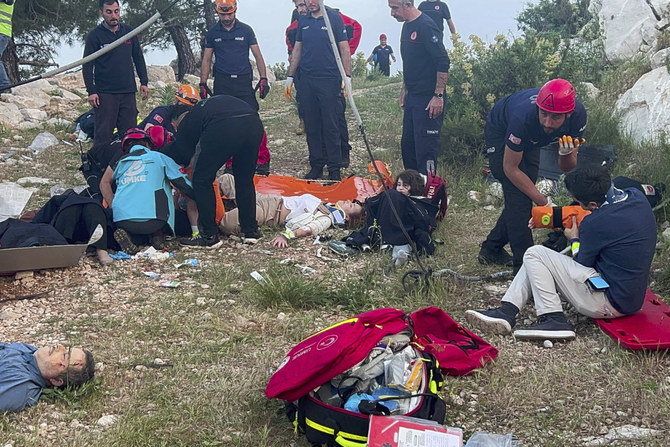
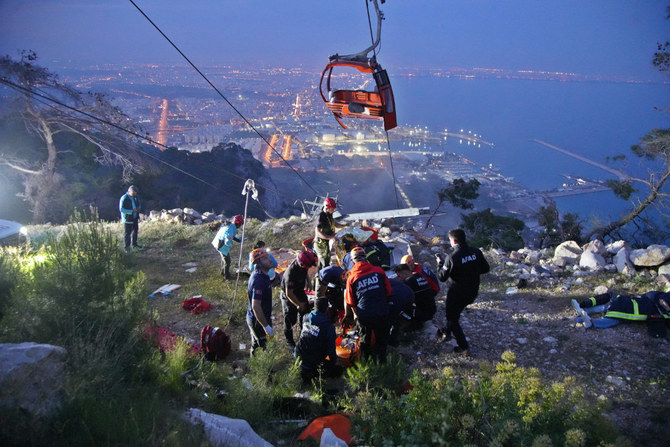
Rescue and emergency team members work with passengers of a cable car transportation system outside Antalya, southern Turkiye, on April 12, 2024. Scores of other people left stranded late into the night after the entire cable car system came to a standstill were rescued on Saturday. (Dia Images via AP)
2 / 3
Members of Turkiye's Disaster Management Authority (AFAD) and Gendarmerie Search and Rescue (JAK) take part in a rescue operation after a cable car cabin collided with a broken pole, in Antalya, Turkiye, April 13, 2024. (Turkish Interior Ministry/Handout via REUTERS)
3 / 3
Members of Turkiye's Disaster Management Authority take part in a rescue operation after a cable car cabin collided with a broken pole in Antalya on April 12, 2024. (Ihlas News Agency via REUTERS)
Short Url
Updated 14 April 2024
Follow

23-hour ordeal ends for 175 holidaymakers stranded in Turkiye cable car

  • The stranded people had been stuck on the Tunektepe cable car, just outside the Mediterranean city of Antalya, since 5:30 p.m. on Friday
  • The cable car carries tourists from Konyaalti beach to a restaurant and viewing platform at the summit of the 618-meter Tunektepe peak

ISTANBUL: The last of 174 people stranded in cable cars high above a mountain in southern Turkiye were brought to safety Saturday, nearly 23 hours after one pod hit a pole and burst open, killing one person and injuring seven when they plummeted to the rocks below.

Interior Minister Ali Yerlikaya announced the successful completion of the rescue operation on X Saturday afternoon.
A total of 607 search and rescue personnel and 10 helicopters were involved, including teams from Turkiye’s emergency response agency, AFAD, the Coast Guard, firefighting teams and mountain rescue teams from different parts of Turkiye, officials said. Helicopters with night-vision capabilities had continued rescuing people throughout the night.
The stranded people had been stuck on the Tunektepe cable car, just outside the Mediterranean city of Antalya, since 5:30 p.m. on Friday, when the accident occurred.
Istanbul resident Hatice Polat and her family were rescued seven hours into the ordeal. Speaking to the Anadolu agency, she said the power went out and the pod flipped four or five times.
“The night was awful, we were very scared. There were children with us, they passed out,” she said. “It was torture being up there for seven hours. It is swaying every second, you’re constantly in fear. ... It was very traumatic, I don’t know how we’ll get over this trauma.”
State-run Anadolu Agency identified the deceased as a 54-year-old Turkish man. Those injured included two children and were six Turkish citizens and one Kyrgyz national. They were all rescued by Coast Guard helicopters soon after the crash and sent for treatment. Images in Turkish media showed the battered car swaying from dislodged cables on the side of the rocky mountain as medics tended the wounded.
Yerlikaya also announced that 13 people rescued from other cars were also taken to hospitals for checkups.
Friday was the final day of a three-day public holiday in Turkiye marking the end of the Muslim holy month of Ramadan, which sees families flock to coastal resorts.
The cable car carries tourists from Konyaalti beach to a restaurant and viewing platform at the summit of the 618-meter (2,010-foot) Tunektepe peak. It is run by Antalya Metropolitan Municipality. The cable car line was completed in 2017 and receives a major inspection around the beginning of the year, as well as routine inspections throughout the year.
Antalya Chief Public Prosecutor’s Office has launched an investigation. An expert commission including mechanical and electrical engineers and health and safety experts was assigned to determine the cause of the incident.


Khartoum markets back to life but ‘nothing like before’

Updated 3 sec ago
Follow

Khartoum markets back to life but ‘nothing like before’

  • The hustle and bustle of buyers and sellers has returned to Khartoum’s central market, but “it’s nothing like before,” fruit vendor Hashim Mohamed told AFP, streets away from where war first broke out
KHARTOUM: The hustle and bustle of buyers and sellers has returned to Khartoum’s central market, but “it’s nothing like before,” fruit vendor Hashim Mohamed told AFP, streets away from where war first broke out nearly three years ago.
On April 15, 2023, central Khartoum awoke to battles between the Sudanese army and the paramilitary Rapid Support Forces (RSF), who had been allies since 2021, when they ousted civilians from a short-lived transitional government.
Their war has since killed tens of thousands and displaced millions.
In greater Khartoum alone, nearly four million people — around half the population — fled the city when the RSF took over.
Hashim Mohamed did not.
“I had to work discreetly, because there were regular attacks” on businesses, said the fruit seller, who has worked in the sprawling market for 50 years.
Like him, those who stayed in the city reported having lived in constant fear of assaults and robberies from militiamen roaming the streets.
Last March, army forces led an offensive through the capital, pushing paramilitary fighters out and revealing the vast looting and destruction left behind.
“The market’s not what it used to be, but it’s much better than when the RSF was here,” said market vendor Adam Haddad, resting in the shade of an awning.
In the market’s narrow, dusty alleyways, fruits and vegetables are piled high on makeshift stalls or tarps spread on the ground.
Two jobs to survive
Khartoum, where entire neighborhoods have been damaged by the fighting, is no longer threatened by the mass starvation that stalks battlefield cities and displacement camps elsewhere in Sudan.
But with the economy a shambles, a good living is still hard to provide.
“People complain about prices, they say it’s too expensive. You can find everything, but the costs keep going up: supplies, labor, transportation,” said Mohamed.
Sudan has known only triple-digit annual inflation for years. Figures for 2024 stood at 151 percent — down from a 2021 peak of 358 percent.
The currency has also collapsed, going from trading at 570 Sudanese pounds to the US dollar before the war to 3,500 in 2026, according to the black market rate.
One Sudanese teacher, who only a few years ago could provide comfortably for his two children, told AFP he could no longer pay his rent with a monthly salary of 250,000 Sudanese pounds ($71).
To feed his family, pay for school and cover health care, he “works in the market or anywhere” on his days off.
“You have to have another job to pay for the bare minimum of basic needs,” he said, asking for anonymity to protect his privacy and to avoid “problems with security services.”
Beyond Khartoum, the war still rages, with the RSF in control of much of western and southern Sudan and pushing into the central Kordofan region.
For Adam Haddad, the road to recovery will be a long one.
“We don’t have enough resources or workers or liquidity going through the market,” he said, adding that reliable electricity was still a problem.
“The government is striving to restore everything, and God willing, in the near future, the power will return and Khartoum will become what it once was.”