

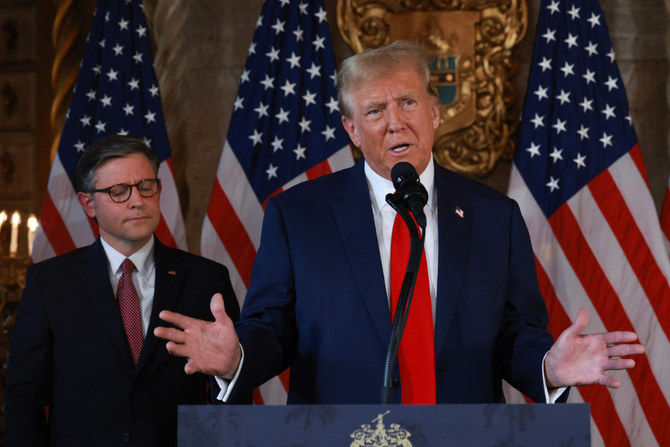

PALM BEACH, Florida: Donald Trump offered a political lifeline Friday to House Speaker Mike Johnson, saying the beleaguered GOP leader is doing a “very good job,” and tamping down the far-right forces led by Rep. Marjorie Taylor Greene trying to oust him from office.
Trump and Johnson appeared side-by-side at the ex-president’s Mar-a-Lago club, a rite of passage for the new House leader as he hitches himself, and his GOP majority, to the indicted Republican Party leader ahead of the November election.
“I stand with the speaker,” Trump said at an evening press conference at his gilded private club.
Trump said he thinks Johnson, of Louisiana, is “doing a very good job – he’s doing about as good as you’re going to do.”
“We’re getting along very well with the speaker — and I get along very well with Marjorie,” Trump said.
But Trump flashed some criticism over efforts to oust the speaker calling it “unfortunate,” saying there are “much bigger problems” right now.
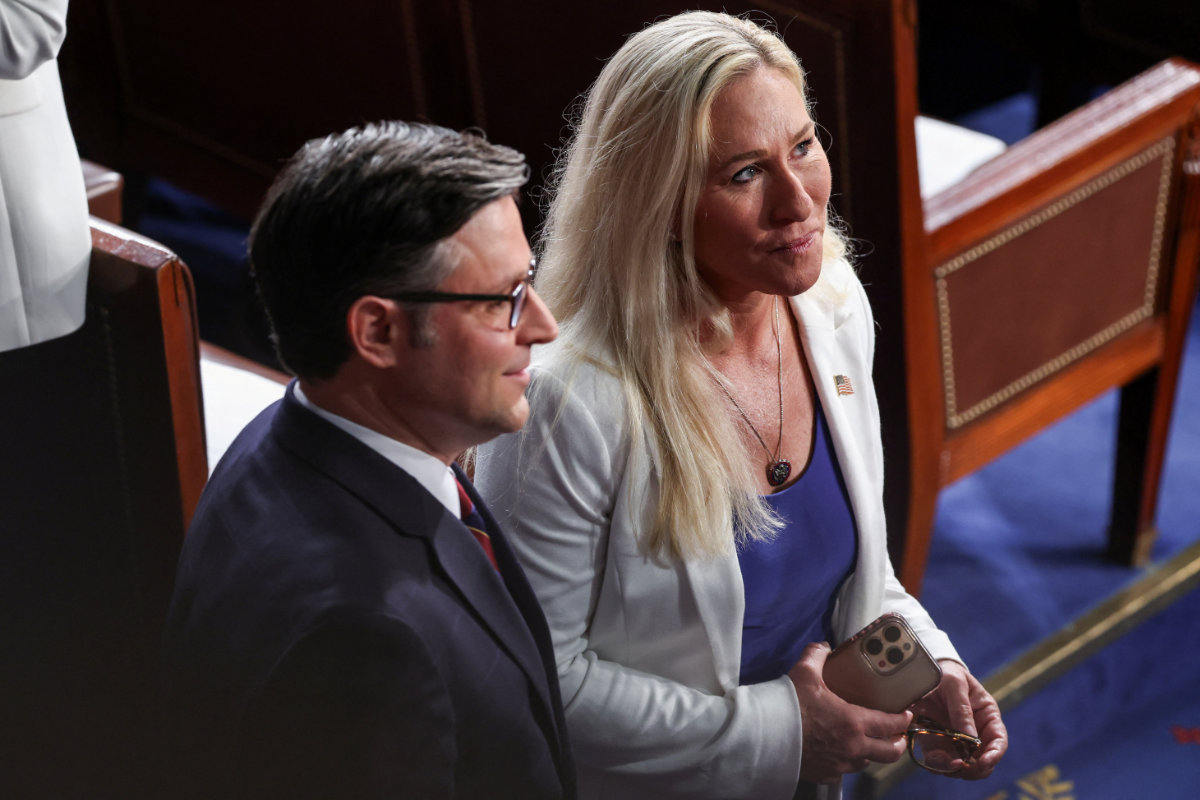
Rep. Marjorie Taylor Greene and House Speaker Mike Johnson are seen together at the US Capitol in Washington as Japanese Prime Minister Fumio Kishida arrived to address a joint meeting of Congress on April 11, 2024. (REUTERS)
The visit was arranged as a joint announcement on new House legislation to require proof of citizenship for voting, but the trip itself is significant for both. Johnson needed Trump to temper hard-line threats to evict him from office. And Trump benefits from the imprimatur of official Washington dashing to Florida to embrace his comeback bid for the White House and his tangled election lies.
“It is the symbolism,” said Charlie Sykes, a conservative commentator and frequent Trump critic.
“There was a time when the Speaker of the House of Representatives was a dominant figure in American politics,” he said. “Look where we are now, where he comes hat in hand to Mar-a-Lago.”
While the moment captured the fragility of the speaker’s grip on the gavel, just six months on the job, it also put on display his evolving grasp of Trump-era politics as the Republicans in Congress align with the “Make America Great Again” movement powering the former president’s re-election bid.
Johnson and Trump underscored their alliance Friday by using similar wording to describe one part of their campaign strategy — pummeling President Joe Biden with alarmist language over what Republicans claim is a “migrant invasion.”
By linking the surge of migrants coming to the US with the upcoming election, Trump and Johnson raised the specter of noncitizens from voting — even though it’s already a federal felony for a noncitizen to cast a ballot in a federal election and exceedingly rare.
Trump called America a “dumping ground” for migrants coming to the US, and revived pressure on Biden to “close the border.”
The speaker nodded along. “It could, if there are enough votes, affect the presidential election,” warned Johnson, who had played a key role in challenging the 2020 election that Trump lost to Biden, previewing potential 2024 arguments.
In fact, Trump had made similar claims of illegal voting in 2016 but the commission he appointed to investigate the issue disbanded without identifying a single case. A previous voter crackdown risked striking actual citizens from the voting rolls.
Ahead of the meeting, the Trump campaign sent a background paper that echoed language from the racist great replacement conspiracy theory to suggest that Biden and Democrats are engaging in what Trump’s campaign called “a willful and brazen attempt to import millions of new voters.”
Some liberal cities like San Francisco have begun to allow noncitizens to vote in a few local elections. But there’s no evidence of significant numbers of immigrants violating federal law by casting illegal ballots.
In the Trump era, the sojourns by Republican leaders to his private club in Palm Beach, Florida, have become defining moments, amplifying the lopsided partnership as the former president commandeers the party in sometimes humiliating displays of power.
Such was the case when Kevin McCarthy, then the House GOP leader, trekked to Mar-a-Lago after having been critical of the defeated president after the Jan. 6, 2021 attack on the Capitol. A cheery photo was posted afterward, a sign of their mending relationship.
Johnson proposed the idea of coming to Mar-a-Lago weeks before Greene filed her motion to vacate him from the speaker’s office, just as another group of hard-liners had previously ousted McCarthy. The visit comes days before the former president’s criminal trial on hush money charges gets underway next week in New York City.
The speaker’s own political future depends on support — or at least not opposition — from the “Make America Great Again” Republicans who are aligned with Trump but creating much of the House dysfunction that has brought work there to a halt.
Johnson commands the narrowest majority in modern times and a single quip from the former president can derail legislation. He was once a Trump skeptic, but the two men now talk frequently.
“I think it’s an emerging relationship,” said Rep. Ryan Zinke, R-Montana, who served as interior secretary in the Trump administration.
Even still, Trump urged Republicans this week to “kill” a national security surveillance bill that Johnson had personally worked to pass, contributing to a sudden defeat that sent the House spiraling. The legislation was approved Friday in a do-over but only after Johnson provided his own vote before departing for Florida.
“I can’t imagine President Trump being very happy about that,” said Greene.
Johnson understands he needs Trump’s backing to conduct almost any business in the House — including his next big priority, providing US aid to Ukraine to fight Russia’s invasion.
In a daring move, the speaker is working both sides to help Ukraine, talking directly to the White House on the national security package that is at risk of collapse with Trump’s opposition. Greene is warning of a snap vote to oust Johnson from leadership if he allows any US assistance to flow to the overseas ally.
“We’re looking at it,” Trump said about the national security package.
On the issue of election integrity, though, Johnson is leading his House GOP majority to embrace Trump’s lies about a stolen 2020 election and laying the groundwork for 2024 challenges.
Trump continues to insist the 2020 election was marred by fraud, even though no evidence has emerged in the last four years to support his claims and every state in the nation certified their results as valid.
As he runs to reclaim the White House, Trump has essentially taken over the Republican National Committee, turning the campaign apparatus toward his priorities. He supported Michael Whatley to lead the RNC, which created a new “Election Integrity Division” and says it is working to hire thousands of lawyers across the country.
Tired of the infighting and wary of another dragged-out brawl like the monthlong slugfest last year to replace McCarthy, few Republicans are backing Greene’s effort to remove Johnson, for now.
But if Trump signals otherwise, that could all change.


