

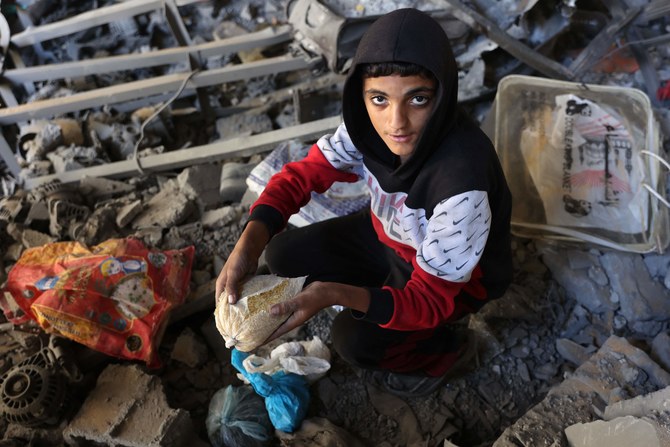

LONDON: Northern Gaza faces a catastrophe without more assistance, the UN’s humanitarian coordinator said on Friday, with communication between the Israeli military and foreign aid groups still poor and no meaningful improvements happening on the ground.
Jamie McGoldrick, who works for the UN Office for the Coordination of Humanitarian Affairs, warned that Gaza was sliding into an ever more precarious situation as Israel’s war against Hamas continues into a sixth month.
He said that according to an Integrated Food Security Phase Classification report 70 percent of people in the north of the Gaza Strip were “in real danger of slipping into famine.”
In a briefing on the situation, McGoldrick said the deaths of seven World Central Kitchen aid workers earlier this month were “not a one off” and that there had been “many incidents of that kind.”
“We work with, interact with, the Israeli Defense Forces and the way we notify and communicate is challenging. We don’t have communications equipment inside Gaza to operate properly, as you would have in … other situation(s),” he said.
“We are working in a very hostile area as humanitarians without the possibility of contacting each other. We don’t have radios, we don’t have mobile networks that work. And so, what we then do is we have to find ways of passing messages back to OCHA and other organizations in Rafah and then relaying out. And if we have a serious security incident, we don’t have a hotline, we don’t have any way of communicating (with) the IDF or facing problems at checkpoint or facing problems en route.
“I think that another thing, I would say, that there’s a real challenge of weapons discipline and the challenge of the behavior of (Israeli) soldiers at checkpoints. And we’ve tried, time and time again, to bring that (to their) attention.”
McGoldrick said that communication with the Israeli military was hampering the flow of aid into Gaza.
“Israel believes that their responsibility ends when they deliver trucks from Kerem Shalom and to the Palestinian side, and I would say that that’s certainly not the case,” he said.
“Their responsibility ends when the aid reaches the civilians in Gaza — we have to have them supportive of that. And that means allowing more facilitation, a lot more routes in and, obviously, to provide security for us as we move. At the moment, we don’t have security.”
He said the toll the war had taken on Gaza’s basic infrastructure was also playing a part in hampering aid deliveries.
“The roads themselves are in very poor condition. We are, as the UN, committed to using all possible routes to scale up humanitarian assistance throughout Gaza, but right now we see that there have been a number of commitments made by Israel and a number of concessions,” he said.
“I don’t think there’s been any notable improvement in terms of our ability to move around, certainly not our approval to get convoys going to the north.”
Opening more crossings to supply northern areas of Gaza was an essential step if famine was to be avoided in the area, McGoldrick said.
“All we can do is keep reminding (Israel) and using the pressure from key (UN) member states to remind Israel of the commitments they’ve made and the commitments that we’ve been asking for such a long time.
“That would be an essential lifeline into the north, because that’s where the population, according to the IPC — the recent famine report — that is where the bulk of people who are the most in danger of slipping into famine.
“If we don’t have the chance to expand the delivery of aid into all parts of Gaza, but in particular to the north, then we’re going to face a catastrophe. And the people up there are living such a fragile and precarious existence.”
McGoldrick also noted the difficulty in accessing fresh water and the devastation caused to Gaza’s health sector by Israel’s military campaign.
“People have very much less water than they need. And as a result of that, waterborne diseases due to the lack of safe and clean water and the destruction of the sanitation systems, you know, they’re all bringing about problems for the population living (there),” he said.
“The hospital system there, Al-Shifa, and Nasser, the two big hospitals have been badly damaged or destroyed. And what we have now is three-quarters of the hospitals and most of the primary healthcare clinics are shutting down, leaving only 10 of 36 hospitals functioning.
“We hear of amputations being carried out with(out) anesthesia. You know, miscarriages have increased by a massive number. And I think of all those systems which are not in place, (and) at the soaring rates of infectious diseases — you know, hepatitis C, dehydration, infections and diarrhea. And obviously, given the fact that our supply chain is so weak, we haven’t been able to deliver enough assistance.”


