Italian MP to propose bill recognizing Eid Al-Fitr as national holiday

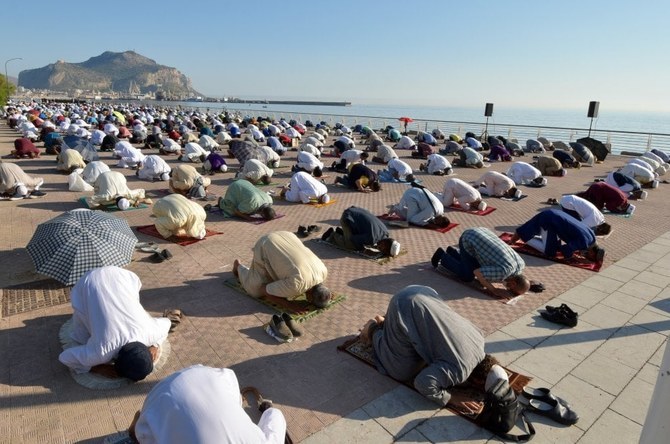
Muslims praying on Foro Italico in the Sicilian capital Palermo in 2022. (X/File Photo)
Short Url
Updated 10 April 2024
Follow

Italian MP to propose bill recognizing Eid Al-Fitr as national holiday

  • Independent Aboubakar Soumahoro reveals plan as thousands of Muslims around Italy mark the end of Ramadan with prayers, community celebrations

ROME: A politician in Italy said on Wednesday that he will ask the country’s parliament to recognize Eid Al-Fitr as a national holiday.

As Muslims around Italy celebrated the end of Ramadan, Aboubakar Soumahoro, formerly of the Green and Left Alliance, but now an independent, said that he planned to bring a bill proposing the move to the Chamber of Deputies.

“Today, Islam is the second religion in Italy. We need to recognize, update, adapt, and harmonize the laws of our country with the current and renewed reality. Italy has changed, enriching itself with plurality, also from a religious point of view. Long live plural Italy,” he posted to his Instagram.

Muslims all over Italy have begun celebrating Eid, with representatives of the Roman Catholic church and various city councils joining the festivities. 

Thousands of Muslims in Palermo, where the Islamic community numbers roughly 25,000, held early-morning prayers at the Foro Italico, a vast open-air area facing the sea.

Cardinal Matteo Zuppi, archbishop of Bologna and president of the Italian Episcopal Conference, sent a message to the Islamic community, wishing “Muslim brothers and sisters in Italy to be well throughout the year.”

He added: “Being good neighbors means wishing each other well. Every blessing comes from God, Almighty and Merciful, and we can share it, as good stewards, firstly through prayer, and then through acts of kindness. Wishing well for the whole year means collaborating in building this goodness day by day.” 

Prayers in Palermo were led by Bedri El-Madani, the imam of the mosque of Piazza Gran Cancelliere, which before 1998 was a Catholic church and was donated to the Islamic community by Salvatore Pappalardo, the late Cardinal of Palermo.

A representative of the mayor of Palermo also gave his best wishes to the Islamic community.

In Turin, the second-largest city in Italy’s industrial north, Mayor Stefano Lo Russo greeted thousands of Muslims at the end of the prayer in the Parco Dora.

“Turin is a great workshop of dialogue, a vast human laboratory that has built its identity through the encounter of cultures and religions, not clashes. We want to continue in this direction,” he said.

“When people from diverse cultures meet, they must learn to understand each other, and make a collective effort to live together and build a better city. That’s what we are doing all together.”

A large crowd also gathered in Naples to celebrate the end of Ramadan, with prayers in the Piazza del Plebiscito attended by City Commissioner for Youth and Labor, Chiara Marciani, and Prefect Michele Di Bari.

“Participation in this celebration is a sign of respect for a large community living in our city, needing more integration into our activities with the attention and respect that all our fellow citizens deserve,” Marciani said.

Amar Abdallah, the Imam of the mosque on Corso Arnaldo Lucci, addressed hundreds of faithful gathered in Piazza Garibaldi, reminding them that “Naples is a city where dialogue has always triumphed.”

According to most recent surveys, Muslims make up 2-4 percent of the Italian population, while Catholics make up 75-80 percent, and atheists or agnostics about 15 percent.


Europeans push back at US over claim they face ‘civilizational erasure’

Updated 16 February 2026
Follow

Europeans push back at US over claim they face ‘civilizational erasure’

  • “Contrary to what some may say, woke, decadent Europe is not facing civilizational erasure,” Kallas told the conference

MUNICH: A top European Union official on Sunday rejected the notion that Europe faces “civilizational erasure,” pushing back at criticism of the continent by the Trump administration.
EU foreign policy chief Kaja Kallas addressed the Munich Security Conference a day after US Secretary of State Marco Rubio offered a somewhat reassuring message to European allies. He struck a less aggressive tone than Vice President JD Vance did in lecturing them at the same gathering last year but maintained a firm tone on Washington’s intent to reshape the trans-Atlantic alliance and push its policy priorities.
Kallas alluded to criticism in the US national security strategy released in December, which asserted that economic stagnation in Europe “is eclipsed by the real and more stark prospect of civilizational erasure.” It suggested that Europe is being enfeebled by its immigration policies, declining birth rates, “censorship of free speech and suppression of political opposition” and a “loss of national identities and self-confidence.”
“Contrary to what some may say, woke, decadent Europe is not facing civilizational erasure,” Kallas told the conference. “In fact, people still want to join our club and not just fellow Europeans,” she added, saying she was told when visiting Canada last year that many people there have an interest in joining the EU.
Kallas rejected what she called “European-bashing.”
“We are, you know, pushing humanity forward, trying to defend human rights and all this, which is actually bringing also prosperity for people. So that’s why it’s very hard for me to believe these accusations.”
In his conference speech, Rubio said that an end to the trans-Atlantic era “is neither our goal nor our wish,” adding that “our home may be in the Western hemisphere, but we will always be a child of Europe.”
He made clear that the Trump administration is sticking to its guns on issues such as migration, trade and climate. And European officials who addressed the gathering made clear that they in turn will stand by their values, including their approach to free speech, climate change and free trade.
British Prime Minister Keir Starmer said Saturday that Europe must defend “the vibrant, free and diverse societies that we represent, showing that people who look different to each other can live peacefully together, that this isn’t against the tenor of our times.”
“Rather, it is what makes us strong,” he said.
Kallas said Rubio’s speech sent an important message that America and Europe are and will remain intertwined.
“It is also clear that we don’t see eye to eye on all the issues and this will remain the case as well, but I think we can work from there,” she said.