

This Eid, Pakistan’s designer ‘lawn wars’ cool off as inflation bites

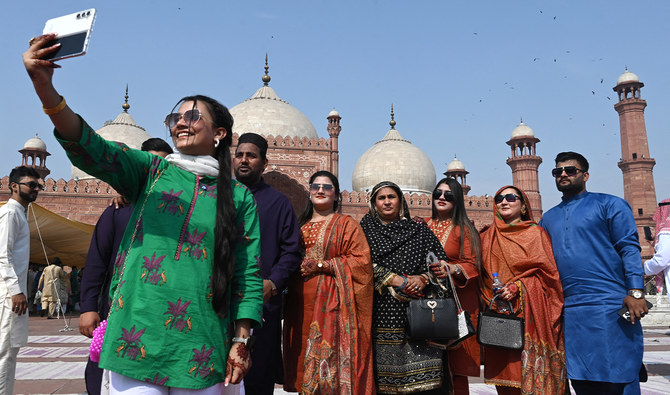
A Muslim woman takes a selfie with her family members after offering a special prayers on the occasion of Eid al-Fitr, which marks the end of the holy fasting month of Ramadan at the Badshahi Mosque in Lahore on April 10, 2024. (AFP/File)
Short Url
Updated 10 April 2024
Follow

This Eid, Pakistan’s designer ‘lawn wars’ cool off as inflation bites

  • Pakistani women prefer to buy dresses made of lightweight lawn, long seen as staple for summer clothes 
  • Branded lawn is major part of how Pakistani housewives, working women and young girls shop for clothes

ISLAMABAD: Noor Fatima, a first-year pre-med student in the Pakistani capital, had been on a quest to find the perfect Eid dress for days but there was one problem. 

The dress she liked cost Rs30,000 ($108), nearly double her budget.

Ahead of Eid each year, women spend hours going to clothing stores or surfing online catalogs in search of their holiday dresses. If Eid falls in the spring or summer months as it has this year, they prefer to buy dresses made of lightweight lawn, long seen as a staple for summer clothes in Pakistan.

The cloth, made of fine combed cotton, is itself ideal for Pakistani climate, and has over generations become the go-to material for traditional shalwar kameez, especially for women. While textile manufacturers like Gul Ahmed have been around since the early 1950s, it is only in the last two decades that branded lawn with round-the-year collections have become a major part of how Pakistanis, from housewives and working women to teenagers and school girls, shop for clothes.

As Eid arrives, the “lawn wars” get more intense as brands release stitched and unstitched collections, billboards, television commercials, flyers, print advertisements and social media bring customers “the most coveted lawn” and online platforms get flooded with images of models, local and international, wearing lawn dresses in exotic locations. Social media is also rife with videos of women fighting over pieces at exhibitions and clothing stores, with the altercations oftening turning physical. 

But this year, the advertising and the marketing has not been able to hide the reality that designer lawn is becoming increasingly unaffordable for most people in a country with double digit inflation, with many women surveyed by Arab News saying the price tags this Eid had left them sour. 

A general survey of designers shows that dresses sold at Rs9000 ($32.42) last year are now starting at Rs16,000 ($57.64) and going upwards of Rs50,000 ($180).

“Last year, [clothes] were expensive but not as expensive compared to this year,” Fatima told Arab News last week as she shopped for Eid dresses in Islamabad’s F-10 shopping area. 

Sumera Tauseef, a principal at a private school, called out lawn designers, saying their prices were not justified. 

“Prices have gone really high,” she said, complaining that designers were buying fabric for cheap but selling pret at steep prices and earning exorbitant profits. 

“Things that cost Rs18,000 ($64.66) to Rs19,000 ($68.25) in previous years, right now cost Rs30-40,000 ($107.76 - $143.68).”

Many customers said the higher prices did not necessarily mean better quality. 

“This time the quality is not there, the designs are very mediocre, and the price is definitely not justified ... So, it has put me in a pickle. It’s been quite a mess this year for everyone,” Sherina Noor, a marketing consultant in Islamabad, said.

“The dresses that I got stitched are way better than theirs [ready to wear] and that too made at a lower cost,” said Mahrukh Sattar, a government officer. “In Pakistan, where people’s affordability is falling, their [designer wear] prices are getting double, triple.”

Imran Khan, a salesman at a multi-brand store, said higher prices of designer clothes had hit demand, with only a limited number of customers now able to afford luxury lawn.

“Last year, Zara Shahjahan, Zaha, and Elan [dress] prices were from Rs9,000 to Rs11,000,” he said, listing a few top brands. 

“But this year, their prices have gone to Rs16,000 ($57.47), Rs17,000 (Rs61.06). We are running slow because most customers cannot afford it.”


Pakistan embassy, UN Tourism mark International Day of Mountains in Riyadh

Updated 6 sec ago
Follow

Pakistan embassy, UN Tourism mark International Day of Mountains in Riyadh

  • Event highlights Pakistan’s mountain ecosystems, mountaineering heritage, climate risks
  • Diplomats, artists and climbers gather to promote sustainable mountain tourism

ISLAMABAD: The Embassy of Pakistan in Riyadh, in collaboration with the UN Tourism Office, hosted an event this week to mark the United Nations-designated International Day of Mountains, bringing together diplomats, civil society members, mountaineers and artists to spotlight the global and Pakistani significance of mountain ecosystems.

Pakistan is home to some of the world’s largest mountain ranges and glacier systems outside the polar regions, including the Himalayas, Karakoram and Hindu Kush, which feed major rivers that sustain agriculture, hydropower and drinking water for millions of people. Rising temperatures linked to climate change are accelerating glacial melt, increasing the risk of floods, landslides and glacial lake outburst floods, while also threatening long-term water security as ice reserves shrink. 

These changes are already affecting mountain communities whose livelihoods depend on farming, tourism and pastoralism, exposing them to displacement, loss of income and environmental degradation, and amplifying the human and economic costs of extreme weather events across downstream regions.

Ambassador of Pakistan to Saudi Arabia Ahmad Farooq is briefing guests about mountain ecosystems in Pakistan at the UN Tourism Office in Riyadh on December 11, 2025. (Pakistan Embassy in Saudi Arabia)

Held at the UN Tourism Office in Riyadh, Thursday’s event focused on the ecological, cultural and economic importance of mountains, with particular attention to Pakistan’s vast high-altitude landscapes.

The evening opened with a micro-documentary titled Mountains of Pakistan, showcasing the country’s mountain ranges and their ecological value. Ambassador of Pakistan to Saudi Arabia Ahmad Farooq, in his opening remarks, highlighted the essential role mountains play in sustaining water systems, food security and communities, while also drawing attention to the growing threats posed by climate change.

“Mountains are not just landscapes, they are life-giving ecosystems, repositories of culture, and sources of inspiration,” Farooq said. “Tonight, we celebrate not only their beauty but our shared responsibility to protect them for future generations.”

Ambassador of Pakistan to Saudi Arabia Ahmad Farooq posing for picture with guests at the UN Tourism Office in Riyadh on December 11, 2025. (Pakistan Embassy in Saudi Arabia)

He also referred to challenges facing Pakistan’s mountain regions, including climate-change-driven glacial melt and related environmental risks, reaffirming Islamabad’s commitment to sustainable mountain development.

The program included remarks by the director of the UN Tourism Office, who underscored the importance of international cooperation in preserving fragile mountain ecosystems. A second micro-documentary, Spirit of Mountaineering, paid tribute to the courage and resilience of Pakistani climbers and their contributions to global mountaineering.

Among the featured speakers was Naila Kiani, a prominent Pakistani mountaineer and environmental advocate, who shared her experiences scaling some of the world’s highest peaks, including K2 and Nanga Parbat. Kiani is the first Pakistani woman and overall third Pakistani to climb 12 of the 14 eight-thousanders.

A prominent Pakistani mountaineer and environmental advocate, Naila Kiani, is addressing an event to mark International Day of Mountains in Riyadh on December 11, 2025. (Pakistan Embassy in Saudi Arabia)

Ambassador Farrukh Amil, a senior Pakistani career diplomat and former ambassador, spoke about Pakistan’s mountain heritage and ongoing initiatives to promote conservation and eco-tourism, while landscape photographer Awais Ali presented a photographic exhibition capturing the majesty of Pakistan’s northern regions and the lives of their communities.

The event concluded with the formal inauguration of the mountain photography exhibition curated by Ali, offering guests an immersive visual journey through Pakistan’s highlands.

The embassy said the celebration reaffirmed Pakistan’s commitment to raising global awareness about mountain ecosystems, promoting sustainable tourism and fostering international collaboration to address climate challenges affecting these fragile environments.