JERUSALEM: Israel’s foreign minister threatened Wednesday that his country’s forces would strike Iran directly if the Islamic Republic launched an attack from its territory against Israel.
His comments came amid heightened tensions between the rival powers following the killings of Iranian generals in a blast at the Iranian consulate in Syria earlier this month.
“If Iran attacks from its territory, Israel will respond and attack in Iran,” Israel Katz said in a post on X in both Farsi and Hebrew.
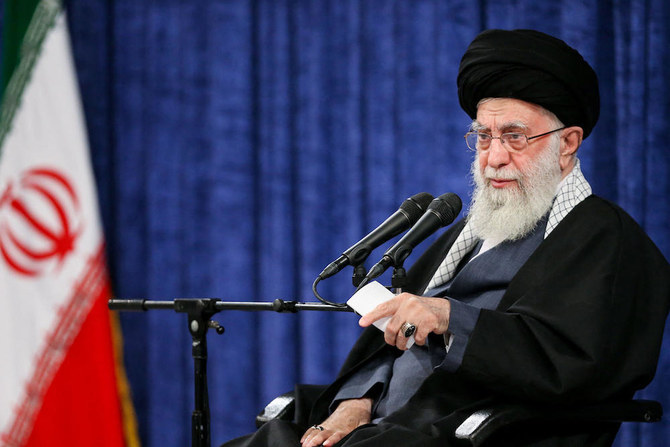
Earlier Wednesday, Iran’s Supreme Leader Ayatollah Ali Khamenei reiterated a promise to retaliate against Israel over the attack on its consulate in Damascus.
Tehran holds Israel responsible for the strike that leveled the building, killing 12 people. Israel has not acknowledged its involvement, though it has been bracing for an Iranian response to the attack, a significant escalation in their long-running shadow war.
The strike killed Gen. Mohammad Reza Zahedi, a senior figure in Iran’s Islamic Revolutionary Guard who led the group’s elite Quds Force in Lebanon and Syria until 2016. The 11 others who died included six Revolutionary Guard members, four Syrians and a Hezbollah militia member.
Israel has attacked scores of Iranian-linked targets in Syria over the years with the apparent intent of disrupting arms transfers and other cooperation with Lebanon’s Hezbollah, which is backed by Iran. The Israeli army rarely comments on these attacks. Since the Israel-Hamas war in Gaza began six months ago, there have been near-daily exchanges of fire between Israeli forces and Hezbollah along the Israel-Lebanon border.
Gaza’s Hamas rulers, who triggered the war by attacking southern Israel on Oct. 7, are also backed by Iran. Tehran also backs an umbrella group of Iraqi militias targeting US military bases and positions in Syria and Iraq, known as The Islamic Resistance of Iraq.
Khamenei made the remarks at a prayer ceremony celebrating the end of the Muslim holy month of Ramadan, saying the strike on its consular was akin to an attack on Iranian territory.
“When they attacked our consulate area, it was like they attacked our territory,” Khamenei said, in remarks broadcast by Iranian state TV. “The evil regime must be punished, and it will be punished.”
Neither Katz nor the Ayatollah elaborated on the way they would retaliate.
Khamenei also criticized the West, particularly the US and Britain, for supporting Israel in its war against Hamas in Gaza.
“It was expected they (would) prevent (Israel) in this disaster. They did not. They did not fulfil their duties, the Western governments,” he said.
Iran does not recognize Israel.

Israel threatens to strike Iran directly if Iran launches attack from its territory
https://arab.news/j7hke
Israel threatens to strike Iran directly if Iran launches attack from its territory
- “If Iran attacks from its territory, Israel will respond and attack in Iran,” Israel Katz said in a post on X
- Earlier Wednesday, Iran’s Supreme Leader Ayatollah Ali Khamenei reiterated a promise to retaliate against Israel over the attack on its consulate in Damascus
Abbas reiterates opposition to displacement of Palestinians
- During Moscow talks, president calls for immediate halt to Israeli acts of terror
- Historically, Russia has supported and stood by the Palestinian people at political and diplomatic levels
MOSCOW: The Palestinian National Authority’s President Mahmoud Abbas has reiterated his opposition to all attempts to displace Palestinian people from their land.
Speaking with Russian President Vladimir Putin at the presidential palace in Moscow, Abbas was reported by the Kremlin’s official website as saying that “the Palestinian people are holding on to their land, and we categorically oppose attempts by the Americans and Israelis to expatriate Palestinians beyond Palestinian territory.”
He said the Palestinian people “will not abandon their land, whatever the cost.” Abbas stressed the need to fully implement US President Donald Trump’s peace plan, leading to the withdrawal of occupation forces and the launch of the reconstruction process.
He emphasized that the Palestinian Authority would assume a central role in administering the Gaza Strip, and that the enclave and the West Bank constituted two parts of a single territorial unit, with a unified and undifferentiated system of civilian institutions.
He stressed the need for an immediate halt to “Israeli settler colonialism and Israeli acts of terror in the West Bank, including Jerusalem, along with the release of withheld Palestinian funds and the cessation of all measures that undermined the Palestinian Authority and the two-state solution.”
He reaffirmed his commitment to continue the struggle for the realization of the Palestinian people’s right to self-determination and of their right to a fully sovereign, independent state based on the borders of June 4, 1967, with East Jerusalem as its capital, while living in security and peace with neighbors.
He told Putin: “What we need is peace, and we hope that with your help and support, we can achieve it — a peace built on the basis of international legal resolutions, decisions of the United Nations, and the principles established following the wars of 1967 and 1973.
“East Jerusalem remains the capital of Palestine, and we know that Russia has always supported — indeed, was the first to support — Palestine, maintaining a firm stance in support of our people.”
Abbas thanked his Russian counterpart for Moscow’s support and commended the bilateral “bonds of friendship” between both countries. He added: “We are friends of Russia and the Russian people. For over 50 years our nations have been bound by a strong friendship that has developed over the decades and continues on the correct path. Russia is a great friend and a nation upon which we rely in many spheres.
“Historically, Russia has supported and stood by the Palestinian people at political and diplomatic levels. Your economic and financial support is both significant in scale and crucial in importance.”
Abbas emphasized moving forward with the implementation of a comprehensive national reform program aimed at consolidating the rule of law, strengthening the principles of good governance, transparency, and accountability, and ensuring the separation of powers.
Putin affirmed Moscow’s “principled and consistent approach” to the Palestinian question.
He said: “We believe that only the establishment and full functioning of the Palestinian state can lead to a lasting settlement of the Middle East conflict.”