

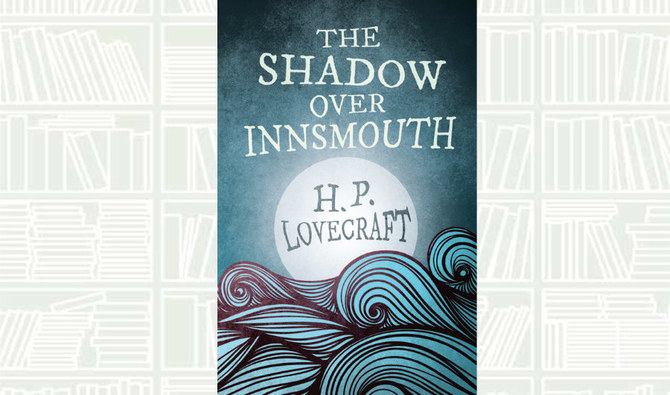
What We Are Reading Today: ‘The Shadow over Innsmouth’

Photo/Supplied
Short Url
Updated 10 April 2024
Follow

What We Are Reading Today: ‘The Shadow over Innsmouth’

Author: H.P. Lovecraft

“The Shadow over Innsmouth” is one of H.P. Lovecraft’s most popular and influential stories, first published in 1936. It follows the narrator, a student on a rambling tour of New England, who stumbles upon the mysterious town of Innsmouth in Massachusetts.

The town of Innsmouth is shrouded in secrecy and strange rumors. The narrator becomes increasingly curious about the town’s dark history and the peculiar appearance of its inhabitants.

As the narrator digs deeper, he discovers a connection between his own family and the sinister activities of Innsmouth. He becomes entangled in a web of conspiracy, horror, and forbidden knowledge.

Eventually, he finds himself pursued by the inhabitants of Innsmouth, who are determined to keep their secrets hidden.

“The Shadow over Innsmouth” is notable for its themes of forbidden knowledge, cosmic horror, and the idea of hidden, ancient races lurking beneath the surface of our world.

It is often considered a significant contribution to Lovecraft’s Cthulhu Mythos, a shared fictional universe featuring ancient deities, forbidden texts, and otherworldly horrors.

Lovecraft was an American writer who developed cosmic tales as a weird, horror fiction literary genre.

His works have profoundly impacted subsequent generations of writers, and his creations, such as the Cthulhu Mythos, have become iconic within the genre.

Lovecraft’s works were not widely recognized during his lifetime, and he primarily published his stories in pulp magazines.

After his death, his writing gained more recognition and a dedicated following.

Other notable works of his are “The Call of Cthulhu,” “At the Mountains of Madness,” and “The Dunwich Horror.”

Lovecraft’s stories continue to captivate readers with their atmospheric descriptions, intricate mythologies, and the sense of cosmic dread they evoke.


What We Are Reading Today: ‘A Love Story from the End of the World’

Photo/Supplied
Updated 17 January 2026
Follow

What We Are Reading Today: ‘A Love Story from the End of the World’

Author: Juhea Kim

Juhea Kim’s 2024 climate fiction work “A Love Story from the End of the World,” turns the climate catastrophe inward, offering ten stories where environmental collapse is felt in the fragile interiors of the human experience.

The short stories in this book imagine a familiar world where ecological collapse is a lived reality. Global cities are sealed inside domes to survive toxic air. Humans drift across ruined landscapes on mobile arks. Islands become landfills for the waste of richer nations. 

Yet Kim keeps her focus trained on the human scale, writing about how people continue to reach for life and one another even as the ground beneath becomes less stable.

They are all love stories, though not in the traditional sense. Some explore romance and longing, others center on family bonds, friendship, or the connection between humans and the natural world.

The writing is clear and precise, never overwrought, delivering characters’ thoughts and emotions while keeping the bigger concerns in clear view.

“Mountain, Island” follows a boy living on a massive landfill island who gains online fame for his K-pop-inspired dances. The contrast between joy and horror is almost unbearable, and it brings to light the global inequalities that we have grown far too used to accepting. 

In “Biodome,” the opening story, Seoul is sealed beneath a protective dome and follows a civil engineer navigating prospects for an arranged marriage. Intimacy and connection feel constrained, shaped by a reality where even the air is controlled and the possibilities of life have narrowed.

“Bioark,” meanwhile, imagines humanity surviving aboard a massive ark after Earth’s land becomes uninhabitable, using this floating world to examine class and capitalism even at the end of everything. 

Kim has spoken in interviews about conceiving this short story collection as an exhibition, inspired by colors and life changing art experiences around the world. Each story, indeed, feels like a distinct work, yet is enriched by its neighbors. Read together, they form a gallery of love, grief and hope.

“A Love Story from the End of the World” is not a fun and cozy read, despite the title. It is heavy, often heartbreaking, and attentive to the ways we remain human even as the world falls apart. 

Readers who loved “How High We Go in the Dark” by Sequoia Nagamatsu or “What We Fed to the Manticore” by Talia Lakhsmi Kolluri, will find a familiar ache in these stories, and perhaps something to ponder long after the final page is turned.