

As inflation bites, Karachiites faced with choice between Eid shopping or bills

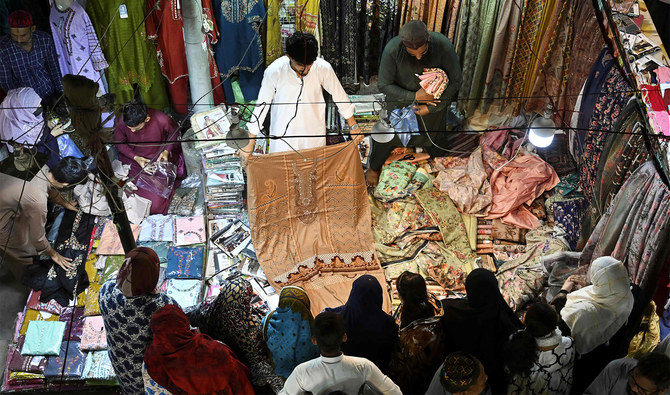
People shop clothes at a market in Karachi on April 5, 2024, ahead of Eid al-Fitr celebrations which marks the end of the Muslim holy month of Ramadan. (AFP)
Short Url
Updated 09 April 2024
Follow

As inflation bites, Karachiites faced with choice between Eid shopping or bills

  • Pakistan Chainstore Association expects Eid sales to shrink by about 10-20 percent due to rising food, fuel costs
  • Traders say while markets still buzzing with people, there are fewer “genuine buyers” and more window shoppers 

KARACHI: With the Eid Al-Fitr holiday around the corner, biting inflation and rising utility bills have forced many residents in Pakistan’s commercial hub of Karachi to forgo holiday shopping, with traders’ representatives predicting an up to 20 percent dip in sales compared to last year. 

Buying new clothes, shoes and accessories is an integral part of Eid Al-Fitr festivities for most Pakistanis each year, or at least those who can afford it. Men wear long-sleeved kameez shalwar suits while women opt for vibrantly colored and embroidered kurtas and ankle-length skirts known as lehengas and ghararas. 

But this month, with Pakistan’s fragile $350 billion economy in crisis, inflation hovering above 20.68 percent year-on-year has put a damper on Eid shopping sprees. 

“Last year there was a lower figure [for Eid sales] which was estimated to be around Rs20 billion [$72.1 million] based on sales in Karachi,” Atiq Mir, chairman of the All Karachi Tahir Ittehad, an umbrella of major business centers in the southern port city, told Arab News. 

“I think this year the figure will be even lower than last year.”

Mir said people from the middle- and lower-middle classes were struggling to afford clothes for their children this Eid. 

“That is because I think the economy of the country is falling, jobs are disappearing and there are no prospects for new jobs,” Mir lamented. “It is a disillusioned public’s Eid that may eat away the happiness of many.”
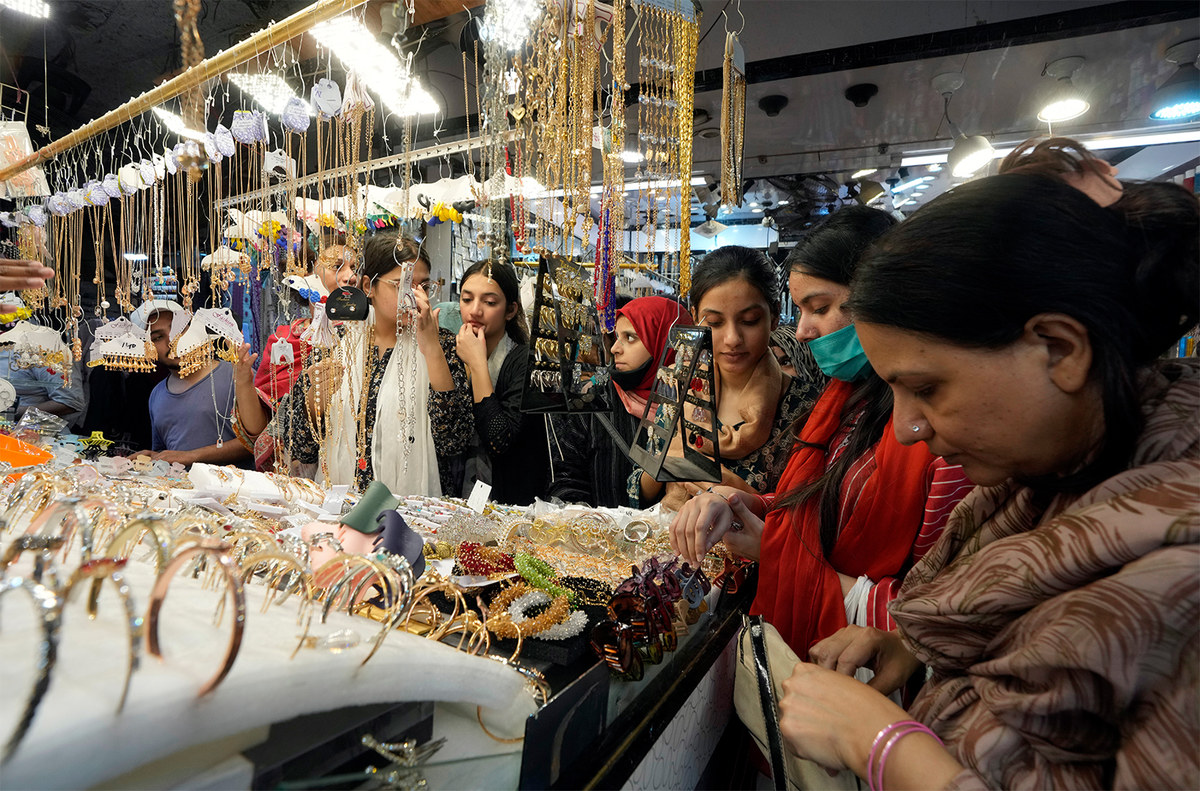


Women browse traditional artificial jewelry while they visit a market to shop for the upcoming Eid al-Fitr celebrations, in Karachi, Pakistan, on April 7, 2024. (AP)

Rana Tariq Mehboob, chairman of the Chainstore Association of Pakistan (CAP), a representative body of over 200 brands in Pakistan operating more than 20,000 outlets nationwide, estimated that high inflation had dented Eid shopping by about 20 percent.

“We estimate that sales have shrunk by about 10-20 percent,” Mehboob said, “because fuel, electricity, and grocery costs have increased.”

Forty percent of Pakistanis now live below the poverty line, up from 39.9 percent in the last fiscal year, a World Bank report released last week said, adding that nearly 10 million people were hovering near the poverty line and risked falling below it.

Pakistan has been caught in a high inflationary spiral since April 2022, with the highest ever inflation rate recorded at 38 percent in May 2023. The government credits soaring inflation to painful decisions it had to take to meet conditions for an IMF bailout program, including hiking energy tariffs and fuel prices.

Gas and electricity rates were hiked by 318.7 percent and 73 percent respectively in a year, according to official data.

“TO SHOP OR EAT”

Pakistani traders at the city’s busy Saddar shopping area said though Karachi’s markets were crowded closer to the Eid holiday, there were fewer “genuine buyers” and more window shoppers. 

“It is obvious that people are receiving higher utility bills which are more than their grocery bills,” Mansur ul Arfeen, a trader, told Arab News. “If they pay those bills first, how will they afford other things?”

“Where they used to buy three suits before, now they are buying only one because their purchasing power is very low,” cloth merchant Suresh Kumar said. “They are mostly going to low category markets because this is relatively expensive stuff here [in Saddar].”

Noreen Sabah, a housewife, complained her budget for Eid clothes was not enough to match prices:

“We came with a budget of Rs1,500-Rs2,000 [$5.4 to $7.21] per children’s dress but we realized the prices were completely out of budget.”

Customer Danish Raza also said high expenses had forced him to only shop for his children this year, rather than for himself, his wife or others in his family. 

“Inflation has increased so much,” he said, “that you are left with the option to either shop or eat.”


Pakistan raises India's suspension of water-sharing treaty with UNGA president, seeks action

Updated 15 February 2026
Follow

Pakistan raises India's suspension of water-sharing treaty with UNGA president, seeks action

  • New Delhi said in April last year it was holding the treaty in abeyance after a gun attack in Indian-administered Kashmir
  • Official says such actions threaten lives of 240 million Pakistanis, particularly at a time of climate stress, water scarcity

ISLAMABAD: Pakistan has taken up India’s suspension of a decades-old water-sharing treaty with the president of the United Nations General Assembly (UNGA), urging action over the move that Islamabad said sets "dangerous precedents."

The Indus Waters Treaty (IWT) divides control of the Indus basin rivers between the two nuclear-armed neighbors. India said in April last year it would hold the treaty “in abeyance” after a gun attack in Indian-administered Kashmir killed more than 26 tourists. New Delhi blamed the assault on Pakistan, Islamabad denied it.

The attack led to a four-day military conflict between the neighbors last May that say them attack each other with fighter jets, missiles, drones and artillery before the United States-brokered a ceasefire. Tensions have remained high between the nuclear-armed neighbors.

During a meeting on the sidelines of the Inter-Parliamentary Union (IPU) annual hearing, Pakistan Senate Chairman Yusuf Raza Gilani told UNGA President Annalena Baerbock that India's unlawful action constituted a blatant violation of the treaty’s provisions and principles of customary international law.

"Such actions threaten the lives and livelihoods of over 240 million Pakistanis and set dangerous precedents, particularly at a time when climate stress and water scarcity demand cooperation and strict respect for international agreements," he was quoted as saying by the Pakistani information ministry.

The treaty, mediated by the World Bank, grants Pakistan rights to the Indus basin’s western rivers — Indus, Jhelum, and Chenab — for irrigation, drinking, and non-consumptive uses like hydropower, while India controls the eastern rivers — Ravi, Beas, and Sutlej — for unrestricted use but must not significantly alter their flow.

Highlighting the adverse impacts of climate change, Gilani said countries like Pakistan remain among the most severely affected and underscored the urgency of collective action, climate justice and strengthened international cooperation.

"The United Nations provides an indispensable platform for addressing these interconnected challenges," he said at the meeting.

Gilani, who was leading a six-member parliamentary delegation, this week delivered the national statement at the IPU annual hearing at the UN headquarters, calling for democratic, transparent, and accountable decision-making in order to enhance the UN’s credibility, according to the Senate of Pakistan.

“Parliaments are indispensable partners in ensuring national ownership of international commitments,” he was quoted as saying by the Senate. “Reform is essential. But it must be ‘Reform for All, Privilege for None’.”

The Senate chairman highlighted the continuing importance of the United Nations as the cornerstone of multilateral cooperation, stressing that the organization’s universal membership and Charter-based mandate remain central to promoting global peace and security.