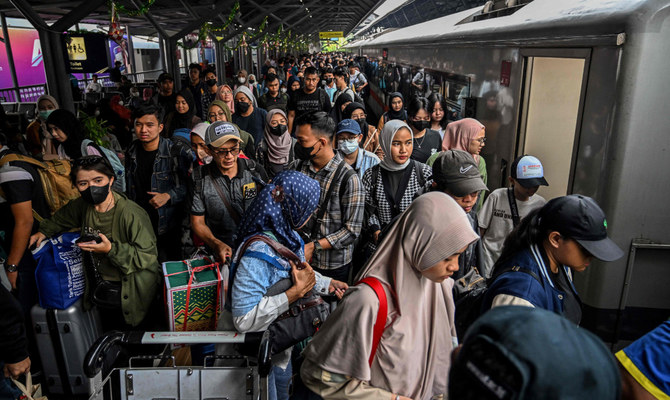
JAKARTA: Aditya Nugraha, a 21-year-old Indonesian, was traveling from the capital city of Jakarta to his hometown of Palembang on Sumatra island, over 500 km (310 miles) away, to celebrate the Islamic holiday of Eid Al-Fitr this week.
The festival, also called Lebaran in Indonesia, marks the end of the holy month of Ramadan. It falls on Wednesday this year and the entire week will be celebrated by more than 220 million people in Indonesia, which has one of the world’s largest Muslim populations.
Aditya was one of the many millions traveling to his home town in a mass exodus known locally as “mudik” and usually marked by hours of traffic jams, especially on the main island of Java.
“We departed from home last night around 9, and now it’s been 13 hours and we are still stuck in this very long traffic. Hopefully, there will be a solution to this soon,” Aditya told Reuters on Monday, waiting to enter the port in the town of Merak for a ferry to cross from Java to Sumatra.
Drone footage on Monday showed thousands of vehicles queuing to enter the ferries, while many more were on the road heading to the port, stretching far outside Merak.
People living in Jakarta, a city of 11 million people, started leaving the capital over the weekend, according to the Transport Ministry.
Around 193 million people were expected to travel during the festivities this year, according to a survey by the ministry, around 56 percent higher compared to the number of travelers during the Eid holidays last year.

Indonesia’s annual exodus starts ahead of Eid Al-Fitr festivities
https://arab.news/4r8sy
Indonesia’s annual exodus starts ahead of Eid Al-Fitr festivities
- People living in Jakarta, a city of 11 million people, started leaving the capital over the weekend, according to the Transport Ministry
EU should consider forming combined military force: defense chief
- Kubilius floated creating a “powerful, standing ‘European military force’ of 100,000 troops” that could eventually replace US forces
- Trump has heightened fears among NATO allies over Washington’s reliability by insisting he wants to take over Greenland
BRUSSELS: EU countries should weigh whether to set up a combined military force that could eventually replace US troops in Europe, the bloc’s defense chief said Sunday.
EU defense commissioner Andrius Kubilius floated creating a “powerful, standing ‘European military force’ of 100,000 troops” as a possible option to better protect the continent.
“How will we replace the 100,000-strong American standing military force, which is the back-bone military force in Europe?” he asked in a speech in Sweden.
The suggestion comes as US President Donald Trump has heightened fears among NATO allies over Washington’s reliability by insisting he wants to take over Greenland.
Worries over Trump’s commitment to Europe have already spurred countries to step up efforts to bolster their militaries in the face of the threat posed by Russia.
Ideas about establishing a central European army have floated around for years but have largely failed to gain traction as nations are wary of relinquishing control over their militaries.
The US has pushed its European allies to increasingly take over responsibility for their own security, and raised the prospect it could shift forces from Europe to focus on China.
“In such times, we should not run away from the most pressing questions on our institutional defense readiness,” said Kubilius, a former Lithuanian prime minister.
In his speech Kubilius also advocated for the creation of a “European Security Council” of key powers — including potentially Britain — that could help the continent take decisions over its own defense quicker.
“The European Security Council could be composed of key permanent members, along with several rotational members,” he said.
“In total around 10-12 members, with the task to discuss the most important issues in defense.”
He said the first focus of such a body should be trying to change the dynamics in the war in Ukraine to ensure that Kyiv does not end up losing.
“We need to have a clear answer — how is the EU going to change that scenario?,” he said.
“This is the reason why we need to have a European Security Council now!“


