

Home Office visa refusal for Gaza families branded ‘unreasonable’ by UK judges

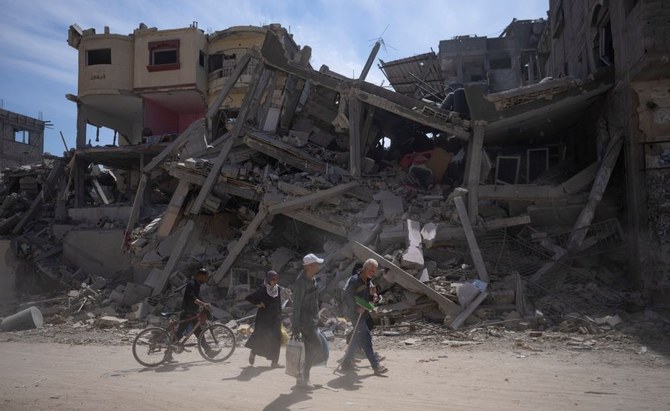
Palestinians walk through the destruction in the wake of an Israeli air and ground offensive in Khan Younis, southern Gaza Strip, Monday, April 8, 2024. (AP Photo)
Short Url
Updated 08 April 2024
Follow

Home Office visa refusal for Gaza families branded ‘unreasonable’ by UK judges

  • Families told to submit biometric data from middle of war zone as part of applications
  • Guidelines found to contradict European Convention on Human Rights

LONDON: Judges in the UK have ruled that Home Office decisions not to process reunion applications by two families in Gaza without biometric data are “irrational and unreasonable,” and based on guidelines contradicting international humanitarian law.

At an immigration tribunal on April 4, the judges said the Home Office’s stance over the two families contravene their “rights to respect for private and family life.”

One of the families, referred to as RM and others and consisting of two parents and two children, is seeking to be reunited with a third child, a daughter currently studying in the UK.

The second family, known as WM and others, consists of a Palestinian woman with four children seeking to join her brother, who is a UK citizen.

Both families have had to flee their homes in Gaza on account of Israel’s invasion of the enclave, which has left more than 32,000 people dead since Oct. 7, according to local health authorities.

The judgement found that Home Office guidance, which requires “evidence that a person faces a personal risk of harm, ‘which is separate to the level of risk faced by the wider population’,” is in breach of Article 8 of the European Convention on Human Rights.

Judge Jackson said: “We do not consider that in the context of the conflict in Gaza … that it is necessary for a person to show that they are specifically targeted to be able to establish that they are at risk due to their personal circumstances.”

Both families, who say they lack food and medical supplies in Gaza, requested for the Home Office to decide on their applications before submitting biometric data due to the challenges in submitting it in the middle of a war zone.

The nearest reliable center for submitting such data for use in a visa application is in Cairo in neighboring Egypt. 

The Home Office refused the request, saying their situations were not “compelling as to make them exceptional” or “different to other people in Gaza.”

Cecilia Correale, a solicitor at the Islington Law Centre, which brought the cases against the Home Office on behalf of the families, along with the Migrants’ Law Project at Asylum Aid, told The Guardian: “This is an important judgment with wider consequences which recognises that the Home Office has adopted policies in breach of Article 8 ECHR which it is applying to multiple families seeking to be reunited.”

A spokesperson for the Gaza Families Reunited campaign told the newspaper: “The Home Office must now urgently rectify its policy and approach to ensure that family members of Palestinians in the UK who are eligible for reunification under existing routes are actually able to exercise their rights.”

A Home Office spokesperson told The Guardian: “We have received the outcome of the judicial review proceedings and are considering the impact. It would be inappropriate to comment further.”


Indonesia reaffirms Yemen’s territorial integrity, backs stability efforts amid tensions

Updated 01 January 2026
Follow

Indonesia reaffirms Yemen’s territorial integrity, backs stability efforts amid tensions

  • Statement comes after Saudi Arabia bombed a UAE weapons shipment at Yemeni port city
  • Jakarta last week said it ‘appreciates’ Riyadh ‘working together’ with Yemen to restore stability

JAKARTA: Indonesia has called for respect for Yemen’s territorial integrity and commended efforts to maintain stability in the region, a day after Saudi Arabia bombed a weapons shipment from the UAE at a Yemeni port city that Riyadh said was intended for separatist forces. 

Saudi Arabia carried out a “limited airstrike” at Yemen’s port city of Al-Mukalla in the southern province of Hadramout on Tuesday, following the arrival of an Emirati shipment that came amid heightened tensions linked to advances by the UAE-backed Southern Transitional Council in the war-torn country. 

In a statement issued late on Wednesday, the Indonesian Ministry of Foreign Affairs said it “appreciates further efforts by concerned parties to maintain stability and security,” particularly in the provinces of Hadramout and Al-Mahara. 

“Indonesia reaffirms the importance of peaceful settlement through an inclusive and comprehensive political dialogue under the coordination of the United Nations and respecting Yemen’s legitimate government and territorial integrity,” Indonesia’s foreign affairs ministry said. 

The latest statement comes after Jakarta said last week that it “appreciates the efforts of the Kingdom of Saudi Arabia, as well as other relevant countries, working together with Yemeni stakeholders to de-escalate tensions and restore stability.” 

Saudi Arabia leads the Coalition to Restore Legitimacy in Yemen, which includes the UAE and was established in 2015 to combat the Houthi rebels, who control most of northern Yemen. 

Riyadh has been calling on the STC, which initially supported Yemen’s internationally recognized government against the Houthi rebels, to withdraw after it launched an offensive against the Saudi-backed government troops last month, seeking an independent state in the south.  

Indonesia has also urged for “all parties to exercise restraint and avoid unilateral action that could impact security conditions,” and has previously said that the rising tensions in Yemen could “further deteriorate the security situation and exacerbate the suffering” of the Yemeni people. 

Indonesia, the world’s biggest Muslim-majority country, maintains close ties with both Saudi Arabia and the UAE, which are its main trade and investment partners in the Middle East.